Michelle van Diën – 413154md
Problem 6. Developing arithmetic skill: Procedural or conceptual?
Baroody, A. J., Bajwa, N. P., & Eiland, M. (2009). Why can’t Johnny remember the basic facts?.
Developmental Disabilities Research Reviews, 15(1), 69–79. doi:10.1002/ddrr.45
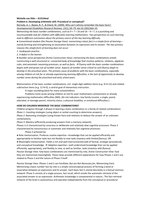
Memorizing the basic number combinations, such as 9 + 7 = 16 and 16 − 9 = 7, is a punishing and
insurmountable task for children with difficulties learning mathematics. Two perspectives on such learning
lead to different conclusions about the primary source of this key learning difficulty.
● Conventional wisdom (the Passive Storage View): memorizing a basic fact is a simple form of learning—
merely forming and strengthening an association between an expression and its answer. The two primary
reasons this simple form of learning does not occur:
1. Inadequate practice.
2. A defect in the learner.
● Number sense perspective (Active Construction View): memorizing the basic combinations entails
constructing a well-structured or -connected body of knowledge that involves patterns, relations, algebraic
rules, and automatic reasoning processes, as well as facts. Fluency with the basic number combinations
begins with and grows out of number sense. Aspects of number sense critical to such fluency begin to
develop in the preschool years. The primary cause of problems with the basic combinations, especially
among children at risk for or already experiencing learning difficulties, is the lack of opportunity to develop
number sense during the preschool and early school years.
Memorization of the basic number combinations, incl. single-digit addition items (e.g. 9+3=12) and related
subtraction items (e.g. 12-9=3), a central goal of elementary instruction.
A major stumbling block for many schoolchildren.
Problems more acute among children at-risk for poor mathematics achievement or already
experiencing mathematics difficulties (MD). (At-risk indicators: low family income; a single, poorly
educated, or teenage parent; minority status; a physical disability; or emotional difficulties.)
HOW DO CHILDREN MEMORIZE THE BASIC COMBINATIONS?
Children progress through 3 phases in learning a basic combination or a family of related combinations:
Phase 1: Counting strategies (using object or verbal counting to determine answers);
Phase 2: Reasoning strategies (using known facts and relations to deduce the answer of an unknown
combination);
Phase 3: Mastery (efficiently producing answers from a memory network).
Phases 1+2 characterized by conscious or deliberate and relatively slow cognitive processes. Phase 3
characterized by nonconscious or automatic and relatively fast cognitive processes.
Phase 3 achieved by:
● Rote memorization. Produces routine expertise—knowledge that can be applied efficiently and
appropriately to familiar tasks but not flexibly to new tasks (mastery with limited fluency). OR
● Meaningful memorization. Yields a rich and well-interconnected web of factual, strategic (procedural),
and conceptual knowledge. Adaptive expertise—well-understood knowledge that can be applied
efficiently, appropriately, and flexibly to new, as well as familiar, tasks (mastery with fluency).
Passive Storage View: how basic combinations are memorized by rote; Active Construction View: how
they are memorized meaningfully. These views provide different explanations for how Phases 1 and 2 are
related to Phase 3 and the nature of Phase 3 itself.
Passive Storage View: Phases 1 and 2 can Facilitate, But are Not Necessary for, Memorizing Facts
Memorizing a basic number fact by rote is a simple nonconceptual process of forming a bond or
association between an expression and its answer. Each basic fact is stored discretely in a factual memory
network. Phase 3 consists of a single process, fact recall, which entails the automatic retrieval of the
associated answer to an expression. Arithmetic knowledge is componential in nature.; The fact-retrieval
network of the brain is autonomous and operates independently from the conceptual or procedural
Problem 6. Developing arithmetic skill: Procedural or conceptual?
Baroody, A. J., Bajwa, N. P., & Eiland, M. (2009). Why can’t Johnny remember the basic facts?.
Developmental Disabilities Research Reviews, 15(1), 69–79. doi:10.1002/ddrr.45
Memorizing the basic number combinations, such as 9 + 7 = 16 and 16 − 9 = 7, is a punishing and
insurmountable task for children with difficulties learning mathematics. Two perspectives on such learning
lead to different conclusions about the primary source of this key learning difficulty.
● Conventional wisdom (the Passive Storage View): memorizing a basic fact is a simple form of learning—
merely forming and strengthening an association between an expression and its answer. The two primary
reasons this simple form of learning does not occur:
1. Inadequate practice.
2. A defect in the learner.
● Number sense perspective (Active Construction View): memorizing the basic combinations entails
constructing a well-structured or -connected body of knowledge that involves patterns, relations, algebraic
rules, and automatic reasoning processes, as well as facts. Fluency with the basic number combinations
begins with and grows out of number sense. Aspects of number sense critical to such fluency begin to
develop in the preschool years. The primary cause of problems with the basic combinations, especially
among children at risk for or already experiencing learning difficulties, is the lack of opportunity to develop
number sense during the preschool and early school years.
Memorization of the basic number combinations, incl. single-digit addition items (e.g. 9+3=12) and related
subtraction items (e.g. 12-9=3), a central goal of elementary instruction.
A major stumbling block for many schoolchildren.
Problems more acute among children at-risk for poor mathematics achievement or already
experiencing mathematics difficulties (MD). (At-risk indicators: low family income; a single, poorly
educated, or teenage parent; minority status; a physical disability; or emotional difficulties.)
HOW DO CHILDREN MEMORIZE THE BASIC COMBINATIONS?
Children progress through 3 phases in learning a basic combination or a family of related combinations:
Phase 1: Counting strategies (using object or verbal counting to determine answers);
Phase 2: Reasoning strategies (using known facts and relations to deduce the answer of an unknown
combination);
Phase 3: Mastery (efficiently producing answers from a memory network).
Phases 1+2 characterized by conscious or deliberate and relatively slow cognitive processes. Phase 3
characterized by nonconscious or automatic and relatively fast cognitive processes.
Phase 3 achieved by:
● Rote memorization. Produces routine expertise—knowledge that can be applied efficiently and
appropriately to familiar tasks but not flexibly to new tasks (mastery with limited fluency). OR
● Meaningful memorization. Yields a rich and well-interconnected web of factual, strategic (procedural),
and conceptual knowledge. Adaptive expertise—well-understood knowledge that can be applied
efficiently, appropriately, and flexibly to new, as well as familiar, tasks (mastery with fluency).
Passive Storage View: how basic combinations are memorized by rote; Active Construction View: how
they are memorized meaningfully. These views provide different explanations for how Phases 1 and 2 are
related to Phase 3 and the nature of Phase 3 itself.
Passive Storage View: Phases 1 and 2 can Facilitate, But are Not Necessary for, Memorizing Facts
Memorizing a basic number fact by rote is a simple nonconceptual process of forming a bond or
association between an expression and its answer. Each basic fact is stored discretely in a factual memory
network. Phase 3 consists of a single process, fact recall, which entails the automatic retrieval of the
associated answer to an expression. Arithmetic knowledge is componential in nature.; The fact-retrieval
network of the brain is autonomous and operates independently from the conceptual or procedural