Defining the Genome I - Chromosomes
Mitosis & Meiosis
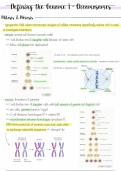
- cytogenetic: field where microscopic analysis of cellular structures (specifically nuclear chr) is used
to investigate inheritance
- mitosis: normal cell division (somatic cells)
=> 1 cell divides into 2 daughter cells (division of sister chr)
=> follow a S-phase (chr duplication)
(2 sets of chr - microtubules extend from centrosomes)
IS-phase)
(Condensation - mitotic spindle extends bw centrioles - membrane breaks down)
(Centrioles at opposite poles)
- meiosis: formation of gametes
=> 1 cell divides into 4 daughter cells with half amount of genetic inf. (haploid chr)
=> sex cells, gametes (sperm/ eggs)
=> 2 cell divisions: homologues (I) + sisters (II)
=> recombination between homologues (prophase I):
DNA from paired chr of parents cross over each other
to exchange nucleotide sequences => changed chr
, Cytogenetic and the human karyotype
- “metaphase spreads” to count chr: stop cell cycle in metaphase (condensed + distinguishable chr)
- X-shaped structure: pair of sister chromatides (DNA replication of 1 chr) joined at centromere
(end of each chromatid = telomere)
- karyotype = complete set of chr (numbered according to length)
=> determined via G-banding (dye Giesma stain chr: light/ dark bands), length, centromere position
22 homologous pairs (autosomes) + 2 sex chr (allosome)
(only father’s chr determine sex of child)
- euploid cells = normal chr number
- aneuploid = abnormal chr number
- fluorescent in situ hybridisation (FISH): DAPI stains chr
+ hybridisation of the fluorescently labelled DNA probes
identifies specific regions (telomere...)
Chromosomal theory of Mendelian inheritance
- Mid 19th: chr first seen
- Mid 19th: nuclear genetic material + inheritance through germ cells
- 1902: connection w/ Mendelian inheritance: homologous chr separate (haploid) and pair again
(diploid) during fertilisation
- 1905: gender determined by sex chr => genes carried by chromosomes
Mitosis & Meiosis
- cytogenetic: field where microscopic analysis of cellular structures (specifically nuclear chr) is used
to investigate inheritance
- mitosis: normal cell division (somatic cells)
=> 1 cell divides into 2 daughter cells (division of sister chr)
=> follow a S-phase (chr duplication)
(2 sets of chr - microtubules extend from centrosomes)
IS-phase)
(Condensation - mitotic spindle extends bw centrioles - membrane breaks down)
(Centrioles at opposite poles)
- meiosis: formation of gametes
=> 1 cell divides into 4 daughter cells with half amount of genetic inf. (haploid chr)
=> sex cells, gametes (sperm/ eggs)
=> 2 cell divisions: homologues (I) + sisters (II)
=> recombination between homologues (prophase I):
DNA from paired chr of parents cross over each other
to exchange nucleotide sequences => changed chr
, Cytogenetic and the human karyotype
- “metaphase spreads” to count chr: stop cell cycle in metaphase (condensed + distinguishable chr)
- X-shaped structure: pair of sister chromatides (DNA replication of 1 chr) joined at centromere
(end of each chromatid = telomere)
- karyotype = complete set of chr (numbered according to length)
=> determined via G-banding (dye Giesma stain chr: light/ dark bands), length, centromere position
22 homologous pairs (autosomes) + 2 sex chr (allosome)
(only father’s chr determine sex of child)
- euploid cells = normal chr number
- aneuploid = abnormal chr number
- fluorescent in situ hybridisation (FISH): DAPI stains chr
+ hybridisation of the fluorescently labelled DNA probes
identifies specific regions (telomere...)
Chromosomal theory of Mendelian inheritance
- Mid 19th: chr first seen
- Mid 19th: nuclear genetic material + inheritance through germ cells
- 1902: connection w/ Mendelian inheritance: homologous chr separate (haploid) and pair again
(diploid) during fertilisation
- 1905: gender determined by sex chr => genes carried by chromosomes