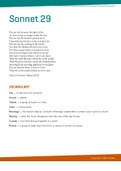
Sonnet 29
Pity me not because the light of day
At close of day no longer walks the sky;
Pity me not for beauties passed away
From field and thicket as the year goes by;
Pity me not the waning of the moon,
Nor that the ebbing tide goes out to sea,
Nor that a man’s desire is hushed so soon,
And you no longer look with love on me.
This have I known always: Love is no more
Than the wide blossom which the wind assails,
Than the great tide that treads the shifting shore,
Strewing fresh wreckage gathered in the gales:
Pity me that the heart is slow to learn
What the swift mind beholds at every turn.
Edna St Vincent Millay (1923)
VOCABULARY
Pity — to feel sorry for someone
Assails — attacks
Thicket — a group of bushes or trees
Gales — strong winds
Wreckage — the broken objects / amount of damage created after a violent event such as a storm
Waning — when the moon disappears from the sky a little day by day
Couplet — two lines that go together in a poem
Octave — a group of eight lines that forms a stanza or section of a poem
Copyright © 2021 Scrbbly
, STORY / SUMMARY
The speaker commands the addressee to not feel sorry for them when
sunlight leaves the sky, or for the passing of “beauties”, which could refer to
her own beauty or beautiful things that she found in life that are now gone.
These beautiful things have passed from the field — where they would be
easily visible — to the “thicket”, i.e. hidden. She also doesn’t want the reader
to feel sorry for her because the moon is “waning”, disappearing. Or because
the tide is flowing out. She then switches from natural imagery to more
personal, human imagery and says we shouldn’t pity her because men stop
loving too quickly, and “you” stopped loving her - this is the first time we
realise that the poem is addressed to her previous partner. She says she has
always known that love is nothing more than flower blossoms being attacked
by the wind, than the sea tide that touches the beach, which brings up litter
and destroyed objects. She asks the addressee to pity her only for the fact
that her heart is slow to catch up and process, whereas her mind is quick to
adapt and move on.
SPEAKER / VOICE
The speaker has a female presence, and she speaks directly in the poem to
her past partner or lover — we don’t know how long their relationship lasted.
She changes her tone from being quite defiant at the beginning — where
she asks the addressee not to feel sorry for her when he stopped loving her
because it was a natural process — but at the end, she does ask him to pity
her as her heart is too slow to catch up (she still loves him / finds it hard to
move on), so it has a more sad and poignant tone. There is a transition from
inner strength to weakness in the poem.
LANGUAGE FEATURES
• Anaphora — “Pity me not” / “Pity me” — Millay repeats the phrase “pity me not” early on in the
poem, each time providing a new example from nature about why we shouldn’t feel sorry for her.
The repetition of the phrase might suggest that she has an obsession with this man and their ended
relationship, or it might indicate that her brain is trying to give lots of different reasons why she
should accept it and move on. Eventually, this phrase breaks down and becomes positive instead of
negative — she says “pity me” and asks the addressee to feel sorry for her, suggesting she has let
her emotions overcome her mind and that she is still broken in some ways despite trying to move
on.
Copyright © 2021 Scrbbly
Pity me not because the light of day
At close of day no longer walks the sky;
Pity me not for beauties passed away
From field and thicket as the year goes by;
Pity me not the waning of the moon,
Nor that the ebbing tide goes out to sea,
Nor that a man’s desire is hushed so soon,
And you no longer look with love on me.
This have I known always: Love is no more
Than the wide blossom which the wind assails,
Than the great tide that treads the shifting shore,
Strewing fresh wreckage gathered in the gales:
Pity me that the heart is slow to learn
What the swift mind beholds at every turn.
Edna St Vincent Millay (1923)
VOCABULARY
Pity — to feel sorry for someone
Assails — attacks
Thicket — a group of bushes or trees
Gales — strong winds
Wreckage — the broken objects / amount of damage created after a violent event such as a storm
Waning — when the moon disappears from the sky a little day by day
Couplet — two lines that go together in a poem
Octave — a group of eight lines that forms a stanza or section of a poem
Copyright © 2021 Scrbbly
, STORY / SUMMARY
The speaker commands the addressee to not feel sorry for them when
sunlight leaves the sky, or for the passing of “beauties”, which could refer to
her own beauty or beautiful things that she found in life that are now gone.
These beautiful things have passed from the field — where they would be
easily visible — to the “thicket”, i.e. hidden. She also doesn’t want the reader
to feel sorry for her because the moon is “waning”, disappearing. Or because
the tide is flowing out. She then switches from natural imagery to more
personal, human imagery and says we shouldn’t pity her because men stop
loving too quickly, and “you” stopped loving her - this is the first time we
realise that the poem is addressed to her previous partner. She says she has
always known that love is nothing more than flower blossoms being attacked
by the wind, than the sea tide that touches the beach, which brings up litter
and destroyed objects. She asks the addressee to pity her only for the fact
that her heart is slow to catch up and process, whereas her mind is quick to
adapt and move on.
SPEAKER / VOICE
The speaker has a female presence, and she speaks directly in the poem to
her past partner or lover — we don’t know how long their relationship lasted.
She changes her tone from being quite defiant at the beginning — where
she asks the addressee not to feel sorry for her when he stopped loving her
because it was a natural process — but at the end, she does ask him to pity
her as her heart is too slow to catch up (she still loves him / finds it hard to
move on), so it has a more sad and poignant tone. There is a transition from
inner strength to weakness in the poem.
LANGUAGE FEATURES
• Anaphora — “Pity me not” / “Pity me” — Millay repeats the phrase “pity me not” early on in the
poem, each time providing a new example from nature about why we shouldn’t feel sorry for her.
The repetition of the phrase might suggest that she has an obsession with this man and their ended
relationship, or it might indicate that her brain is trying to give lots of different reasons why she
should accept it and move on. Eventually, this phrase breaks down and becomes positive instead of
negative — she says “pity me” and asks the addressee to feel sorry for her, suggesting she has let
her emotions overcome her mind and that she is still broken in some ways despite trying to move
on.
Copyright © 2021 Scrbbly