Classification and Evolution
Classification
The Five Kingdoms
Phylogeny
Evidence for Evolution
Types of Variation
Representing Variation Graphically
Adaptations
Changing Population Characteristics
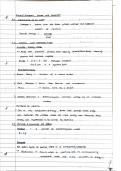
Classification
,Scientists classify organisms in order to identify species, to predict characteristics and to find
evolutionary links.
Identifying Species – by using a clearly defined system of classification, the species an
organism belongs to can be easily identified. This allows scientists worldwide to share
research.
Predicting Characteristics – If several members of a group have similar characteristics, it is
likely that other species in the group will share these characteristics. These characteristics
can be either physical or behavioural.
Finding Evolutionary Links – Species in the same group probably share homologous features
because they have evolved from a common ancestor.
Shared Homologous Features e.g. the pentadactyl limb
All terrestrial
vertebrates
(mammals,
reptiles,
amphibians and
birds) share a
homologous
feature called the
pentadactyl limb.
Such as feature is
strong evidence that all organisms
possessing them have a common
ancestor. The great variation between
each is due to random mutations
through natural selection. In the course
of evolution, the bones in each animal
have adapted to their way of life.
The Five Kingdoms
, Kingdom Examples Unicellular or Cell Structure Movement Nutrition
Multicellular
Classification
The Five Kingdoms
Phylogeny
Evidence for Evolution
Types of Variation
Representing Variation Graphically
Adaptations
Changing Population Characteristics
Classification
,Scientists classify organisms in order to identify species, to predict characteristics and to find
evolutionary links.
Identifying Species – by using a clearly defined system of classification, the species an
organism belongs to can be easily identified. This allows scientists worldwide to share
research.
Predicting Characteristics – If several members of a group have similar characteristics, it is
likely that other species in the group will share these characteristics. These characteristics
can be either physical or behavioural.
Finding Evolutionary Links – Species in the same group probably share homologous features
because they have evolved from a common ancestor.
Shared Homologous Features e.g. the pentadactyl limb
All terrestrial
vertebrates
(mammals,
reptiles,
amphibians and
birds) share a
homologous
feature called the
pentadactyl limb.
Such as feature is
strong evidence that all organisms
possessing them have a common
ancestor. The great variation between
each is due to random mutations
through natural selection. In the course
of evolution, the bones in each animal
have adapted to their way of life.
The Five Kingdoms
, Kingdom Examples Unicellular or Cell Structure Movement Nutrition
Multicellular