Demand Function
Demand is a multivariate relationship, that is , it is determined by many factors. Demand function
shows functional relationship between quantity demanded and its determinants. Demand function is
expressed as
Q = f(p,Y,Ps, Pc, Ta, A etc)
Where,
Q is the quantity demand of good X
P is the price of X
Y is the income of the consumer
Ps is the price of substitute
Pc is the price of complementary goods
Ta is the taste and preference of the consumer
A is the level of advertisement
The simplest of form of the demand function is written is Q =f(P) - ceteris paribus
Linear and Non –linear demand functions
The demand function Q =f(P) can be modeled by the simple linear equation
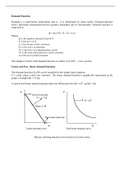
P = a-bQ, where a and b are constants. The linear demand function is graphically represented in the
graph. (example Qd = 12-2p)
A typical non-linear demand equation takes the following form Qd = α/P eg Qd = 8/p
P P
a vertical intercept
P = a - bQ
Q= α/P
Slope is -b
Horizontal intercept
a/b
Q Q
Linear demand curve Non linear demand curve
(Practice drawing demand curves based on Lecture notes)
,Supply function
There are several variables that influence the supply of good X. Supply functions shows functional
relationship between quantity supplied and its determinants. Mathematically, supply function takes the
following form
Qs = f(P,C,Po,Te,N,O)
Where Qs is the quantity supplied of good X
P is the price of the good X
C is the cost of production
Po is Price of other goods
Te is the technology
N is the number of other producers in the market
O is other factors
The simplest of form of the supply function is written is Qs =f(P) - ceteris paribus. This can be
modeled by the simple linear equation P = c + dQ, c and d are constants. Eg, Qs = 20p
A supply function is shown graphically.
P
P = c +dQ. Slope = d
Law of Demand : The law of demand states that there is a negative, or inverse,
relationship between price and the quantity of a good demanded and its price. This
means that demand curves slope downward.
The law of supply states that there is a positive relationship between price and
quantity of a good supplied. This means that supply curves typically have a positive
slope.
Equilibrium Price
Equilibrium price is the price determined by the forced of demand and supply. An equilibrium is the
condition that exists when quantity supplied and quantity demanded are equal. Qd = Qs
, ( Given Qd= 2- 0.02P and Qs = 0.2 +0.07P find equilibrium price and quantity)
(Practice all questions given in the class)
Elasticity: Demand elasticity, Supply elasticity, Price elasticity, Income elasticity, Cross elasticity-
Engel function.
A Price Elasticity of Demand: PED measures the responsiveness (sensitivity) of quantity demanded to
changes in the price . It is also referred to as own price elasticity.
percentage change in quantity demanded % ∆Qd
Ed = ------------------------------------------------ -----------
Percentage change in price % ∆P
For a demand function Q = f(P) ed = | dQ/dP x P/Q|
1
For a demand function P = f (Q) ed = ------ x P/Q
dP/dQ
Marginal function
Or Ed = --------------------------
Average Function
Types of Price Elasticity of Demand
1. Inelastic Demand:Quantity demanded does not respond strongly to price changes. Price
elasticity of demand is less than one.
2. Elastic Demand: Quantity demanded responds strongly to changes in price.Price elasticity of
demand is greater than one.
3. Perfectly Inelastic: Quantity demanded does not respond to price changes.
4. Perfectly Elastic: Quantity demanded changes infinitely with any change in price.
5. Unit Elastic: Quantity demanded changes by the same percentage as the price.
(Draw graph for each case and explain)
Demand is a multivariate relationship, that is , it is determined by many factors. Demand function
shows functional relationship between quantity demanded and its determinants. Demand function is
expressed as
Q = f(p,Y,Ps, Pc, Ta, A etc)
Where,
Q is the quantity demand of good X
P is the price of X
Y is the income of the consumer
Ps is the price of substitute
Pc is the price of complementary goods
Ta is the taste and preference of the consumer
A is the level of advertisement
The simplest of form of the demand function is written is Q =f(P) - ceteris paribus
Linear and Non –linear demand functions
The demand function Q =f(P) can be modeled by the simple linear equation
P = a-bQ, where a and b are constants. The linear demand function is graphically represented in the
graph. (example Qd = 12-2p)
A typical non-linear demand equation takes the following form Qd = α/P eg Qd = 8/p
P P
a vertical intercept
P = a - bQ
Q= α/P
Slope is -b
Horizontal intercept
a/b
Q Q
Linear demand curve Non linear demand curve
(Practice drawing demand curves based on Lecture notes)
,Supply function
There are several variables that influence the supply of good X. Supply functions shows functional
relationship between quantity supplied and its determinants. Mathematically, supply function takes the
following form
Qs = f(P,C,Po,Te,N,O)
Where Qs is the quantity supplied of good X
P is the price of the good X
C is the cost of production
Po is Price of other goods
Te is the technology
N is the number of other producers in the market
O is other factors
The simplest of form of the supply function is written is Qs =f(P) - ceteris paribus. This can be
modeled by the simple linear equation P = c + dQ, c and d are constants. Eg, Qs = 20p
A supply function is shown graphically.
P
P = c +dQ. Slope = d
Law of Demand : The law of demand states that there is a negative, or inverse,
relationship between price and the quantity of a good demanded and its price. This
means that demand curves slope downward.
The law of supply states that there is a positive relationship between price and
quantity of a good supplied. This means that supply curves typically have a positive
slope.
Equilibrium Price
Equilibrium price is the price determined by the forced of demand and supply. An equilibrium is the
condition that exists when quantity supplied and quantity demanded are equal. Qd = Qs
, ( Given Qd= 2- 0.02P and Qs = 0.2 +0.07P find equilibrium price and quantity)
(Practice all questions given in the class)
Elasticity: Demand elasticity, Supply elasticity, Price elasticity, Income elasticity, Cross elasticity-
Engel function.
A Price Elasticity of Demand: PED measures the responsiveness (sensitivity) of quantity demanded to
changes in the price . It is also referred to as own price elasticity.
percentage change in quantity demanded % ∆Qd
Ed = ------------------------------------------------ -----------
Percentage change in price % ∆P
For a demand function Q = f(P) ed = | dQ/dP x P/Q|
1
For a demand function P = f (Q) ed = ------ x P/Q
dP/dQ
Marginal function
Or Ed = --------------------------
Average Function
Types of Price Elasticity of Demand
1. Inelastic Demand:Quantity demanded does not respond strongly to price changes. Price
elasticity of demand is less than one.
2. Elastic Demand: Quantity demanded responds strongly to changes in price.Price elasticity of
demand is greater than one.
3. Perfectly Inelastic: Quantity demanded does not respond to price changes.
4. Perfectly Elastic: Quantity demanded changes infinitely with any change in price.
5. Unit Elastic: Quantity demanded changes by the same percentage as the price.
(Draw graph for each case and explain)