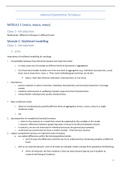
,Lecture 1 : introduction
Intelligence and computations
Intelligence : the ability to acquire and
apply knowledge and problem solving
computations :
the action mathematical calculation
'
of
the computers
-
use of
data)
knowledge :
experience ( =
represented by facts and information
computational intelligence :
computers acquire knowledge and solve problems
Artificial intelligence vs .
Computational intelligence
symbolic Al Neural networks
-
-
logic knowledge representations Evolutionary algorithms
'
. . .
,
sub -
symbolic A1 : Nature -
inspired algorithms
intelligence
'
neural nets swarm
-
- -
.
evolutionary algorithms Probabilistic methods
'
inspired Optimization
'
nature -
algorithms
statistical learning
probabilistic methods
optimization
in the end ,
it's almost the same
is ?
why As successful
Accessible and hardware
-
powerful
intuitive programming languages +
specialized packages
-
components of Al ICI systems
'
knowledge representation :
how to represent and process data ?
knowledge acquisition ( learning objective &
algorithms) knowledge ?
:
now to
'
extract
?
Learning problems what kind problems we formulate
'
:
of can
Optimization
Find optimal ( min Max ) possible
the solution or from a
given set of solutions
that minimizes I maximizes
given objective function
in order to save the problem ,
we need a numerical
algorithm
,Learning as optimization
For given data find best representation from
, the data a
given clan of
representations that minimizes given learning objective Closs ) .
optimization algorithm
=
learning algorithm
Learning tasks
supervised learning
distinguish inputs and outputs
>
-
interested in prediction
-
minimize a prediction er ror
Unsupervised learning
'
no distinction
structure
-
look for a data
-
minimize a reconstruction error , compression rate . . . .
Reinforcement learning
-
an agent interacts with an environment
want to learn policy
'
a
rewarded
-
each action is
-
maximize a total reward
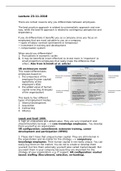
, Lecture 2 :
optimization
Optimization
Find optimal solution ( minimum maximum) possible
the or from a
given set of
solutions that minimizes 1 maximizes given objective function
Formally :
Remarks :
'
min f- Cx) =
Max E -
f Cx) }
'S
's
E. X R X CO I }
-
=
g
=
.
. , ,
-
optimal solution :
Fae × fCn* ) E f Cn) and tic ; Cx )
*
f b;
Optimization problems
Taxonomy of
'
constrained 1 Unconstrained
convex 1 Non convex
-
-
Deterministic 1 stochastic
'
continuous 1 Discrete
-
-
Global 1 Local
optimization Methods
three main classes :
Derivative methods can methods)
-
-
free order
does mathematical definition constraint is and
>
not need a , a placed
the problem is optimized from there
e
g hill climbing iterated local
-
-
.
,
search
Gradient ( 1st )
'
-
based methods order methods
use information gradient objective function working top
-
about of , from the
downwards
gradient ADAM
-
e.g .
descent ,
Hessian (2nd order methods)
-
-
based methods
require to calculate nesn
-
e
g Newton 's method
-
-
.
Iterative optimization methods
interested numerical methods
'
in
Therefore consider iterative optimization methods
-
,
Intelligence and computations
Intelligence : the ability to acquire and
apply knowledge and problem solving
computations :
the action mathematical calculation
'
of
the computers
-
use of
data)
knowledge :
experience ( =
represented by facts and information
computational intelligence :
computers acquire knowledge and solve problems
Artificial intelligence vs .
Computational intelligence
symbolic Al Neural networks
-
-
logic knowledge representations Evolutionary algorithms
'
. . .
,
sub -
symbolic A1 : Nature -
inspired algorithms
intelligence
'
neural nets swarm
-
- -
.
evolutionary algorithms Probabilistic methods
'
inspired Optimization
'
nature -
algorithms
statistical learning
probabilistic methods
optimization
in the end ,
it's almost the same
is ?
why As successful
Accessible and hardware
-
powerful
intuitive programming languages +
specialized packages
-
components of Al ICI systems
'
knowledge representation :
how to represent and process data ?
knowledge acquisition ( learning objective &
algorithms) knowledge ?
:
now to
'
extract
?
Learning problems what kind problems we formulate
'
:
of can
Optimization
Find optimal ( min Max ) possible
the solution or from a
given set of solutions
that minimizes I maximizes
given objective function
in order to save the problem ,
we need a numerical
algorithm
,Learning as optimization
For given data find best representation from
, the data a
given clan of
representations that minimizes given learning objective Closs ) .
optimization algorithm
=
learning algorithm
Learning tasks
supervised learning
distinguish inputs and outputs
>
-
interested in prediction
-
minimize a prediction er ror
Unsupervised learning
'
no distinction
structure
-
look for a data
-
minimize a reconstruction error , compression rate . . . .
Reinforcement learning
-
an agent interacts with an environment
want to learn policy
'
a
rewarded
-
each action is
-
maximize a total reward
, Lecture 2 :
optimization
Optimization
Find optimal solution ( minimum maximum) possible
the or from a
given set of
solutions that minimizes 1 maximizes given objective function
Formally :
Remarks :
'
min f- Cx) =
Max E -
f Cx) }
'S
's
E. X R X CO I }
-
=
g
=
.
. , ,
-
optimal solution :
Fae × fCn* ) E f Cn) and tic ; Cx )
*
f b;
Optimization problems
Taxonomy of
'
constrained 1 Unconstrained
convex 1 Non convex
-
-
Deterministic 1 stochastic
'
continuous 1 Discrete
-
-
Global 1 Local
optimization Methods
three main classes :
Derivative methods can methods)
-
-
free order
does mathematical definition constraint is and
>
not need a , a placed
the problem is optimized from there
e
g hill climbing iterated local
-
-
.
,
search
Gradient ( 1st )
'
-
based methods order methods
use information gradient objective function working top
-
about of , from the
downwards
gradient ADAM
-
e.g .
descent ,
Hessian (2nd order methods)
-
-
based methods
require to calculate nesn
-
e
g Newton 's method
-
-
.
Iterative optimization methods
interested numerical methods
'
in
Therefore consider iterative optimization methods
-
,