Week 1: Planning, Marketing
Environment, and Strategies
SOSTAC
What is SOSTAC?
Developed by PR Smith, SOSTAC® is a strategic marketing management process used to help with
marketing planning.
It was developed by PR Smith in the 1990s and later formalized in his 2004 book, Strategic Marketing
Communications.
S Situation: where are we now? (assessing where your business is presently)
O Objectives: where do we want to be? (setting the mission / goals for the business)
S Strategy: how do we get there? (an overview of how to achieve the objectives)
T Tactics: how exactly do we get there? (the details of the strategy e.g. the marketing mix)
A Action: what should we do? (how do you ensure excellent execution of the plan)
C Control (monitor): did we get there? (establishes how you know whether you are getting
there i.e. what do you monitor?)
Summary of SOSTAC
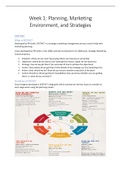
Smart Insights developed a SOSTAC® infographic which summarises the key issues to consider at
each stage when using the planning model.
, Case Study: L’Oréal and The Body Shop
Who are L’Oréal?
L’Oréal is a cosmetic company that has developed an experience of over a century.
In 2010:
With its great success leaps in technology advancement, L’Oréal hit the mark of 22.3 billion sales
with 27 established brands in 130 countries all over the global.
Over the years L’Oréal has developed a strong human capital with over 68,900 employees.
The Major Product Lines of L’Oréal IN 2010
1. Consumer product division: involves mass-marketing of consumer products with brands like
Maybelline and L’Oréal Paris
2. Luxury product division: sells high-status international brands like Giorgio Armani and
Lancôme
3. Professional product division: products such as Matrix offered by this division are specifically
for professional salons
4. Active cosmetics: these products are for pharmacies and beauty stores.
5. The Body Shop: Eco-friendly and organic products without applying any animal test. People
nowadays care about a company’s “social responsibility”, for instance, pollution issue, global
warming, packaging eco-friendly, free animal testing, etc.
Problems in 2016
L'Oréal considers selling The Body Shop, as the profit of the Body shop is the lowest compared to the
other product lines.
Imagining you work for L'Oréal and you are recently appointed as the marketing manager for the UK
market.
L'Oréal values your opinion
So, what is your decision? Why?
Keep it or sell it?
Scenario Decision
To do decide this, a marketing plan is required. This is a guide, which states the (internal and
external) background information of the organisation, its business goals and the reasons they can be
achieved, and how to reach those goals.
Step 1: Know and evaluate the core value of your company and then think about your ‘Plan’.
Business Plan
A business plan has three levels:
• Functional level: Positioning yourself: Knowing what you already have and what you do not
have yet (looking at the functional areas of the organization e.g. finance, marketing,
manufacturing, and human resources).
• Strategic level: a decision process, to match the resource and capabilities of the business, as
a whole, to market opportunities for long-term growth (sometime short-term).
Environment, and Strategies
SOSTAC
What is SOSTAC?
Developed by PR Smith, SOSTAC® is a strategic marketing management process used to help with
marketing planning.
It was developed by PR Smith in the 1990s and later formalized in his 2004 book, Strategic Marketing
Communications.
S Situation: where are we now? (assessing where your business is presently)
O Objectives: where do we want to be? (setting the mission / goals for the business)
S Strategy: how do we get there? (an overview of how to achieve the objectives)
T Tactics: how exactly do we get there? (the details of the strategy e.g. the marketing mix)
A Action: what should we do? (how do you ensure excellent execution of the plan)
C Control (monitor): did we get there? (establishes how you know whether you are getting
there i.e. what do you monitor?)
Summary of SOSTAC
Smart Insights developed a SOSTAC® infographic which summarises the key issues to consider at
each stage when using the planning model.
, Case Study: L’Oréal and The Body Shop
Who are L’Oréal?
L’Oréal is a cosmetic company that has developed an experience of over a century.
In 2010:
With its great success leaps in technology advancement, L’Oréal hit the mark of 22.3 billion sales
with 27 established brands in 130 countries all over the global.
Over the years L’Oréal has developed a strong human capital with over 68,900 employees.
The Major Product Lines of L’Oréal IN 2010
1. Consumer product division: involves mass-marketing of consumer products with brands like
Maybelline and L’Oréal Paris
2. Luxury product division: sells high-status international brands like Giorgio Armani and
Lancôme
3. Professional product division: products such as Matrix offered by this division are specifically
for professional salons
4. Active cosmetics: these products are for pharmacies and beauty stores.
5. The Body Shop: Eco-friendly and organic products without applying any animal test. People
nowadays care about a company’s “social responsibility”, for instance, pollution issue, global
warming, packaging eco-friendly, free animal testing, etc.
Problems in 2016
L'Oréal considers selling The Body Shop, as the profit of the Body shop is the lowest compared to the
other product lines.
Imagining you work for L'Oréal and you are recently appointed as the marketing manager for the UK
market.
L'Oréal values your opinion
So, what is your decision? Why?
Keep it or sell it?
Scenario Decision
To do decide this, a marketing plan is required. This is a guide, which states the (internal and
external) background information of the organisation, its business goals and the reasons they can be
achieved, and how to reach those goals.
Step 1: Know and evaluate the core value of your company and then think about your ‘Plan’.
Business Plan
A business plan has three levels:
• Functional level: Positioning yourself: Knowing what you already have and what you do not
have yet (looking at the functional areas of the organization e.g. finance, marketing,
manufacturing, and human resources).
• Strategic level: a decision process, to match the resource and capabilities of the business, as
a whole, to market opportunities for long-term growth (sometime short-term).