100% satisfaction guarantee Immediately available after payment Both online and in PDF No strings attached 4.6 TrustPilot
logo-home
Exam (elaborations)

NURS 611 Assignment 4.1 Workbook Assignment (Maryville University)

Rating
-
Sold
-
Pages
16
Uploaded on
07-06-2021
Written in
2020/2021

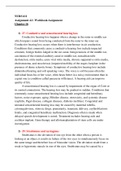
NURS 611 Assignment 4.1: Workbook Assignment Chapter 16 1) 27: Conductive and sensorineural hearing loss Conductive hearing loss happens when a change in the outer or middle ear which impairs sound from being conducted from the outer to the inner ear. Conductive hearing loss occurs when there is interference in air conduction. Conditions that commonly cause a conductive hearing loss include impacted cerumen, foreign bodies lodged in the ear canal, benign tumors of the middle ear, carcinoma of the external auditory canal or middle ear, eustachian tube dysfunction, otitis media, acute viral otitis media, chronic suppurative otitis media, cholesteatoma, and otosclerosis (impaired mobility of the stapes footplate in the presence of dense sclerotic bone). Symptoms of conductive hearing loss include diminished hearing and soft speaking voice. The voice is soft because often the individual hears his or her voice, often hears better in a noisy environment than in a quiet one (a condition called paracusia willisiana). A hearing aid can improve quality of life. A sensorineural hearing loss is caused by impairment of the organ of Corti or its central connections. The hearing loss may be gradual or sudden. Conditions that commonly cause sensorineural hearing loss include congenital and hereditary factors, noise exposure, aging, Ménière disease, ototoxicity, and systemic disease (syphilis, Paget disease, collagen diseases, diabetes mellitus). Congenital and neonatal sensorineural hearing loss may be caused by maternal rubella, cytomegalovirus, ototoxic drugs, prematurity, traumatic delivery, erythroblastosis fetalis, and congenital hereditary malfunction. Diagnosis often is made when delayed speech development is noted. Treatment includes hearing aids and cochlear implant. Gene therapy and allotransplantation of stem cells are under investigation. 2) 29: Strabismus and nystagmus Strabismus is the deviation of one eye from the other when a person is looking at an object; it results in failure of the two eyes to simultaneously focus on the same image and therefore loss of binocular vision. The deviation result from a weak or hypertonic muscle in one of the eyes. Strabismus may be caused by a neuromuscular disorder of the eye muscle, diseases involving the cerebral hemispheres, or thyroid disease. The primary symptom of strabismus is diplopia (double vision). Strabismus in children requires early intervention to prevent the development of amblyopia (reduced vision in the affected eye without ocular pathology and with full optical correction). Surgery may be helpful to both children and adults with strabismus. Nystagmus is an involuntary unilateral or bilateral rhythmic movement of the eyes and can occur in infants (congenital) or adults (acquired). It may be present at rest, or it may occur with eye movement. The two major forms of nystagmus are pendular nystagmus and jerk nystagmus. Pendular nystagmus is a regular alternating forward and backward movement of the eyes in which both phases of the movement are equal in length. In jerk nystagmus one phase of the eye movement is faster than the other. Nystagmus may be caused by an imbalance in the normally coordinated reflex activity of the inner ear, vestibular nuclei (connecting the vestibular nerve with vestibulospinal tracts), cerebellum, medial longitudinal fascicle (connecting the mesencephalon with the upper portion of the spinal cord), or nuclei of the oculomotor, trochlear, and abducens cranial nerves. Drugs, retinal disease, and diseases involving the cervical cord also may produce nystagmus. Infantile nystagmus syndrome has an unknown pathogenesis. The syndrome develops in the first 6 months of age and is more prevalent in males. Untreated nystagmus can lead to loss of visual acuity. Paralysis of specific extraocular muscles may cause abnormal closure of the eyelid, ptosis (drooping of the eyelid), and diplopia. The abnormalities occur as a result of unopposed muscle activity. Trauma or pressure in the area of the cranial nerves may cause paralysis of specific extraocular muscles. Diabetes mellitus and myasthenia gravis may affect specific extraocular muscles. 3) 30: Presbycusis Presbycusis is hearing loss in older age. Auditory changes caused by aging are common. Approximately 30% to 40% of people older than 65 years have hearing loss caused by genetic and environmental factors. Changes may occur in the structural and functional components of the peripheral or central auditory system. Accumulative damage to the middle ear and inner ear, particularly of hair cells (sensory presbycusis) and the cochlea (neural presbycusis), is caused by damaging factors such as noise, inflammation, toxins, oxidative stress, and vascular damage (atherosclerosis and diabetes mellitus). Ototoxic drugs include antibiotics, such as streptomycin, neomycin, gentamicin, and vancomycin; diuretics, such as ethacrynic acid and furosemide; chemicals, such as salicylate, quinine, carbon monoxide, nitrogen mustard, arsenic, mercury, gold, tobacco, and alcohol; and cancer drugs (cisplatin). Because of increased concentrations of antibiotics in the endolymph, these drugs generally cause damage to cochlea or the organ of Corti cells. Diuretics affect hearing primarily by altering the sodium- potassium balance, causing extracellular fluid accumulation and changes in the microstructure of secretory cells. Quinine, mercury, and lead affect the neural pathways of hearing, including the spinal ganglia, the eighth cranial nerve, and the cochlear nucleus. Loss of hearing for sounds in the high-frequency range is most common and interferes with understanding speech, particularly high frequency consonant sounds (s, sh, f). Hearing may be lost in both ears but not at the same time. The ability to discriminate localization of sound varies with high and low frequencies and diminishes with age. In the low frequency range, sound localization is a function of the timing of sound arrival between the two ears; localization of high frequency sounds is a function of sound intensity. Because older adults tend to lose high-frequency hearing first, they may have difficulty localizing high-frequency sounds and understanding speech. Cognitive impairment and poor quality of life are associated with presbycusis. 4) 45: Glaucoma Glaucoma are the second leading cause of blindness and are considered by intraocular pressures greater than 12 to 20 mmHg, with death of retinal ganglion cells and optic nerve axons. Family history is a risk factor. Most forms of glaucoma are associated with resistance to aqueous humor outflow. Primary open- angle glaucoma is the most common and is associated with alterations in the trabecular meshwork. Chronic increased intraocular pressure causes death of retinal ganglions and optic nerve degeneration with loss of peripheral vision, followed by central vision impairment and blindness. Extremely high pressures can cause blindness within days or hours. Loss of visual acuity results from the optic nerve pressure, which is believed to block cytoplasm flow from neuronal bodies in the retina to peripheral optic nerve fibers entering the brain. Lack of nutrients, ischemia, oxidative stress associated with mitochondrial failure, inflammatory cytokines, excessive apoptosis, and altered immune mechanisms may lead to death of the involved neurons. Initially there are no symptoms. With increasing pressure, acute pain may result. There is loss of peripheral vision and progression to blindness. Glaucoma often is treated with pharmaceutical eye drops to reduce secretion or increase absorption of aqueous humor. Surgery may be needed to open trabeculae spaces and to reduce intraocular pressure. 5) 58: Chronic Pain Chronic or persistent pain last for more than 3 to 6 months and pain is lasting beyond the expected normal healing time. Chronic or persistent pain may be continuing (low back pain) or intermittent (migraine headaches). Chronic pain are caused by changes in the peripheral and central nervous systems that produce nociception dysregulation and pain modulation processes (peripheral and central sensitization). Neuropathic pain is chronic pain caused by a primary lesion or dysfunction in the nervous system. Neuropathic pain caused long-term changes in pain pathway structures (neuroplasticity) and abnormal processing of sensory information. There is amplification of pain without stimulation by injury or inflammation. Neuropathic pain is often explained as burning, shooting, shock like, or tingling. It is considered by hyperalgesia, increased sensitivity to a normally painful stimulus (touch, pressure, pinprick, cold, and heat), or allodynia, the induction of pain by normally non-painful stimuli. Neuropathic pain is classified as either peripheral or central and is associated with central and peripheral sensitization. Peripheral neuropathic pain is caused by peripheral nerve lesions and an increase in the sensitivity and excitability of primary sensory neurons and cells in the dorsal root ganglion (peripheral sensitization). Examples include nerve entrapment, diabetic neuropathy, or chronic pancreatitis.

Show more Read less
Institution
NURS 611 Assignment 4.1 Workbook Assignment
Course
NURS 611 Assignment 4.1 Workbook Assignment


Whoops! We can’t load your doc right now. Try again or contact support.

Written for

Institution
NURS 611 Assignment 4.1 Workbook Assignment
Course
NURS 611 Assignment 4.1 Workbook Assignment

Document information

Uploaded on
June 7, 2021
Number of pages
16
Written in
2020/2021
Type
Exam (elaborations)
Contains
Unknown

Subjects

Get to know the seller

Seller avatar
Reputation scores are based on the amount of documents a seller has sold for a fee and the reviews they have received for those documents. There are three levels: Bronze, Silver and Gold. The better the reputation, the more your can rely on the quality of the sellers work.
Laudabletasks Eastern Virginia Medical School
View profile
Follow You need to be logged in order to follow users or courses
Sold
3403
Member since
5 year
Number of followers
2701
Documents
6565
Last sold
23 hours ago
Writing and Academics (pinnacleaces at gmail dot com)

I offer a full range of online academic services aimed to students who need support with their academics. Whether you need tutoring, help with homework, paper writing, or proofreading, I am here to help you reach your academic goals. My experience spans a wide range of disciplines. I provide online sessions using the Google Workplace. If you have an interest in working with me, please contact me for a free consultation to explore your requirements and how I can help you in your academic path. I am pleased to help you achieve in your academics and attain your full potential.

Read more Read less
3.9

486 reviews

5
247
4
83
3
76
2
24
1
56

Trending documents

Recently viewed by you

Why students choose Stuvia

Created by fellow students, verified by reviews

Quality you can trust: written by students who passed their tests and reviewed by others who've used these notes.

Didn't get what you expected? Choose another document

No worries! You can instantly pick a different document that better fits what you're looking for.

Pay as you like, start learning right away

No subscription, no commitments. Pay the way you're used to via credit card and download your PDF document instantly.

Student with book image

“Bought, downloaded, and aced it. It really can be that simple.”

Alisha Student

Frequently asked questions