OPMT 1197
Business Statistics
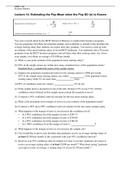
Lecture 14: Estimating the Pop Mean when the Pop SD (σ) is Known
Standard Error of the Mean; σ
σ Margin of Error: ME = z ⋅
σ
x =
n n
Confidence Interval Estimate for the Mean: x ± z ⋅ σn
You were recently hired by the BCIT School of Business to market their business programs.
You are preparing a brochure for potential students and would like to include in the brochure the
average starting salary that students can expect after they graduate. You need to come up with
an estimate of the mean starting salary of recent BCIT graduates. You randomly select 36 recent
graduates from the BCIT business programs and ask them what their starting salary was. From
your sample, you obtain an average of $3,000 per month.
(a) What is your point estimate of the population mean starting salary?
(b) 95% of all sample means are within how many standard errors of the population mean?
Standard Error = standard deviation of the sample means.
(c) Suppose the population standard deviation for the starting salaries is $900 per month.
95% of the sample mean starting salaries are within of the population mean
starting salary while 5% are more than away.
(d) 95% of confidence intervals contain , 5% do not.
(e) If the sample mean is located in in one of the tails (bottom 2.5% or top 2.5%) will the
confidence interval based on this sample mean contain the population mean?
(f) Construct a 95% confidence interval estimate for the true mean starting salary.
(g) What is the maximum error (margin of error) on your estimate of the population mean?
(h) Construct a 90% and a 99% confidence interval estimate for the true mean starting salary.
(i) What happens to the margin of error as you increase the confidence level?
• At a 90% confidence level the margin of error is $246.75
• At a 95% confidence level the margin of error is $294.00
• At a 99% confidence level the margin of error is $386.40
• At a 100% confidence level the margin of error is ?
(j) What happens to the margin of error as you increase the sample size?
(k) You would like to put in your brochure that graduates receive an average starting salary of
at least $3,500 per month. Is this consistent with your 95% confidence interval?
(l) Based on your 95% confidence interval estimate is it okay to say that “graduates can expect to
receive an average starting salary of at least $3,000 per month”? What about saying “graduates
can expect to earn, on average, a starting salary of at least $2,700 per month”?
Business Statistics
Lecture 14: Estimating the Pop Mean when the Pop SD (σ) is Known
Standard Error of the Mean; σ
σ Margin of Error: ME = z ⋅
σ
x =
n n
Confidence Interval Estimate for the Mean: x ± z ⋅ σn
You were recently hired by the BCIT School of Business to market their business programs.
You are preparing a brochure for potential students and would like to include in the brochure the
average starting salary that students can expect after they graduate. You need to come up with
an estimate of the mean starting salary of recent BCIT graduates. You randomly select 36 recent
graduates from the BCIT business programs and ask them what their starting salary was. From
your sample, you obtain an average of $3,000 per month.
(a) What is your point estimate of the population mean starting salary?
(b) 95% of all sample means are within how many standard errors of the population mean?
Standard Error = standard deviation of the sample means.
(c) Suppose the population standard deviation for the starting salaries is $900 per month.
95% of the sample mean starting salaries are within of the population mean
starting salary while 5% are more than away.
(d) 95% of confidence intervals contain , 5% do not.
(e) If the sample mean is located in in one of the tails (bottom 2.5% or top 2.5%) will the
confidence interval based on this sample mean contain the population mean?
(f) Construct a 95% confidence interval estimate for the true mean starting salary.
(g) What is the maximum error (margin of error) on your estimate of the population mean?
(h) Construct a 90% and a 99% confidence interval estimate for the true mean starting salary.
(i) What happens to the margin of error as you increase the confidence level?
• At a 90% confidence level the margin of error is $246.75
• At a 95% confidence level the margin of error is $294.00
• At a 99% confidence level the margin of error is $386.40
• At a 100% confidence level the margin of error is ?
(j) What happens to the margin of error as you increase the sample size?
(k) You would like to put in your brochure that graduates receive an average starting salary of
at least $3,500 per month. Is this consistent with your 95% confidence interval?
(l) Based on your 95% confidence interval estimate is it okay to say that “graduates can expect to
receive an average starting salary of at least $3,000 per month”? What about saying “graduates
can expect to earn, on average, a starting salary of at least $2,700 per month”?