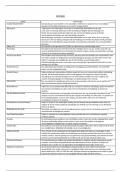
PVL3704_ EXAM PACK ANSWERS 2020.
PVL3704 - Enrichment Liability And Estoppel. PVL3704_ EXAM PACK ANSWERS 2020.. Write a critical discussion on whether patrimonial loss is a requirement in the South African law of estoppel with reference to relevant case law. [10] Basically they are two schools of thought when it comes to the issue of patrimonial loss as a requirement for the South African law of estoppel. It was averred that the patrimonial position in which the estoppel-asserter finds himself or herself at the moment of litis contestatio must be compared with the hypothetical patrimonial position in which he or she would have been (at the moment of litis contestatio) had no false belief been created. There is prejudice if the former is at all less advantageous than the latter.De Wet avers that the prejudice suffered must be patrimonial loss. This was confirmed in Jonker v Boland Bank Pks Bpk 2000 where it was held that the type of prejudice which underlies a successful invocation of estoppel is patrimonial in nature. On the other hand in Peri-Urban Areas Health Board v Breet NO Trollip JA discussed the concept of prejudice widely as a requirement for a successful plea of estoppel. In that case the court pointed out that the concept of prejudice encompases detrimental action that may affect patrimonial loss or the detrimental changing of legal position. The party relying on the principle must show some kind of prejudice, even of the minimum kind just mentioned. It would appear from this approach that the requirement for prejudice is fulfilled if the estoppel-asserter proves only that he or she has changed his or her legal position by entering into a contract or what appeared to be a contract, without having to prove that he or she has incurred expense, or that he or she would have ensured that the contract was valid or that he or she could profitably have contracted elsewhere, and so on. If this is correct, it appears that prejudice simply refers to a change in a person's legal position, provided the estoppel-asserter does not or would not find himself or herself in a better position than that in which he or she would have been had the impression not been created. Incurring a debt or liability or losing a right or claim as such, without any prejudicial financial implications, will be accepted as sufficient prejudice for a successful plea of estoppel. Downloaded by: Rikus07 | Distribution of this document is illegal S - The study-notes marketplace In Mthanti v Netherlands Insurance Co the court was of the opinion that it was unnecessary to decide whether mere loss of time in the form of a delay relating to the precise time at which a case served before the court qualifies as prejudice for estoppel De Walt also pointed out that in the current state of our law no clarity exists about the content of the prejudice requirement for fraud and estoppel besides certain general tendencies included in the concept of prejudice. Question 5 Discus the negligence requirement for a succesful plea of estoppel in South African case law. [10] Test for negligence: if a reasonable person in the position of the deceiver (estoppeldenier) would have foreseen loss or prejudice to the deceived (estoppel-asserter) and would have taken steps to prevent the loss, and if the deceiver either did not foresee loss or did not take the necessary steps to prevent it, the deceiver is negligent. The negligence requirement in SA case law: Williams: The owner of a building found a purchaser for the building, but the prospective purchaser refused to buy it while it was still being leased. The lessee, thinking that his lease was due to expire on a particular day, wrote a letter to the owner expressing his intention of vacating the property by a certain date. The letter was shown by the owner to the prospective purchaser who, on the strength of it, concluded the purchase. The lessee discovered that he had made a mistake and notified the new owner of the fact. The owner applied for his eviction. The court found that the lessee was not entitled to rely on the lease: “defendant had been guilty of culpable negligence in not ascertaining the terms of his lease before signing the letter”. The lessee was negligent in not looking at his lease, and made his misrepresentation, therefore the new owner could rely on estoppel The Appeal Court has required culpa on the part of the estoppel- denier as an essential element for a successful plea of estoppel raised as a defence against the rei vindicatio of the owner of the thing claimed. In Grosvenor, the judge stated that in the case of rei vindicatio there should be at least negligence on the part of the estoppel-denier. K was introduced to the respondent by P as a possible purchaser of the respondent’s motorcar. K decided to buy the motorcar, but stated that he did not have his chequebook with him, having left it in Welkom. Arrangements were made for P to accompany K to Welkom and there to give K possession of the motor car as against delivery of the cheque. The respondent had lost the motor car’s license papers he gave K, a written document to explain his possession of the motor car in the event of any enquiries. The document, signed by the respondent, contained the statement that the respondent had sold the motorcar to K. The Downloaded by: Rikus07 | Distribution of this document is illegal S - The study-notes marketplace respondent carried out his side of the contract, but K’s cheque was dishonoured. K had sold the car to the appellant. The appellant pleaded estoppel against the rei vindicatio of the respondent. The Supreme Court and AD rejected this plea of estoppel. The judge held that culpa on the part of the estoppel-denier was required before the estoppelasserter could succeed. To establish the defence of estoppel the appellant, apart from the facts in dispute, had to prove that negligence on the part of the respondent caused him to be misled into the erroneous belief that K had the right to dispose of the car. Where the plaintiff’s claim was based on the rei vindicatio. In Johaandien: J wanted to buy a motorcar from F, but wished to obtain some evidence of F’ alleged ownership. F referred J to the Stanley Porter garage. In answer to J’s inquiry, the representative of the garage informed J that F had bought the motorcar under a hire-purchase agreement, that he had paid the last instalment and that the garage consequently had no further right to the car. J bought the motorcar from F. At a later stage it claimed the motorcar from J by means of the rei vindicatio. J raised estoppel on the ground of the information supplied to him by Stanley Porter. His raising of estoppel did not succeed since he could not prove negligence on the part of the garage. Majority of the AD decided that negligence as laid down in the Grosvenor case was a requirement for estoppel where it was raised as a defence against the owner’s rei vindicatio. It was required that a reasonable person in the position of the plaintiff (Stanley Porter, the estoppel-denier) should have realised that the information with which he provided the defendant (Johaandien – estoppel-asserter) was untrue or possibly untrue. In the absence of such realisation there could be no question of negligence. The defendant did not allege that the plaintiff was negligent. He submitted that it was sufficient for a successful invocation of estoppel if the party who created the impression had simply foreseen that the third party would act on the ground of his representation, and not that he was also aware of the untruthfulness of his representation. The judge rejected this argument, holding that estoppel could not succeed in the absence of proof of negligence, and that the defendant should hand over the motorcar to the plaintiff, the true owner. Minority judgement held that negligence in these particular circumstances was not a requirement, and that the defence of estoppel should be upheld. “If the misrepresentation was of such a nature that a prospective buyer could reasonably be expected to be led by the representation to buy without enquiring about the ownership of the thing, the buyer who is moved by such a misrepresentation, should be protected. • • Relying on the Grosvenor case, the majority of the court said: that only when the owner makes a culpable misrepresentation will his rei vindicatio be repudiable by estoppel. • • The Johaadien’s case can be seen as the beginning of a possible development, which may result in the abandonment of the requirement of fault for estoppel as a defence against the rei vindicatio in cases where factors like requirements of contemporary commercial intercourse or equity necessitate it. Downloaded by: Rikus07 | Distribution of this document is illegal S - The study-notes marketplace OCTOBER/NOVEMBER 2017 SECTION A QUESTION 1 1. 5 2. 5 (p26) 3. 1 (p18) 4. 4 (p18) 5. 3 (p23) 6. 3 (p73) 7. 1 (p73) 8. 2 (tut 101 amendments) 9. 4 (tut 101 amendments) 10.1 11.4 (p59/60) 12.5 (p59/60) 13.5 (p64) 14.4 (p77) 15.5 (p93/94) 16.3 (p34) 17.4 18.4 19.3 20.1 (p38) 21.3 (p73) 22.4 (p77/78) 23.4 24.2 (p55/57) 25.2 (p72/73) Downloaded by: Rikus07 | Distribution of this document is illegal S - The study-notes marketplace SECTION B QUESTION 1 Discus the requirement that the defendant’s enrichment must have been at the expense of the plaintiff. [10] See Study Guide 1 par 2.2.3, page 21ff and par 8.2.2, page 81ff. (a) Discussion of the causal link requirement and provision of relevant examples. (2) (b) Discussion of the indirect enrichment problem: (i) Explanation of the problem. (2) (ii) Discussion of the view of De Vos (Study Guide 1, page 21). (2) (iii) Discussion of Gouws v Jester Pools (Pty) Ltd 1968 (3) SA 563 (T). (2) (iv) Discussion of Buzzard Electrical v 158 Jan Smuts Avenue Investments 1996 (4) SA 19 (A). (2) (v) Discussion of a right of retention and Brooklyn House Furnishers Ltd v Knoetze & Sons 1970 (3) SA 264 (A). (2) (vi) Discussion of ABSA Bank Ltd t/a Bankfin v Stander t/a CAW Paneelkloppers 1998 1 SA 929 (C). (3) (vii) Motivated exposition of your own view. (2) Downloaded by: Rikus07 | Distribution of this document is illegal S - The study-notes marketplace QUESTION 2 K rents a farm from L. K effected the following improvements on the farm without L’s knowledge (a) built a dam at a cost of R30 000, (b) built a luxury lapa on the edge of the dam at a cost of R100 000 and (c) sank a borehole at a cost of R20 000. K also repaired the roof of the farm house which had started to leak at a cost of R10 000. Discuss fully the legal position with regard to these improvements when the lease expires. Also briefly discuss whether the position would have been different if the lease agreement between K and L had been invalid. [15] Occupier: Person with physical control of a thing that belongs to another with the intention to derive a limited benefit. Discuss fully the legal position with regard to these improvements when the lease expires: K is a Legal occupier. This is someone who uses the property witht the consent of the owner – he has the intention to derive a limited benefit. Action: In a case where person promoted own interests while managing affairs of another he will have an enrichment action (ANG utilis) but only to the extent of the owner’s enrichment. Lien: An enrichement lien (right of retention) also available to the occupier for all necessary expenses and useful expenses if owner enriched at the oexpense of the occupier. But right of retention can only exist if the improvement attached thereto is still part of the thing or attached to it but not if improvements have already been removed from the thing. Placaats of 1958 and 1669: the owner of farmlands are protected against a lessee who had improved the property without the constent of the owner to such a degree that the owner was not able to compensate the lessee for improvements and the lessee could stay in occupation of the property in terms of an enrichment lien. Without the lessors consent: Downloaded by: Rikus07 | Distribution of this document is illegal S - The study-notes marketplace The lessee may remove all structures except necessary improvements, during existence of lease as long as he does not leave the property in a worse condition than when he received it. Can also remove anyhting he sowed or planted. Anything attached to property which lessee does not remove, becomes property of owner when lease ends and can’t then be removed. This is if the improvements were made without the consent of the owner. Also briefly discuss whether the position would have been different if the lease agreement between K and L had been invalid. Yes it will be different. In this instance K will be an unlawful: Bona Fide Occupier: This is a person who occupies immovable property in the bona fide but mistaken belief that he’s entitled to do so, as he’s unaware of fact that he has no legal ground for controlling the property. He has no intention to be owner but derives a limited benefit without the consent of the owner in good faith. In Bellingham case: The defendant, who was lessee of a farm, built something on a certain piece of ground in mistaken belief that it was also subject to the lease and was thus a bona fide detentor regarding the ground. Court granted him a right of retention and a right to compensation for improvememts but judge didn’t make it clear whether the defendant was a bona fide detentor. Students must also discuss the case of Fletcher: Downloaded by: Rikus07 | Distribution of this document is illegal S - The study-notes marketplace QUESTION 3 Fully discuss the requiremment of prejudice in relation to estoppel. Refer to examples in your answer. [10] The person relying on estoppel must prove that through the misrepresentation the person misled has changed his or her position to his or her prejudice, whether by failing to act or by acting. The term prejudice is an encompassing term, De Wet avers that the prejudice the plaintiff suffers if thier reliance on estoppel fails, must be patrimonial prejudice. In this sense the concept of prejudice points to patrimonial loss which is determined by comparing the actual patrimonial position of the aggrieved person with a hypothetical position, namely the position one would have been they never been misled. If the patrimonial position which they would have been in, is better than their current position at the moment, then prejudice exists. In Autolec Ltd v Du Plessis it was stated that prejudice is not limited to direct, instantaneous and palpable loss of money but also includes less gross and easily calculable detriment or change of legal position The requirement for prejudice is also fulfilled if the plaintiff proves that their legal position changed by entering into a contract or what appeared to be a contract, without having to prove that they incurred expenses. This therefore means a change in a person's legal position, provided the plaintiff does not or would not find himself or herself in a better position than that in which they would have been had the impression not been created falls under the concept of prejudice. Lastly incurring a debt or liability or losing a right or claim as such, without any prejudicial financial implications, will be accepted as sufficient prejudice for a successful plea of estoppel.
Written for
- Institution
- University of South Africa
- Course
- PVL3704 - Enrichment Liability And Estoppel (PVL3704)
Document information
- Uploaded on
- October 6, 2021
- Number of pages
- 176
- Written in
- 2021/2022
- Type
- Exam (elaborations)
- Contains
- Questions & answers
Subjects
- pvl3704
-
pvl3704 enrichment liability and estoppel
-
enrichment liability and estoppel
-
pvl3704 exam pack answers 2020