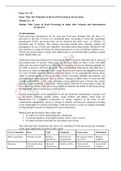
Paper No.: 02
Paper Title: The Principles of the Food Processing & Preservation
Module No. : 01
Module Title: Scope of Food Processing in India with National and International
Perspective
1.0 Introduction
Food processing encompasses all the steps that food goes through from the time it is
harvested to the time it arrives on consumer’s plate. According to Food and Agriculture
Organization (FAO), processed foods can be classified into three types (1) Primary (2)
Secondary and (3) Tertiary. The primary processing include basic cleaning, grading and
packaging as in case of fruits and vegetables. Secondary processing includes alteration of the
basic product to a stage just before the final preparation as in case of milling of paddy to rice.
Tertiary processing leads to a high value-added ready-to eat food like bakery products, instant
foods, health drinks, etc.
Traditional food processing had two functions: to make food more digestible and to preserve
food during times of scarcity. Most crops are seasonal. There are times of the year when
either glut can result in high levels of wastage or shortages can arise if adequate measures are
not taken to preserve and store the foods. This is particularly important in areas that have a
dry season or winter period when crops cannot be grown and animals are slaughtered because
of a lack of fodder. In these situations stored dry grains or root crops provide energy; dried,
salted or smoked meats, or cheeses provide a source of protein, vitamins and minerals; and
processed fruits and vegetables such as pickles, chutneys or dried fruits or leaves provide
vitamins and minerals. A few crops, including cassava and some types of beans also contain
poisons or anti-nutritional components, which must be removed by processing to make the
food safe to eat. Hence, Food processing enables to maintain the health of the human beings
throughout the year by increasing its food security.
By processing food, it can be customized to suit the nutritional requirements of groups such
as the elderly, pregnant women, infants, young children and athletes. Such foods are
characterized by a balanced composition of energy suppliers in the form of fats,
carbohydrates and proteins, and by a cocktail of vitamins and minerals composed according
to the current state of scientific knowledge. Food processing is a route to creating sustainable
livelihoods and economic development for rural communities.
Modern food processing has three major aims:
1. To make food safe (microbiologically, chemically).
2. To provide products of the highest quality (flavor, color, texture)
3. To make food into forms that are convenient (ease of use)
The following table summarizes the item to be controlled in food processing and comments
on the major approaches involved in this control.
To be Controlled Heat Cold Chemicals Active water Mechanical
Micro-organisms Prevents growth Reduces Preservatives Do not grow below Reduces
growth rate retard growth Aw of 0.6 numbers
Enzymes Destroyed by heat Decrease Modify activity Alters rate of increase ES
activity reaction rate enzyme activity complex
, formation
Chemical Increases chemical Reduces May inhibit or Can alter rate of Not
Reactions rate, browning, reaction rate activate reaction, like applicable
oxidation oxidation
Physical Structure Increases effects Decreases May modify High. Aw may Can destroy
effects structure cause caking structures
However, the art and science of food processing has come a long way in the last few decades.
The ever changing lifestyles, food habits and tastes of customers’ world over are making the
food plate look different from what it was yesterday. The world food production and
consumption pattern is evolving with the change in the needs of the customer. Increasing
demand for ethnic and different foods from customers across the world has redefined the
market canvas for food processors across the world. With these changes, producers,
processors, retailers and suppliers of food, world over, are reorienting their business plans to
meet the new demands of the customers. The significant benefits for different stakeholders
involved in food processing are:
§ Farmer – higher yield, better farm realization, lower risk
§ Consumer – greater variety, lower prices, new products
§ Companies – new business opportunities, demand growth
§ Economy/Government – Employment generation, reduced rural migration
The emerging opportunities in food processing are interesting and challenging as well.
1.1 Global Food Processing Industry:
The global processed food industry is estimated to be valued around EUR 2.5 trillion and
accounts for three-fourth of the global food sales. The global food industry is ever changing
and evolving. However, health, convenience and value continue to be the key value
propositions in this industry.
Despite the large size of the industry, only 6 percent of processed foods are traded across
borders compared to 16 percent of major bulk agricultural commodities. The United States
and European Union together account for over 60 percent of total retail processed food sales
in the world.
Rest of the world
9%
US Europ e
21% 39%
Asia Pacific
31%
Trade liberalization policies through multi-lateral and regional trade agreements have led to a
rapid growth in food processing. In the Asian region, Japan is the largest food processing
market, but India and China are likely to grow at a faster rate in the next decade. The
Paper Title: The Principles of the Food Processing & Preservation
Module No. : 01
Module Title: Scope of Food Processing in India with National and International
Perspective
1.0 Introduction
Food processing encompasses all the steps that food goes through from the time it is
harvested to the time it arrives on consumer’s plate. According to Food and Agriculture
Organization (FAO), processed foods can be classified into three types (1) Primary (2)
Secondary and (3) Tertiary. The primary processing include basic cleaning, grading and
packaging as in case of fruits and vegetables. Secondary processing includes alteration of the
basic product to a stage just before the final preparation as in case of milling of paddy to rice.
Tertiary processing leads to a high value-added ready-to eat food like bakery products, instant
foods, health drinks, etc.
Traditional food processing had two functions: to make food more digestible and to preserve
food during times of scarcity. Most crops are seasonal. There are times of the year when
either glut can result in high levels of wastage or shortages can arise if adequate measures are
not taken to preserve and store the foods. This is particularly important in areas that have a
dry season or winter period when crops cannot be grown and animals are slaughtered because
of a lack of fodder. In these situations stored dry grains or root crops provide energy; dried,
salted or smoked meats, or cheeses provide a source of protein, vitamins and minerals; and
processed fruits and vegetables such as pickles, chutneys or dried fruits or leaves provide
vitamins and minerals. A few crops, including cassava and some types of beans also contain
poisons or anti-nutritional components, which must be removed by processing to make the
food safe to eat. Hence, Food processing enables to maintain the health of the human beings
throughout the year by increasing its food security.
By processing food, it can be customized to suit the nutritional requirements of groups such
as the elderly, pregnant women, infants, young children and athletes. Such foods are
characterized by a balanced composition of energy suppliers in the form of fats,
carbohydrates and proteins, and by a cocktail of vitamins and minerals composed according
to the current state of scientific knowledge. Food processing is a route to creating sustainable
livelihoods and economic development for rural communities.
Modern food processing has three major aims:
1. To make food safe (microbiologically, chemically).
2. To provide products of the highest quality (flavor, color, texture)
3. To make food into forms that are convenient (ease of use)
The following table summarizes the item to be controlled in food processing and comments
on the major approaches involved in this control.
To be Controlled Heat Cold Chemicals Active water Mechanical
Micro-organisms Prevents growth Reduces Preservatives Do not grow below Reduces
growth rate retard growth Aw of 0.6 numbers
Enzymes Destroyed by heat Decrease Modify activity Alters rate of increase ES
activity reaction rate enzyme activity complex
, formation
Chemical Increases chemical Reduces May inhibit or Can alter rate of Not
Reactions rate, browning, reaction rate activate reaction, like applicable
oxidation oxidation
Physical Structure Increases effects Decreases May modify High. Aw may Can destroy
effects structure cause caking structures
However, the art and science of food processing has come a long way in the last few decades.
The ever changing lifestyles, food habits and tastes of customers’ world over are making the
food plate look different from what it was yesterday. The world food production and
consumption pattern is evolving with the change in the needs of the customer. Increasing
demand for ethnic and different foods from customers across the world has redefined the
market canvas for food processors across the world. With these changes, producers,
processors, retailers and suppliers of food, world over, are reorienting their business plans to
meet the new demands of the customers. The significant benefits for different stakeholders
involved in food processing are:
§ Farmer – higher yield, better farm realization, lower risk
§ Consumer – greater variety, lower prices, new products
§ Companies – new business opportunities, demand growth
§ Economy/Government – Employment generation, reduced rural migration
The emerging opportunities in food processing are interesting and challenging as well.
1.1 Global Food Processing Industry:
The global processed food industry is estimated to be valued around EUR 2.5 trillion and
accounts for three-fourth of the global food sales. The global food industry is ever changing
and evolving. However, health, convenience and value continue to be the key value
propositions in this industry.
Despite the large size of the industry, only 6 percent of processed foods are traded across
borders compared to 16 percent of major bulk agricultural commodities. The United States
and European Union together account for over 60 percent of total retail processed food sales
in the world.
Rest of the world
9%
US Europ e
21% 39%
Asia Pacific
31%
Trade liberalization policies through multi-lateral and regional trade agreements have led to a
rapid growth in food processing. In the Asian region, Japan is the largest food processing
market, but India and China are likely to grow at a faster rate in the next decade. The