Apart from increasing trade barriers, assess factors which might explain changes in a country’s
pattern of trade with other countries. Refer to the principle of comparative advantage in your
answer.
Knowledge = red
Analysis = green
Application = blue
Evaluation = pink
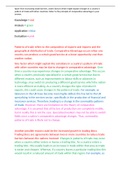
Patterns of trade refers to the composition of exports and imports and the
geographical distribution of trade. Comparative Advantage occurs when one
country can produce a certain good/service at a lower opportunity cost than
another nation.
One factor which might explain the variations in a country’s pattern of trade
with other countries may be due to changes in comparative advantage. Over
time a country may experience changes in comparative advantage. This occurs
when a country previously specialised in a certain good/service but due to
different reasons, such as improvements in labour skills or advances in
technology, may switch to producing a different good/service which the nation
is more efficient at making. As a country changes the type of product it
exports, this could cause changes in the pattern of trade. For example, as
labourers in the UK have become more highly skilled, this has led to the UK
specialising in the services sector, specifically in the production of financial and
insurance services. Therefore, leading to a change in the commodity patterns
of trade. However, there are limitations to the theory of comparative
advantage. It is assumed that all factors of production are completely mobile,
but in reality this is not the case. Specialised workers may not be able to switch
fields once a nation’s comparative advantage changes. Thus, commodity
patterns of trade is likely not to change.
Another possible reason could be the increased growth in trading blocs.
Trading blocs are agreements between two or more countries to reduce trade
barriers between the nations involved. Changes in patterns of trade may occur
when a country either enters or leaves a trading bloc. As a country enters a
trading bloc, this usually leads to an increase in trade within that area as trade
is easier and cheaper. Whereas, if a country leaves a particular trading bloc this
would result in a reduced amount of trade within that region. For example, as
pattern of trade with other countries. Refer to the principle of comparative advantage in your
answer.
Knowledge = red
Analysis = green
Application = blue
Evaluation = pink
Patterns of trade refers to the composition of exports and imports and the
geographical distribution of trade. Comparative Advantage occurs when one
country can produce a certain good/service at a lower opportunity cost than
another nation.
One factor which might explain the variations in a country’s pattern of trade
with other countries may be due to changes in comparative advantage. Over
time a country may experience changes in comparative advantage. This occurs
when a country previously specialised in a certain good/service but due to
different reasons, such as improvements in labour skills or advances in
technology, may switch to producing a different good/service which the nation
is more efficient at making. As a country changes the type of product it
exports, this could cause changes in the pattern of trade. For example, as
labourers in the UK have become more highly skilled, this has led to the UK
specialising in the services sector, specifically in the production of financial and
insurance services. Therefore, leading to a change in the commodity patterns
of trade. However, there are limitations to the theory of comparative
advantage. It is assumed that all factors of production are completely mobile,
but in reality this is not the case. Specialised workers may not be able to switch
fields once a nation’s comparative advantage changes. Thus, commodity
patterns of trade is likely not to change.
Another possible reason could be the increased growth in trading blocs.
Trading blocs are agreements between two or more countries to reduce trade
barriers between the nations involved. Changes in patterns of trade may occur
when a country either enters or leaves a trading bloc. As a country enters a
trading bloc, this usually leads to an increase in trade within that area as trade
is easier and cheaper. Whereas, if a country leaves a particular trading bloc this
would result in a reduced amount of trade within that region. For example, as