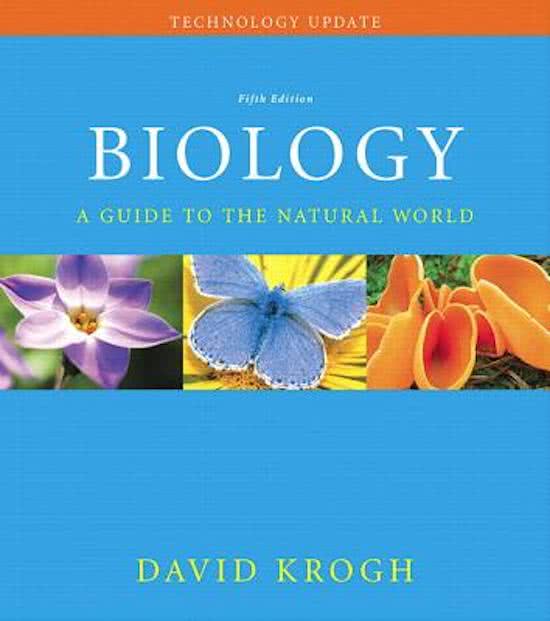
Biology: A Guide to the Natural World, 5e (Krogh)
Chapter 1 Science as a Way of Learning: A Guide to the Natural World
1) What invention by Bell Labs in 1947 brought about modern electronics?
A) the invention of software
B) the invention of the transistor
C) the invention of the CD
D) the invention of the computer
Answer: B
Topic: Section 1.1
Skill: Knowledge/Comprehension
2) Science presents society with ________, about which society then makes decisions.
A) values
B) theories
C) options
D) worst-case scenarios
Answer: C
Topic: Section 1.1
Skill: Knowledge/Comprehension
3) Because scientists are in the business of investigating nature, scientists function as:
A) society's eyes and ears on the natural world.
B) political advisors.
C) authorities on the natural world.
,D) protectors of the natural world.
Answer: A
Topic: Section 1.1
Skill: Knowledge/Comprehension
4) Which of the following is at the root cause for all cancers?
A) antibiotic resistance
B) obesity
C) the normal cell division process
D) a breakdown of the cell division process
Answer: D
Topic: Section 1.1
Skill: Knowledge/Comprehension
,5) Which of the following is true?
A) A scientific theory is a hunch about a natural event.
B) A scientific fact and a scientific theory carry the same weight in the scientific
community.
C) A scientific theory explains what we know to this date about a natural event.
D) A scientific theory is the final answer to a question about a natural event.
Answer: C
Topic: Section 1.2
Skill: Application/Analysis
6) Choose the answer that best describes the sequence of the scientific method.
A) experiment, observation, hypothesis, conclusion
B) hypothesis, experiment, observation, conclusion
C) guess, hypothesis, experiment, conclusion
D) observation, hypothesis, experiment, absolute fact
E) observation, hypothesis, experiment, conclusion
Answer: E
Topic: Section 1.2
Skill: Application/Analysis
7) The role of a control in an experiment is to:
A) prove a hypothesis is correct.
B) ensure the experiment can be repeated.
C) prove that a hypothesis is correct and ensure repeatability.
D) provide a basis of comparison to an experimental group.
Answer: D
, Topic: Section 1.2
Skill: Application/Analysis
8) We use the scientific method every day. Imagine your car doesn't start one morning
before school. Which of these is a reasonable hypothesis regarding the problem?
A) I'm going to be late.
B) I'm out of gas.
C) Check to see whether your lights were left on all night.
D) Add a quart of oil.
Answer: B
Topic: Section 1.2
Skill: Application/Analysis
Chapter 1 Science as a Way of Learning: A Guide to the Natural World
1) What invention by Bell Labs in 1947 brought about modern electronics?
A) the invention of software
B) the invention of the transistor
C) the invention of the CD
D) the invention of the computer
Answer: B
Topic: Section 1.1
Skill: Knowledge/Comprehension
2) Science presents society with ________, about which society then makes decisions.
A) values
B) theories
C) options
D) worst-case scenarios
Answer: C
Topic: Section 1.1
Skill: Knowledge/Comprehension
3) Because scientists are in the business of investigating nature, scientists function as:
A) society's eyes and ears on the natural world.
B) political advisors.
C) authorities on the natural world.
,D) protectors of the natural world.
Answer: A
Topic: Section 1.1
Skill: Knowledge/Comprehension
4) Which of the following is at the root cause for all cancers?
A) antibiotic resistance
B) obesity
C) the normal cell division process
D) a breakdown of the cell division process
Answer: D
Topic: Section 1.1
Skill: Knowledge/Comprehension
,5) Which of the following is true?
A) A scientific theory is a hunch about a natural event.
B) A scientific fact and a scientific theory carry the same weight in the scientific
community.
C) A scientific theory explains what we know to this date about a natural event.
D) A scientific theory is the final answer to a question about a natural event.
Answer: C
Topic: Section 1.2
Skill: Application/Analysis
6) Choose the answer that best describes the sequence of the scientific method.
A) experiment, observation, hypothesis, conclusion
B) hypothesis, experiment, observation, conclusion
C) guess, hypothesis, experiment, conclusion
D) observation, hypothesis, experiment, absolute fact
E) observation, hypothesis, experiment, conclusion
Answer: E
Topic: Section 1.2
Skill: Application/Analysis
7) The role of a control in an experiment is to:
A) prove a hypothesis is correct.
B) ensure the experiment can be repeated.
C) prove that a hypothesis is correct and ensure repeatability.
D) provide a basis of comparison to an experimental group.
Answer: D
, Topic: Section 1.2
Skill: Application/Analysis
8) We use the scientific method every day. Imagine your car doesn't start one morning
before school. Which of these is a reasonable hypothesis regarding the problem?
A) I'm going to be late.
B) I'm out of gas.
C) Check to see whether your lights were left on all night.
D) Add a quart of oil.
Answer: B
Topic: Section 1.2
Skill: Application/Analysis