UNIT 7: TEACHING GRAMMAR
1.Introduction:
This unit is divided into four parts:
• Grammar Basics.
• The Tenses.
• Further Grammar.
• Teaching Grammar.
2.Grammar Basics:
2.1 Back to Basics:
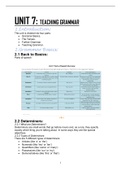
Parts of speech
2.2 Determiners:
2.2.1 What are Determiners?:
Determiners are small words that go before nouns and, as a rule, they specify
exactly which thing you’re talking about. In some ways they are like special
adjectives.
2.2.2 Types of Determiners:
There are 5 different types of determiners:
• Articles (like ‘a’ or ‘the’)
• Numerals (like ‘two’ or ‘ten’)
• Quantifiers (like ‘some’ or ‘many’)
• Possessives (like ‘our’ or ‘my’)
• Demonstratives (like ‘this’ or ‘that’)
1
,Rule : You must use a determiner before a singular countable noun (like ‘teacher’).
You can use determiners before plural nouns and countable nouns.
2.3 Different Types of Verbs:
2.3.1 Auxiliary Verbs:
Auxiliary verbs or ‘helping verbs’ form the tenses, moods and voices of other verbs.
The common auxiliary verbs are do, be and have.
2.3.2 Modal Verbs:
Modal verbs are special verbs which behave differently to regular and ‘conventional’
irregular verbs. They are used to express likelihood, ability, permission and
obligation. Examples : Can, should, could, would, might, may, shall, ought to, will.
A few rules:
• Modal verbs don’t take the ‘s’ in the third person.
• We use ‘not’ to make modal verbs negative, even in the present simple and
past simple.
• Many modal verbs can’t be used in the Past or Future tenses.
• They make questions by ‘inversion’.
• They are followed directly by the infinitive of another verb.
Probability:
They can be used when we want to say how sure we are that something happened /
is happening / will happen. We call these modals of speculation, deduction, certainty
or probability.
Probability in the present:
Must, might, could, can’t, will / wont, should / shouldn’t, can.
Probability in the past:
• Must + have + past participle
• Might + have + past participle
• Could + have + past participle
• May + have + past participle
• Can’t + have + past participle
• Will / won’t + have + past participle
• Should + have + past participle
Ability
• Can or could
• Obligation and Advice
2
, Permission
• Can, could and may.
• Habits
• Will, would, did (past).
2.3.3 Transitive Verbs:
A transitive verb takes a direct object; that is, the verb transmits an action to an
object.
2.3.4 Intransitive verbs:
An intransitive verb does not take an object. It is worth noting that many verbs can
be either transitive or intransitive, depending on the sentence.
2.4 Articles:
The 3 main articles:
• ‘A’ and ‘an’ : ‘A’ is used before words starting with a consonant sound. ‘An’ is
used before words started with a vowel sound.
• You use ‘a’ or ‘an; the first time you mention something.
• You use ‘the’ each time you mention it after that.
Some textbooks state ‘a’ is for new information, and ‘the’ is for known information –
that is, you already know the person or thing the speaker is referring to.
When you don’t have to use ‘a’ or ‘the’ at all:
• When you mean all.
• With another determiner.
• With people’s names.
• For meals.
• Some place names.
• Most companies and magazines.
2.5 Section summary:
Key points to remember:
• Determiners are small words that come before the noun in sentences to
specify exactly which thing you are talking about.
• Articles and Quantifiers are two types of determiners and both have sets of
rules and exceptions that you need to make your learners aware of, but not all
at once.
• It’s common for learners to make errors with determiners but these errors will
often ben easy to identify and correct for you as a native-level speaker.
3.Building Phrases:
In this section, we will be looking at the following element in more details:
• How to put nouns together.
• Putting adjectives and nouns together.
• Using prepositions with nouns, adjectives and verbs.
• Identifying typical learner errors and how to address them.
3.1 Combining Nouns:
To connect people with another noun you just add –‘s to the name followed by the
other noun.
3
1.Introduction:
This unit is divided into four parts:
• Grammar Basics.
• The Tenses.
• Further Grammar.
• Teaching Grammar.
2.Grammar Basics:
2.1 Back to Basics:
Parts of speech
2.2 Determiners:
2.2.1 What are Determiners?:
Determiners are small words that go before nouns and, as a rule, they specify
exactly which thing you’re talking about. In some ways they are like special
adjectives.
2.2.2 Types of Determiners:
There are 5 different types of determiners:
• Articles (like ‘a’ or ‘the’)
• Numerals (like ‘two’ or ‘ten’)
• Quantifiers (like ‘some’ or ‘many’)
• Possessives (like ‘our’ or ‘my’)
• Demonstratives (like ‘this’ or ‘that’)
1
,Rule : You must use a determiner before a singular countable noun (like ‘teacher’).
You can use determiners before plural nouns and countable nouns.
2.3 Different Types of Verbs:
2.3.1 Auxiliary Verbs:
Auxiliary verbs or ‘helping verbs’ form the tenses, moods and voices of other verbs.
The common auxiliary verbs are do, be and have.
2.3.2 Modal Verbs:
Modal verbs are special verbs which behave differently to regular and ‘conventional’
irregular verbs. They are used to express likelihood, ability, permission and
obligation. Examples : Can, should, could, would, might, may, shall, ought to, will.
A few rules:
• Modal verbs don’t take the ‘s’ in the third person.
• We use ‘not’ to make modal verbs negative, even in the present simple and
past simple.
• Many modal verbs can’t be used in the Past or Future tenses.
• They make questions by ‘inversion’.
• They are followed directly by the infinitive of another verb.
Probability:
They can be used when we want to say how sure we are that something happened /
is happening / will happen. We call these modals of speculation, deduction, certainty
or probability.
Probability in the present:
Must, might, could, can’t, will / wont, should / shouldn’t, can.
Probability in the past:
• Must + have + past participle
• Might + have + past participle
• Could + have + past participle
• May + have + past participle
• Can’t + have + past participle
• Will / won’t + have + past participle
• Should + have + past participle
Ability
• Can or could
• Obligation and Advice
2
, Permission
• Can, could and may.
• Habits
• Will, would, did (past).
2.3.3 Transitive Verbs:
A transitive verb takes a direct object; that is, the verb transmits an action to an
object.
2.3.4 Intransitive verbs:
An intransitive verb does not take an object. It is worth noting that many verbs can
be either transitive or intransitive, depending on the sentence.
2.4 Articles:
The 3 main articles:
• ‘A’ and ‘an’ : ‘A’ is used before words starting with a consonant sound. ‘An’ is
used before words started with a vowel sound.
• You use ‘a’ or ‘an; the first time you mention something.
• You use ‘the’ each time you mention it after that.
Some textbooks state ‘a’ is for new information, and ‘the’ is for known information –
that is, you already know the person or thing the speaker is referring to.
When you don’t have to use ‘a’ or ‘the’ at all:
• When you mean all.
• With another determiner.
• With people’s names.
• For meals.
• Some place names.
• Most companies and magazines.
2.5 Section summary:
Key points to remember:
• Determiners are small words that come before the noun in sentences to
specify exactly which thing you are talking about.
• Articles and Quantifiers are two types of determiners and both have sets of
rules and exceptions that you need to make your learners aware of, but not all
at once.
• It’s common for learners to make errors with determiners but these errors will
often ben easy to identify and correct for you as a native-level speaker.
3.Building Phrases:
In this section, we will be looking at the following element in more details:
• How to put nouns together.
• Putting adjectives and nouns together.
• Using prepositions with nouns, adjectives and verbs.
• Identifying typical learner errors and how to address them.
3.1 Combining Nouns:
To connect people with another noun you just add –‘s to the name followed by the
other noun.
3