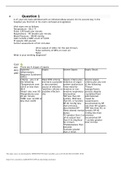
Question 1
A 47 year old male admitted with an infected elbow wound. On his second day in the
hospital you find him in his room confused and agitated.
Vital signs are as follows:
Temperature – 96.2 °F
Pulse -140 beats per minute
Respirations – 40 breaths per minute
Blood Pressure – 90/40 mmHg
Labs include a WBC count of 3,000
Pt weighs 185 pounds
Further assessment of him includes:
Urine output of 100cc for the last 8 hours
Pulse oximetry of 88% on room air
Pallor
What is your working diagnosis?
Corr
ect There are 4 stages of sepsis.
Ans Systemic Sepsis Severe Sepsis Septic Shock
wer: Inflammatory
Response Syndrome
(SIRS)
Criteria – any 2 of Meet SIRS criteria Sepsis criteria plus Severe sepsis
the following: and have a possible evidence of organ criteria plus any one
*Temperature over or documented system dysfunction of the following:
100.9 or less than source of infection *new need for *Tissue
96.8 *positive cultures or invasive or non- hypoperfusion
*Heart rate over 90 possible infection invasive respiratory persists despite
*Respirations over site intervention crystalloid fluid
20 per minute *BP less than 90 administered.
*WBC over 12,000 or systolic, MAP less *need for
less than 4,000 than 65, or Systolic vasopressors
BP 40 mmHg less documented by BP
than previous less than 90 systolic,
documented BP MAP less than 65, or
*New altered mental Systolic BP 40
status mmHg less than
*Cr greater than 2 or previous
urine output less documented BP
than 0.5cc/kg/hour * Lactate greater
for 2 hours than 4 mm/L
*Plateletssless than
100,000
*Lactate greater
than 2 mm/L
This study source was downloaded by 100000839287192 from CourseHero.com on 03-08-2022 08:02:20 GMT -06:00
https://www.coursehero.com/file/60383211/Week-4-knowledge-checkdocx/
, This patient meets the criteria for septic shock
Temp – 96.2
Heart Rate 140
Respirations 40
WBC 3000
Source of infection – elbow wound
Organ dysfunction – confused, urine output of 12 cc per hour (min 42 per weight)
Blood pressure of 90/40 with a MAP of 56.5
o Question 2
A 50 year old woman is thought to be in septic shock. What physical assessment findings
would you expect to find to confirm this type of shock?
Correct
Answer: Hypotension is the common finding in all shock states. In septic shock, you
would also expect to find:
Tachycardia
Full bounding pulses
Pink, warm, flushed skin
Tachypnea
Decreased urine output
Fever
Hemodynamic measures would indicate a decreased cardiac output,
decreased systemic vascular resistance, and a decreased central venous
pressure.
o Question 3
A 56 year old man is thought to be in hypovolemic shock. What are the initial
interventions for a patient in hypovolemic shock?
Correct
Answer: Initial treatment would include:
*identify and stop fluid loss / bleeding if possible
*Crystalloid fluid replacement – 0.9% NS or LR initially infuse 2 L of fluid and
then reassess.
*Hemorrhagic shock should be treated with a balanced infusion of packed
red blood cells, plasma, and platelets. Type O negative PRBC can be
administered until cross matched cells are available.
*Vasopressors can worsen tissue hypoxia and are not initial treatment in
hypovolemia or hemorrhage.
This study source was downloaded by 100000839287192 from CourseHero.com on 03-08-2022 08:02:20 GMT -06:00
https://www.coursehero.com/file/60383211/Week-4-knowledge-checkdocx/
A 47 year old male admitted with an infected elbow wound. On his second day in the
hospital you find him in his room confused and agitated.
Vital signs are as follows:
Temperature – 96.2 °F
Pulse -140 beats per minute
Respirations – 40 breaths per minute
Blood Pressure – 90/40 mmHg
Labs include a WBC count of 3,000
Pt weighs 185 pounds
Further assessment of him includes:
Urine output of 100cc for the last 8 hours
Pulse oximetry of 88% on room air
Pallor
What is your working diagnosis?
Corr
ect There are 4 stages of sepsis.
Ans Systemic Sepsis Severe Sepsis Septic Shock
wer: Inflammatory
Response Syndrome
(SIRS)
Criteria – any 2 of Meet SIRS criteria Sepsis criteria plus Severe sepsis
the following: and have a possible evidence of organ criteria plus any one
*Temperature over or documented system dysfunction of the following:
100.9 or less than source of infection *new need for *Tissue
96.8 *positive cultures or invasive or non- hypoperfusion
*Heart rate over 90 possible infection invasive respiratory persists despite
*Respirations over site intervention crystalloid fluid
20 per minute *BP less than 90 administered.
*WBC over 12,000 or systolic, MAP less *need for
less than 4,000 than 65, or Systolic vasopressors
BP 40 mmHg less documented by BP
than previous less than 90 systolic,
documented BP MAP less than 65, or
*New altered mental Systolic BP 40
status mmHg less than
*Cr greater than 2 or previous
urine output less documented BP
than 0.5cc/kg/hour * Lactate greater
for 2 hours than 4 mm/L
*Plateletssless than
100,000
*Lactate greater
than 2 mm/L
This study source was downloaded by 100000839287192 from CourseHero.com on 03-08-2022 08:02:20 GMT -06:00
https://www.coursehero.com/file/60383211/Week-4-knowledge-checkdocx/
, This patient meets the criteria for septic shock
Temp – 96.2
Heart Rate 140
Respirations 40
WBC 3000
Source of infection – elbow wound
Organ dysfunction – confused, urine output of 12 cc per hour (min 42 per weight)
Blood pressure of 90/40 with a MAP of 56.5
o Question 2
A 50 year old woman is thought to be in septic shock. What physical assessment findings
would you expect to find to confirm this type of shock?
Correct
Answer: Hypotension is the common finding in all shock states. In septic shock, you
would also expect to find:
Tachycardia
Full bounding pulses
Pink, warm, flushed skin
Tachypnea
Decreased urine output
Fever
Hemodynamic measures would indicate a decreased cardiac output,
decreased systemic vascular resistance, and a decreased central venous
pressure.
o Question 3
A 56 year old man is thought to be in hypovolemic shock. What are the initial
interventions for a patient in hypovolemic shock?
Correct
Answer: Initial treatment would include:
*identify and stop fluid loss / bleeding if possible
*Crystalloid fluid replacement – 0.9% NS or LR initially infuse 2 L of fluid and
then reassess.
*Hemorrhagic shock should be treated with a balanced infusion of packed
red blood cells, plasma, and platelets. Type O negative PRBC can be
administered until cross matched cells are available.
*Vasopressors can worsen tissue hypoxia and are not initial treatment in
hypovolemia or hemorrhage.
This study source was downloaded by 100000839287192 from CourseHero.com on 03-08-2022 08:02:20 GMT -06:00
https://www.coursehero.com/file/60383211/Week-4-knowledge-checkdocx/