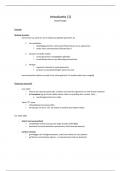
Western Governors University - C170 Course Study Glossary of all Chapter Terms
Western Governors University - C170 Course Study Glossary of all Chapter Terms 1.AREA: In DB2, a named sectionof permanent storage space that is reserved to store the database. iative entity: See composite entity. e entity: See composite entity. date key: A minimal superkey; that is, a key that does not contain a subset of attributes that is itself a superkey. See key. re: A property of relational operators that permits the use of relational algebra operators on existing tables (relations) to produce new relations. site entity: An entity designed to transform an M:N relationship into two 1:M relationships. The composite entity'sprimary key comprises at least the primary keys of the entities that it connects. Also known as a bridge entity or associative entity. See also linking table. site key: A multiple-attribute key. dent: An attribute whose value is determined by another attribute. mination: The role of a key. In the context of a database table, the statement "A determines B" indicates that knowing the value of attribute A means that the value of attribute B can be looked up. 10.DIFFERENCE: In relational algebra, an operator used to yield all rows from one table that are not found in another union-compatible table. 11.DIVIDE: In relational algebra, an operator that answers queries about one set of data being associated with all values of data in another set of data. n: In data modeling, the construct used to organize and describe an attribute's set of possible values. y integrity: The property of a relational table that guarantees each entity has a unique value in a primary key and that the key has no null values. oin: A join operator that links tables based on an equality condition that compares specified columns of the tables. : Special codes implemented by designers to trigger a required response, alert end users to specified conditions, or encode values. Flags may be used to prevent nulls by bringing attention to the absence of a value in a table. gn key (FK): An attribute or attributes in one table whose values must match the primary key in another table or whose values must be null. See key. functional dependence: A condition in which an attribute is functionally dependent on a composite key but not on any subset of the key. ional dependence: Within a relation R, an attribute B is functionally dependent on an attribute A if and only if a given value of attribute A determines exactly one value of attribute B. The relationship "B is dependent on A" is equivalent to "A determines B," and is writtenas A B. yms: The use of the same name to label different attributes. Homonyms generally should be avoided. Some relational software automatically checks for homonyms and either alerts the user to their existence or automatically makes the appropriate adjustments. See also synonym. This study source was downloaded by from CourseH on :36:11 GMT -05:00 : An ordered array of index key values and row ID values (pointers). Indexes are generally used to speed up and facilitate data retrieval. Also known as an index key. key: See index. join: A join operation in which only rows that meet a given criterion are selected. The join criterion can be an equality condition (natural join or equijoin) or an inequality condition (theta join). The inner join is the most commonly used type of join. Contrast with outer join. 23.INTERSECT: In relational algebra, an operator used to yield only the rows that are common to two union-compatible tables. 24.JOIN: In relational algebra, a type of operator used to yield rows from two tables based on criteria. There are many types of joins, such as naturaljoin, theta join, equijoin, and outer join. columns: Columns that are used in the criteriaof join operations. The join columns generally share similar values (have a compatible domain). : One or more attributes that determine other attributes. See also superkey, candidate key, primary key (PK), secondary key, and foreignkey. attribute: The attributes that form a primary key. See also prime attribute. outer join: In a pair of tables to be joined, a join that yields all the rows in the left table, including those that have no matching values in the other table. For example, a left outer join of CUSTOMER with AGENT will yield all of the CUSTOMER rows, including the ones that do not have a matching AGENT row. See also outer join and right outer join. ng table: In the relational model, a table that implements an M:M relationship. See also composite entity. al join: A relational operation that yields a new table composed of only the rows with common values in their common attribute(s). : The absence of an attribute value. Note that a null is not a blank. join: A relational algebra join operation that produces a table in which all unmatched pairs are retained; unmatched values in the relatedtable are left null. Contrast with inner join. See also left outer join and right outer join. cate logic: Used extensively in mathematics to provide a framework in which an assertion (statement of fact) can be verified as either true or false. ry key (PK): In the relational model, an identifier composed of one or more attributes that uniquely identifies a row. Also, a candidate key selected as a unique entity identifier. See also key. attribute: A key attribute; that is, an attribute that is part of a key or is the whole key. See also key attributes. 36.PRODUCT: In relational algebra, an operator used to yield all possible pairs of rows from two tables. Also known as the Cartesian product. 37.PROJECT: In relational algebra, an operator used to select a subset of columns. ential integrity: A condition by which a dependent table's foreignkey must have either a null entry or a matching entry in the relatedtable. ional algebra: A set of mathematical principles that form the basis for manipulating relational table contents; the eight main functions are SELECT, PROJECT, JOIN, INTERSECT, UNION, DIFFERENCE, PRODUCT, and DIVIDE. r: Short for relation variable, a variable that holds a relation. A relvar is a container (variable) for holding relation data, not the relation itself.
Escuela, estudio y materia
- Institución
-
Western Governers University
- Grado
-
C170 Revised
Información del documento
- Subido en
- 1 de mayo de 2022
- Número de páginas
- 9
- Escrito en
- 2021/2022
- Tipo
- Examen
- Contiene
- Preguntas y respuestas
Temas
-
western governors university c170 course study glossary of all chapter terms