Frédéric Kröger Corporate Finance – Summary
Corporate Finance – Summary
❖ Role and Objective of Financial Management (Chap 1)
o MANAGING IN A COMPETITIVE WORLD
o 3 Kind of questions faced by Financial Managers
▪ Investment decisions
E.g. Will a particular investment be successful ?
▪ Financing decisions
E.g. Where will the funds come from to finance the investment ?
▪ Dividend decisions
E.g. How should cash flows be used or distributed ? What’s the optimal dividend policy ?
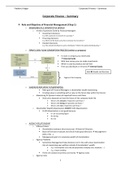
o FIRM’S CASH FLOW GENERATION PROCESS (within a company)
▪ To start a company you need funds
→ External funds
▪ With loan money you can make investments
▪ Which is used to produce and sell GaS
▪ Then you distribute or reinvest (→ Internal funds)
GaS ➔ Goods and Services
Engine of the Company
o SHAREHOLDER WEALTH MAXIMIZING
▪ Main goal of Financial Managers is shareholder wealth maximizing
▪ Creating value is something with a view on the future (lies within the future)
o Maximizing PV (present value) of expected future cash flows
▪ Stock price depends on how the future of the company looks like
• What is the amount of expected cash flows ?
• What is the timing of expected cash flows ?
• What is the risk of expected cash flows ?
o Shareholder Wealth Maximization IS NOT Profit Maximization
▪ Profit Maximization is not good because
• It’s an accounting figure
• No timing
• No risk
o AGENCY RELATIONSHIP
o Different Roles
▪ Shareholders (owners) elect every year → Board of Directors
▪ Board of Directors evaluate and check if take good decisions → Management
(CEO, CFO, …)
▪ Management goal is to maximize wealth of shareholders
o Agency Problems
▪ Sometimes Management take decisions not in line with value maximization
Aim at maximizing own welfare instead of shareholders’ wealth
• E.g.: Consumption of on-the-job perquisites (company cars, airplanes, …)
• E.g.: Empire building
▪ There are solutions but they cost money → Agency Costs
o Agency Costs
1
,Frédéric Kröger Corporate Finance – Summary
▪ Management incentives (stock options)
▪ Monitor performance (audits)
▪ Complex organization structures (multiple managers)
▪ Protective covenants (capital rationing)
o SAMPLE ORGANIZATION CHART
2
,Frédéric Kröger Corporate Finance – Summary
❖ Time Value of Money (Chap 5)
“A $ today is worth more than a $ tomorrow”
o FUTURE VALUE OF A CASH FLOW
o Simple Interest ➔ Interest paid on the principal sum only
𝑭𝑽𝒏 = 𝑷𝑽𝟎 . (𝟏 + 𝒏 . 𝒊)
o Compound Interest ➔ Interest paid on the principal and on prior interest
𝑭𝑽𝒏 = 𝑷𝑽𝟎 . (𝟏 + 𝒊)𝒏
▪ (1 + i)n is Future Value Interest Factor (FVIFi,n ) can be found in Table I
When using the table → 𝑭𝑽𝒏 = 𝑷𝑽𝟎 . (𝑭𝑽𝑰𝑭𝒊,𝒏 )
o PRESENT VALUE OF A CASH FLOW
o Present Value
𝟏
𝑷𝑽𝟎 = 𝑭𝑽𝒏 . [ ]
(𝟏 + 𝒊)𝒏
▪ Present Value Interest Factor (PVIFi,n ) can be found in Table II
When using the → 𝑷𝑽𝟎 = 𝑭𝑽𝒏 . (𝑷𝑽𝑰𝑭𝒊,𝒏 )
o INTEREST COMPOUNDED MORE THAN ONE PER YEAR
▪ Interest paid out more frequently than once per year
o Future Value
▪ m ➔ # of times interest is compounded
▪ n ➔ # of years
▪ 𝐢𝐧𝐨𝐦 ➔ Nominal interest rate
𝒊𝒏𝒐𝒎 𝒏𝒎
𝑭𝑽𝒏 = 𝑷𝑽𝟎 . [𝟏 + ]
𝒎
o Present Value
𝑭𝑽𝒏
𝑷𝑽𝟎 = 𝒏𝒎
𝒊
[𝟏 + 𝒏𝒐𝒎
𝒎 ]
o Effective annual rate of interest
• If I get 5% per year but it is paid twice a year, it means you get twice 2,5%
which is more valuable than getting once 5%
• 𝐢𝐞𝐟𝐟 ➔ Effective interest rate
𝒊𝒏𝒐𝒎 𝒎
𝟏 + 𝒊𝒆𝒇𝒇 = [𝟏 + 𝒎
]
o ANNUITY
▪ Annuity ➔ Series of equal cashflows (PMT (payment)) for a specified number
of periods
o Ordinary Annuity
▪ Ordinary Annuity ➔ PMT occurs at the end of each period
3
, Frédéric Kröger Corporate Finance – Summary
▪ Future Value of an Ordinary Annuity
(1+i)n −1
• is Future Value Interest Factor of an Annuity (FVIFAi,n ) can be
i
found in Table III
When using the table → 𝑭𝑽𝑨𝑵𝒏 = 𝑷𝑴𝑻 . (𝑭𝑽𝑰𝑭𝑨𝒊,𝒏 )
▪ Present Value of an Ordinary Annuity
1
1−
i(1+i)n
• is Present Value Interest Factor of an Annuity (PVIFAi,n ) can
i
be found in Table IV
When using the table → 𝑷𝑽𝑨𝑵𝟎 = 𝑷𝑴𝑻 . (𝑷𝑽𝑰𝑭𝑨𝒊,𝒏 )
▪ Present Value of a Perpetuity
• Perpetuity is a special Annuity that goes on forever
𝑷𝑴𝑻
𝑷𝑽𝑷𝑬𝑹𝟎 =
𝒊
o Annuity Due
▪ Annuity Due ➔ PMT occurs at the beginning of each period
▪ Future Value of an Annuity Due
(1+i)n −1
• is Future Value Interest Factor of an Annuity (FVIFAi,n ) can be
i
found in Table III
When using the table → 𝑭𝑽𝑨𝑵𝑫𝒏 = 𝑷𝑴𝑻 . (𝑭𝑽𝑰𝑭𝑨𝒊,𝒏) . (𝟏 + 𝒊)
▪ Present Value of an Annuity Due
1
1−
i(1+i)n
• is Present Value Interest Factor of an Annuity (PVIFAi,n ) can
i
be found in Table IV
When using the table → 𝑷𝑽𝑨𝑵𝑫𝟎 = 𝑷𝑴𝑻 . (𝑷𝑽𝑰𝑭𝑨𝒊,𝒏 ) . (𝟏 + 𝒊)
4
Corporate Finance – Summary
❖ Role and Objective of Financial Management (Chap 1)
o MANAGING IN A COMPETITIVE WORLD
o 3 Kind of questions faced by Financial Managers
▪ Investment decisions
E.g. Will a particular investment be successful ?
▪ Financing decisions
E.g. Where will the funds come from to finance the investment ?
▪ Dividend decisions
E.g. How should cash flows be used or distributed ? What’s the optimal dividend policy ?
o FIRM’S CASH FLOW GENERATION PROCESS (within a company)
▪ To start a company you need funds
→ External funds
▪ With loan money you can make investments
▪ Which is used to produce and sell GaS
▪ Then you distribute or reinvest (→ Internal funds)
GaS ➔ Goods and Services
Engine of the Company
o SHAREHOLDER WEALTH MAXIMIZING
▪ Main goal of Financial Managers is shareholder wealth maximizing
▪ Creating value is something with a view on the future (lies within the future)
o Maximizing PV (present value) of expected future cash flows
▪ Stock price depends on how the future of the company looks like
• What is the amount of expected cash flows ?
• What is the timing of expected cash flows ?
• What is the risk of expected cash flows ?
o Shareholder Wealth Maximization IS NOT Profit Maximization
▪ Profit Maximization is not good because
• It’s an accounting figure
• No timing
• No risk
o AGENCY RELATIONSHIP
o Different Roles
▪ Shareholders (owners) elect every year → Board of Directors
▪ Board of Directors evaluate and check if take good decisions → Management
(CEO, CFO, …)
▪ Management goal is to maximize wealth of shareholders
o Agency Problems
▪ Sometimes Management take decisions not in line with value maximization
Aim at maximizing own welfare instead of shareholders’ wealth
• E.g.: Consumption of on-the-job perquisites (company cars, airplanes, …)
• E.g.: Empire building
▪ There are solutions but they cost money → Agency Costs
o Agency Costs
1
,Frédéric Kröger Corporate Finance – Summary
▪ Management incentives (stock options)
▪ Monitor performance (audits)
▪ Complex organization structures (multiple managers)
▪ Protective covenants (capital rationing)
o SAMPLE ORGANIZATION CHART
2
,Frédéric Kröger Corporate Finance – Summary
❖ Time Value of Money (Chap 5)
“A $ today is worth more than a $ tomorrow”
o FUTURE VALUE OF A CASH FLOW
o Simple Interest ➔ Interest paid on the principal sum only
𝑭𝑽𝒏 = 𝑷𝑽𝟎 . (𝟏 + 𝒏 . 𝒊)
o Compound Interest ➔ Interest paid on the principal and on prior interest
𝑭𝑽𝒏 = 𝑷𝑽𝟎 . (𝟏 + 𝒊)𝒏
▪ (1 + i)n is Future Value Interest Factor (FVIFi,n ) can be found in Table I
When using the table → 𝑭𝑽𝒏 = 𝑷𝑽𝟎 . (𝑭𝑽𝑰𝑭𝒊,𝒏 )
o PRESENT VALUE OF A CASH FLOW
o Present Value
𝟏
𝑷𝑽𝟎 = 𝑭𝑽𝒏 . [ ]
(𝟏 + 𝒊)𝒏
▪ Present Value Interest Factor (PVIFi,n ) can be found in Table II
When using the → 𝑷𝑽𝟎 = 𝑭𝑽𝒏 . (𝑷𝑽𝑰𝑭𝒊,𝒏 )
o INTEREST COMPOUNDED MORE THAN ONE PER YEAR
▪ Interest paid out more frequently than once per year
o Future Value
▪ m ➔ # of times interest is compounded
▪ n ➔ # of years
▪ 𝐢𝐧𝐨𝐦 ➔ Nominal interest rate
𝒊𝒏𝒐𝒎 𝒏𝒎
𝑭𝑽𝒏 = 𝑷𝑽𝟎 . [𝟏 + ]
𝒎
o Present Value
𝑭𝑽𝒏
𝑷𝑽𝟎 = 𝒏𝒎
𝒊
[𝟏 + 𝒏𝒐𝒎
𝒎 ]
o Effective annual rate of interest
• If I get 5% per year but it is paid twice a year, it means you get twice 2,5%
which is more valuable than getting once 5%
• 𝐢𝐞𝐟𝐟 ➔ Effective interest rate
𝒊𝒏𝒐𝒎 𝒎
𝟏 + 𝒊𝒆𝒇𝒇 = [𝟏 + 𝒎
]
o ANNUITY
▪ Annuity ➔ Series of equal cashflows (PMT (payment)) for a specified number
of periods
o Ordinary Annuity
▪ Ordinary Annuity ➔ PMT occurs at the end of each period
3
, Frédéric Kröger Corporate Finance – Summary
▪ Future Value of an Ordinary Annuity
(1+i)n −1
• is Future Value Interest Factor of an Annuity (FVIFAi,n ) can be
i
found in Table III
When using the table → 𝑭𝑽𝑨𝑵𝒏 = 𝑷𝑴𝑻 . (𝑭𝑽𝑰𝑭𝑨𝒊,𝒏 )
▪ Present Value of an Ordinary Annuity
1
1−
i(1+i)n
• is Present Value Interest Factor of an Annuity (PVIFAi,n ) can
i
be found in Table IV
When using the table → 𝑷𝑽𝑨𝑵𝟎 = 𝑷𝑴𝑻 . (𝑷𝑽𝑰𝑭𝑨𝒊,𝒏 )
▪ Present Value of a Perpetuity
• Perpetuity is a special Annuity that goes on forever
𝑷𝑴𝑻
𝑷𝑽𝑷𝑬𝑹𝟎 =
𝒊
o Annuity Due
▪ Annuity Due ➔ PMT occurs at the beginning of each period
▪ Future Value of an Annuity Due
(1+i)n −1
• is Future Value Interest Factor of an Annuity (FVIFAi,n ) can be
i
found in Table III
When using the table → 𝑭𝑽𝑨𝑵𝑫𝒏 = 𝑷𝑴𝑻 . (𝑭𝑽𝑰𝑭𝑨𝒊,𝒏) . (𝟏 + 𝒊)
▪ Present Value of an Annuity Due
1
1−
i(1+i)n
• is Present Value Interest Factor of an Annuity (PVIFAi,n ) can
i
be found in Table IV
When using the table → 𝑷𝑽𝑨𝑵𝑫𝟎 = 𝑷𝑴𝑻 . (𝑷𝑽𝑰𝑭𝑨𝒊,𝒏 ) . (𝟏 + 𝒊)
4