IFRS 3: Business combinations
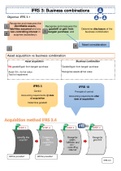
Objective: IFRS 3.1
Recognise and measures the
1 identifiable assets, Recognise and measures the
liabilities assumed and any goodwill or gain from Determine disclosure of the
non‐controlling interest in 3 bargain purchase; and business combination
2
acquiree (subsidiary);
4 Need consideration
1
Asset acquisition vs business combination
Asset acquisition Business combination
No goodwill/gain from bargain purchase Goodwill/gain from bargain purchase
Asset CA > its fair value Recognise assets @ fair value
Test for impairment
IFRS 3 IFRS 10
Control Principle of control
Accounting requirements @ date Accounting requirements after
of acquisition date of acquisition
Determine goodwill
Will be provided Will be provided
IFRS 3.5
,Intangible assets
Steps to account for business combination:
Must meet definitions of
1. Recognise, separately from goodwill (on their asset, liability in
own), the identifiable assets acquired, the conceptual framework
liabilities assumed and any non‐controlling @ acquisition
interest in the acquiree (IFRS 3.10).
IFRS 3.11
2. The identifiable assets acquired and the liabilities assumed must be part of the exchange between
acquirer (i.e. parent) and acquiree (i.e. subsidiary) (IFRS 3.12).
THIS CAUSES:
Intangible asset
→ Not in subsidiary’s FS
→ Recognise at the date of acquisition because of business combination
Examples are licences, patents, trademarks (arise from contractual or other legal rights) and in‐process
research (separately identifiable).
, Remeasurement of assets at fair value
Three possible approaches
Fair value/revalue assets in subsidiary’s own (individual)
records.
refer to GS 6.1
Note that the subsidiary should adopt a relevant
accounting policy to do so
Fair value assets at acquisition date (not in own records of
subsidiary, apply IFRS 3) Extra journals provided
Fair value assets at acquisition date (IFRS 3) AND
Subsidiary fair value/revalue the same asset at a later stage in refer to CE 1 – Raka
subsidiary’s own records, adopting a relevant accounting policy Ltd
Exception
Contingent liabilities:
IAS 37 Provisions, Contingent Liabilities and Remember that a contingent
Contingent Assets defines a contingent liability as: liability is NOT recognised in
individual financial statements
(a) A possible obligation; or because it does not meet the
recognition criteria.
(b) A present obligation that is not recognised because it is
not ‘probable’ or the amount cannot be measured reliably (IFRS 3.22).
A present obligation (if fair value can be measured
A possible obligation is NOT recognised as part of reliably) is recognised as part of the business
a business combination. combination at the acquisition date although the
recognition criteria are not met. (IFRS 3.23).
Objective: IFRS 3.1
Recognise and measures the
1 identifiable assets, Recognise and measures the
liabilities assumed and any goodwill or gain from Determine disclosure of the
non‐controlling interest in 3 bargain purchase; and business combination
2
acquiree (subsidiary);
4 Need consideration
1
Asset acquisition vs business combination
Asset acquisition Business combination
No goodwill/gain from bargain purchase Goodwill/gain from bargain purchase
Asset CA > its fair value Recognise assets @ fair value
Test for impairment
IFRS 3 IFRS 10
Control Principle of control
Accounting requirements @ date Accounting requirements after
of acquisition date of acquisition
Determine goodwill
Will be provided Will be provided
IFRS 3.5
,Intangible assets
Steps to account for business combination:
Must meet definitions of
1. Recognise, separately from goodwill (on their asset, liability in
own), the identifiable assets acquired, the conceptual framework
liabilities assumed and any non‐controlling @ acquisition
interest in the acquiree (IFRS 3.10).
IFRS 3.11
2. The identifiable assets acquired and the liabilities assumed must be part of the exchange between
acquirer (i.e. parent) and acquiree (i.e. subsidiary) (IFRS 3.12).
THIS CAUSES:
Intangible asset
→ Not in subsidiary’s FS
→ Recognise at the date of acquisition because of business combination
Examples are licences, patents, trademarks (arise from contractual or other legal rights) and in‐process
research (separately identifiable).
, Remeasurement of assets at fair value
Three possible approaches
Fair value/revalue assets in subsidiary’s own (individual)
records.
refer to GS 6.1
Note that the subsidiary should adopt a relevant
accounting policy to do so
Fair value assets at acquisition date (not in own records of
subsidiary, apply IFRS 3) Extra journals provided
Fair value assets at acquisition date (IFRS 3) AND
Subsidiary fair value/revalue the same asset at a later stage in refer to CE 1 – Raka
subsidiary’s own records, adopting a relevant accounting policy Ltd
Exception
Contingent liabilities:
IAS 37 Provisions, Contingent Liabilities and Remember that a contingent
Contingent Assets defines a contingent liability as: liability is NOT recognised in
individual financial statements
(a) A possible obligation; or because it does not meet the
recognition criteria.
(b) A present obligation that is not recognised because it is
not ‘probable’ or the amount cannot be measured reliably (IFRS 3.22).
A present obligation (if fair value can be measured
A possible obligation is NOT recognised as part of reliably) is recognised as part of the business
a business combination. combination at the acquisition date although the
recognition criteria are not met. (IFRS 3.23).