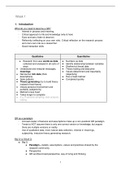
Lecture 1
The
goal is to abstract away the patterns of reasoning from
the natural
language .
We want to
say exactly how and when
conclusions from
we can reach certain certain
hypotheses .
Informal arguments can be written in a formal symbolic way .
In the propositional logic
language of ,
sentences or formulas
that write down to
you are
going represent statements or
associations or
propositions .
the
goal symbolic logic is to identify the core elements
of
of reasoning and argumentation and explain how they work .
notations
Symbols of
key logical are :
if A then B "
"
A B implication
"
A and
conjunction
"
A B B
disjunction
"
A B A or B
"
A negation
" "
not A
" "
× A for every ×, A universal
A "
for some existential
"
+ × ,
A
Natural deduction is used to proof systems .
A deductive
system is sound if it
only allows us to derive valid
assertions and entailment . It is complete .
If the
system
is strong enough to allow us to verify all valid assertions
and entailment's .
rules of inference
implication
A B A
E implication elimination
B if we know A B and A ,
then we can conclude B .
I
A.
thetemporary assumption that A holds is
by making it explicit in the conclusion
" "
: cancelled .
B
1 I implication introduction rule
A B assume A 4) try to conclude B
, Conjunction hypotheses are on
A B I and introduction rule top and conclusions at
A B the bottom
A B and elimination left
EL
A
A B
Er and elimination right
B
An introduction rule shows how to establish a claim involving
the connective ,
while an elimination rule shows how to use
such a statement that contains the connective to derive others .
natural deduction =
a
proof is a tree of applications of
the rules of inference . The root is at the bottom .
In natural deduction is proof from
,
every proof a
hypotheses .
In other words ,
in any proof ,
there is a finite set of
EB C. conclusion A what the
hypotheses ,
. . . 3 and a ,
and
proof shows is that A follows from B. C. . . .
the assumption rule A can be used at
any time
"
A have proved A
"
assuming ,
we
(1)
A A B A
prove C from E
A B B B C B
hypotheses and C E
1. A C
I (1)
A C
prove CCA CB C) ) ( CA B) C) from no hypotheses
I. A CB C)
2 . A B
(2)
A B
(1) EL (2)
A CB C) A A B
Er
B C B
E
C
I (2)
(A B) C
I (1)
( CA CB C) ) ( CA B) C)
, Lecture 2
rules of inference
negation and falsity
1
It means that it is impossible .
:
negation introduction
, I
if we assume A and we establish impossibility
A then have
we not A
A A
E negation elimination
or contradiction introduction I
E contradiction elimination
A if I can prove falsity ,
then I can prove anything
=
last resort
disjunction
A introduction
T
- L disjunction left
AVB
B
In disjunction introduction right
AVB in order to known A B it suffices to
,
/ , prove one side CA or B) .
A B
: :
two hypothetical branches
.
A B C C
, E disjunction elimination
C
derive the formula from no hypotheses :
(A B) L7A B) cancelled
hypotheses can be
I. (A B) (2) (3)
2. A a)
A- It 4)
B
In
LA B) A B (A B) A B
3. B -
I I (3)
I (2) I
7A B
I
7A B
-
I (1)
(A B) L7A B)
The
goal is to abstract away the patterns of reasoning from
the natural
language .
We want to
say exactly how and when
conclusions from
we can reach certain certain
hypotheses .
Informal arguments can be written in a formal symbolic way .
In the propositional logic
language of ,
sentences or formulas
that write down to
you are
going represent statements or
associations or
propositions .
the
goal symbolic logic is to identify the core elements
of
of reasoning and argumentation and explain how they work .
notations
Symbols of
key logical are :
if A then B "
"
A B implication
"
A and
conjunction
"
A B B
disjunction
"
A B A or B
"
A negation
" "
not A
" "
× A for every ×, A universal
A "
for some existential
"
+ × ,
A
Natural deduction is used to proof systems .
A deductive
system is sound if it
only allows us to derive valid
assertions and entailment . It is complete .
If the
system
is strong enough to allow us to verify all valid assertions
and entailment's .
rules of inference
implication
A B A
E implication elimination
B if we know A B and A ,
then we can conclude B .
I
A.
thetemporary assumption that A holds is
by making it explicit in the conclusion
" "
: cancelled .
B
1 I implication introduction rule
A B assume A 4) try to conclude B
, Conjunction hypotheses are on
A B I and introduction rule top and conclusions at
A B the bottom
A B and elimination left
EL
A
A B
Er and elimination right
B
An introduction rule shows how to establish a claim involving
the connective ,
while an elimination rule shows how to use
such a statement that contains the connective to derive others .
natural deduction =
a
proof is a tree of applications of
the rules of inference . The root is at the bottom .
In natural deduction is proof from
,
every proof a
hypotheses .
In other words ,
in any proof ,
there is a finite set of
EB C. conclusion A what the
hypotheses ,
. . . 3 and a ,
and
proof shows is that A follows from B. C. . . .
the assumption rule A can be used at
any time
"
A have proved A
"
assuming ,
we
(1)
A A B A
prove C from E
A B B B C B
hypotheses and C E
1. A C
I (1)
A C
prove CCA CB C) ) ( CA B) C) from no hypotheses
I. A CB C)
2 . A B
(2)
A B
(1) EL (2)
A CB C) A A B
Er
B C B
E
C
I (2)
(A B) C
I (1)
( CA CB C) ) ( CA B) C)
, Lecture 2
rules of inference
negation and falsity
1
It means that it is impossible .
:
negation introduction
, I
if we assume A and we establish impossibility
A then have
we not A
A A
E negation elimination
or contradiction introduction I
E contradiction elimination
A if I can prove falsity ,
then I can prove anything
=
last resort
disjunction
A introduction
T
- L disjunction left
AVB
B
In disjunction introduction right
AVB in order to known A B it suffices to
,
/ , prove one side CA or B) .
A B
: :
two hypothetical branches
.
A B C C
, E disjunction elimination
C
derive the formula from no hypotheses :
(A B) L7A B) cancelled
hypotheses can be
I. (A B) (2) (3)
2. A a)
A- It 4)
B
In
LA B) A B (A B) A B
3. B -
I I (3)
I (2) I
7A B
I
7A B
-
I (1)
(A B) L7A B)