NR 507 week 5 case study with References . all quizzes answered
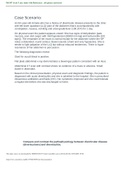
Case Scenario:
An 84- year-old -female who has a history of diverticular disease presents to the clinic
with left lower quadrant (LLQ) pain of the abdomen that is accompanied by with
constipation, nausea, vomiting and a low-grade fever (100.20 F) for 1 day.
On physical exam the patient appears unwell. She has signs of dehydration (pale
mucosa, poor skin turgor with mild hypotension [90/60 mm Hg] and tachycardia [101
bpm]). The remainder of her exam is normal except for her abdomen where the NP
notes a distended, round contour. Bowel sounds a faint and very hypoactive. She is
tender to light palpation of the LLQ but without rebound tenderness. There is hyper-
resonance of her abdomen to percussion.
The following diagnostics reveal:
Stool for occult blood is positive.
Flat plate abdominal x-ray demonstrates a bowel-gas pattern consistent with an ileus.
Abdominal CT scan with contrast shows no evidence of a mass or abscess. Small
bowel in distended.
Based on the clinical presentation, physical exam and diagnostic findings, the patient is
diagnosed with acute diverticulitis and she is admitted to the hospital. She is prescribed
intravenous antibiotics and fluids (IVF). Her symptoms improved and she could tolerate
a regular diet before she was discharged to home.
Compare and contrast the pathophysiology between diverticular disease
(diverticulosis) and diverticulitis.
This study source was downloaded by 100000832361371 from CourseHero.com on 08-04-2022 04:18:56 GMT -05:00
https://www.coursehero.com/file/137940270/Week-5-discussiondocx/
Case Scenario:
An 84- year-old -female who has a history of diverticular disease presents to the clinic
with left lower quadrant (LLQ) pain of the abdomen that is accompanied by with
constipation, nausea, vomiting and a low-grade fever (100.20 F) for 1 day.
On physical exam the patient appears unwell. She has signs of dehydration (pale
mucosa, poor skin turgor with mild hypotension [90/60 mm Hg] and tachycardia [101
bpm]). The remainder of her exam is normal except for her abdomen where the NP
notes a distended, round contour. Bowel sounds a faint and very hypoactive. She is
tender to light palpation of the LLQ but without rebound tenderness. There is hyper-
resonance of her abdomen to percussion.
The following diagnostics reveal:
Stool for occult blood is positive.
Flat plate abdominal x-ray demonstrates a bowel-gas pattern consistent with an ileus.
Abdominal CT scan with contrast shows no evidence of a mass or abscess. Small
bowel in distended.
Based on the clinical presentation, physical exam and diagnostic findings, the patient is
diagnosed with acute diverticulitis and she is admitted to the hospital. She is prescribed
intravenous antibiotics and fluids (IVF). Her symptoms improved and she could tolerate
a regular diet before she was discharged to home.
Compare and contrast the pathophysiology between diverticular disease
(diverticulosis) and diverticulitis.
This study source was downloaded by 100000832361371 from CourseHero.com on 08-04-2022 04:18:56 GMT -05:00
https://www.coursehero.com/file/137940270/Week-5-discussiondocx/