Question 1
pts
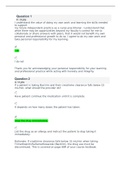
I understand the value of doing my own work and learning the skills needed
to support
my future independent practice as a nurse practitioner. I understand that
while there may be opportunities beyond my faculty’s control for me to
collaborate or share answers with peers, that it would not benefit my own
personal and professional growth to do so. I agree to do my own work and
take personal responsibility for my learning.
I do
I do not
Thank you for acknowledging your personal responsibility for your learning
and professional practice while acting with honesty and integrity.
Question 2
pts
If a patient is taking Bactrim and their creatinine clearance falls below 15
mL/min, what should the provider do?
Have patient continue the medication until it is complete.
It depends on how many doses the patient has taken.
Stop the drug immediately.
List the drug as an allergy and instruct the patient to stop taking it
immediately.
Rationale: If creatinine clearance falls below 15 mL/min when taking
Trimethoprim/Sulfamethoxazole (Bactrim), the drug use must be
discontinued. This is covered on page 694 of your course textbook.
, Question 3
pts
In patients with a creatinine clearance of 15-30 mL/min taking Bactrim, how
should the
dosing be adjusted?
Reduced by 50%
Reduced by 25%
Increased by 50%
Increased by 25%
Rationale: In patients with renal impairment (creatinine clearance of 15–
30 mL/min), dosage should be decreased by 50%. This is covered on
page 690 and 694 of your course textbook.
Question 4
pts
What baseline data is needed to prescribe trimethoprim/sulfamethoxazole?
(Select all that apply)
Establish an infection appropriate for this drug class exists
Complete blood count with white cell differential for prolonged therapy
Hepatic function if there is concern in may be compromised
, Renal function if there is concern in may be compromised
Rationale: This information can be found in the Summary of Key Prescribing
Considerations in the chapter that covers this drug class.
Question 5
pts
Using your textbook, match the antibiotic class to the patient care concern for
children/adolescents.
Use each option only once by selecting the option that is most true.
Commonly used to treat bacterial infections, including otitis media and
gonococcal and pneumococcal infections.
Cephalosporins
Common drug used to treat bacterial infections.
Penicillins
Should not be used in children younger than 8 years because they may cause
permanent discoloration of the teeth.
Tetracyclines
Safe for use against bacterial infections but not commonly used in outpatient
settings.
Aminoglycosides
Rationale: This information can be found in the Summary of Key Prescribing
Considerations in the chapter that covers this drug class.
Question 6
pts
Which representative antibiotics are inhibitors of cell wall synthesis as listed
in your course textbook? (Select all that apply)
pts
I understand the value of doing my own work and learning the skills needed
to support
my future independent practice as a nurse practitioner. I understand that
while there may be opportunities beyond my faculty’s control for me to
collaborate or share answers with peers, that it would not benefit my own
personal and professional growth to do so. I agree to do my own work and
take personal responsibility for my learning.
I do
I do not
Thank you for acknowledging your personal responsibility for your learning
and professional practice while acting with honesty and integrity.
Question 2
pts
If a patient is taking Bactrim and their creatinine clearance falls below 15
mL/min, what should the provider do?
Have patient continue the medication until it is complete.
It depends on how many doses the patient has taken.
Stop the drug immediately.
List the drug as an allergy and instruct the patient to stop taking it
immediately.
Rationale: If creatinine clearance falls below 15 mL/min when taking
Trimethoprim/Sulfamethoxazole (Bactrim), the drug use must be
discontinued. This is covered on page 694 of your course textbook.
, Question 3
pts
In patients with a creatinine clearance of 15-30 mL/min taking Bactrim, how
should the
dosing be adjusted?
Reduced by 50%
Reduced by 25%
Increased by 50%
Increased by 25%
Rationale: In patients with renal impairment (creatinine clearance of 15–
30 mL/min), dosage should be decreased by 50%. This is covered on
page 690 and 694 of your course textbook.
Question 4
pts
What baseline data is needed to prescribe trimethoprim/sulfamethoxazole?
(Select all that apply)
Establish an infection appropriate for this drug class exists
Complete blood count with white cell differential for prolonged therapy
Hepatic function if there is concern in may be compromised
, Renal function if there is concern in may be compromised
Rationale: This information can be found in the Summary of Key Prescribing
Considerations in the chapter that covers this drug class.
Question 5
pts
Using your textbook, match the antibiotic class to the patient care concern for
children/adolescents.
Use each option only once by selecting the option that is most true.
Commonly used to treat bacterial infections, including otitis media and
gonococcal and pneumococcal infections.
Cephalosporins
Common drug used to treat bacterial infections.
Penicillins
Should not be used in children younger than 8 years because they may cause
permanent discoloration of the teeth.
Tetracyclines
Safe for use against bacterial infections but not commonly used in outpatient
settings.
Aminoglycosides
Rationale: This information can be found in the Summary of Key Prescribing
Considerations in the chapter that covers this drug class.
Question 6
pts
Which representative antibiotics are inhibitors of cell wall synthesis as listed
in your course textbook? (Select all that apply)