INV3701
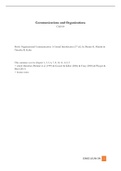
Investments: Equity Asset Valuation
Assignment Solutions
SEMESTER 2
ASSIGNMENT 02
Due date and time: 12 September 2022 at 13H00
Unique number: 733869
Aim: To evaluate your knowledge of some of the fundamental aspects of equity valuation:
application and process, equity return concepts, the dividend discount model and free cash
flow models. Refer to lessons 1 to 6, which include chapters 1, 3 to 5 and, 7 to 10 in the
prescribed book.
The following assignment contains 20 multiple-choice questions. [20 marks]
Questions
1. Which one of the following statements is most likely correct?
A. Residual income is suitable for a firm that has positive free cash flow for the
foreseeable future.
B. The dividend discount model is suitable for a firm that has the perspective of a
minority shareholder.
C. Free cash flow models are suitable for firms that have a dividend payment
history or have a dividend payment history that is clearly and appropriately
related to earnings.
Option B Correct
Dividend discount model Refer to pages 235–241 in the 3rd ed., and 317–322 in the 4th ed
, 2. The increase in fixed assets is defined as ...
A. capital expenditure less depreciation.
B. net income less capital expenditure.
C. net income less depreciation less capital expenditure.
Option A Correct
Use the following information to answer question 3.
Greek Manufacturing has free cash flow to the firm (FCFF) and free cash flow to equity
(FCFE) of R7.4 and R9.2 million respectively. The required rate of equity is 12.2% and the
weighted average cost of capital is 9.3%. Greek Manufacturing has outstanding debt of
R132.5 million. The following information on the growth rates is available:
Growth rate
FCFE 4.5%
FCFF 6%
3.Calculate the total value of German Manufacturing’s equity by using the FCFF valuation
method.
A. R105.20 million
B. R124.86 million
C. R237.70 million
Option A Correct
Firm Value = FCFF1 /Wacc -g
= 7.4 (1.06)/0.093-0.066
= R237.70
Value of Equity = Firm value – MV debt
= 237.70 – 132.5
= 105.20
Refer to page 298 in the 3rd ed., and 387 in the 4th ed.
Investments: Equity Asset Valuation
Assignment Solutions
SEMESTER 2
ASSIGNMENT 02
Due date and time: 12 September 2022 at 13H00
Unique number: 733869
Aim: To evaluate your knowledge of some of the fundamental aspects of equity valuation:
application and process, equity return concepts, the dividend discount model and free cash
flow models. Refer to lessons 1 to 6, which include chapters 1, 3 to 5 and, 7 to 10 in the
prescribed book.
The following assignment contains 20 multiple-choice questions. [20 marks]
Questions
1. Which one of the following statements is most likely correct?
A. Residual income is suitable for a firm that has positive free cash flow for the
foreseeable future.
B. The dividend discount model is suitable for a firm that has the perspective of a
minority shareholder.
C. Free cash flow models are suitable for firms that have a dividend payment
history or have a dividend payment history that is clearly and appropriately
related to earnings.
Option B Correct
Dividend discount model Refer to pages 235–241 in the 3rd ed., and 317–322 in the 4th ed
, 2. The increase in fixed assets is defined as ...
A. capital expenditure less depreciation.
B. net income less capital expenditure.
C. net income less depreciation less capital expenditure.
Option A Correct
Use the following information to answer question 3.
Greek Manufacturing has free cash flow to the firm (FCFF) and free cash flow to equity
(FCFE) of R7.4 and R9.2 million respectively. The required rate of equity is 12.2% and the
weighted average cost of capital is 9.3%. Greek Manufacturing has outstanding debt of
R132.5 million. The following information on the growth rates is available:
Growth rate
FCFE 4.5%
FCFF 6%
3.Calculate the total value of German Manufacturing’s equity by using the FCFF valuation
method.
A. R105.20 million
B. R124.86 million
C. R237.70 million
Option A Correct
Firm Value = FCFF1 /Wacc -g
= 7.4 (1.06)/0.093-0.066
= R237.70
Value of Equity = Firm value – MV debt
= 237.70 – 132.5
= 105.20
Refer to page 298 in the 3rd ed., and 387 in the 4th ed.