Peter Hacker - Insight and Illusion: Themes in the Philosophy of Wittgenstein
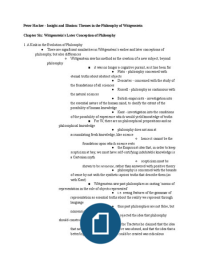
Chapter Six: Wittgenstein’s Later Conception of Philosophy
1. A Kink in the Evolution of Philosophy
● There are significant similarities in Wittgenstein’s earlier and later conceptions of
philosophy, but also differences
○ Wittgenstein saw his method as the creation of a new subject, beyond
philosophy
■ it was no longer a cognitive pursuit, as it has been for
● Plato - philosophy concerned with
eternal truths about abstract objects
● Descartes - concerned with the study of
the foundations of all sciences
● Russell - philosophy as continuous with
the natural sciences
● British empiricists - investigation into
the essential nature of the human mind, to clarify the extent of the
possibility of human knowledge
● Kant - investigation into the conditions
of the possibility of experience which would yield knowledge of truths
■ For W, there are no philosophical propositions and no
philosophical knowledge
● philosophy does not aim at
accumulating fresh knowledge, like science
○ hence it cannot be the
foundation upon which science rests
● the Empiricist idea that, in order to keep
scepticism at bay, we must have self-certifying indubitable knowledge is
a Cartesian myth
○ scepticism must be
shown to be nonsense, rather than answered with positive theory
● philosophy is concerned with the bounds
of sense by not with the synthetic apriori truths that describe them (as
with Kant)
■ Wittgenstein saw past philosophies as casting ‘norms of
representation in the role of objects represented’
● i.e. seeing features of the grammar of
representation as essential truths about the reality we represent through
language
● thus past philosophies are not false, but
nonsensical
■ Wittgenstein also rejected the idea that philosophy
should construct an ideal language
● in the Tractatus he claimed that the idea
that natural languages were defective was absurd, and that the idea that a
better/logically more perfect one could be created was ridiculous
Chapter Six: Wittgenstein’s Later Conception of Philosophy
1. A Kink in the Evolution of Philosophy
● There are significant similarities in Wittgenstein’s earlier and later conceptions of
philosophy, but also differences
○ Wittgenstein saw his method as the creation of a new subject, beyond
philosophy
■ it was no longer a cognitive pursuit, as it has been for
● Plato - philosophy concerned with
eternal truths about abstract objects
● Descartes - concerned with the study of
the foundations of all sciences
● Russell - philosophy as continuous with
the natural sciences
● British empiricists - investigation into
the essential nature of the human mind, to clarify the extent of the
possibility of human knowledge
● Kant - investigation into the conditions
of the possibility of experience which would yield knowledge of truths
■ For W, there are no philosophical propositions and no
philosophical knowledge
● philosophy does not aim at
accumulating fresh knowledge, like science
○ hence it cannot be the
foundation upon which science rests
● the Empiricist idea that, in order to keep
scepticism at bay, we must have self-certifying indubitable knowledge is
a Cartesian myth
○ scepticism must be
shown to be nonsense, rather than answered with positive theory
● philosophy is concerned with the bounds
of sense by not with the synthetic apriori truths that describe them (as
with Kant)
■ Wittgenstein saw past philosophies as casting ‘norms of
representation in the role of objects represented’
● i.e. seeing features of the grammar of
representation as essential truths about the reality we represent through
language
● thus past philosophies are not false, but
nonsensical
■ Wittgenstein also rejected the idea that philosophy
should construct an ideal language
● in the Tractatus he claimed that the idea
that natural languages were defective was absurd, and that the idea that a
better/logically more perfect one could be created was ridiculous