BIOS 260 WEEK 1 QUIZ All Quizzes with Answers
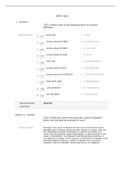
WEEK 1 QUIZ 1. Question : (TCO 1) Match each of the following terms to its brief definition. Student Answer: : blood test » 7 : CBC : normal values for WBCs » 6 : 6-10 thousand : normal values for RBCs » 3 : 4-6 million : normal values for HGB » 4 : 12-14 : heart test » 8 : echocardiogram : normal values for HCT » 9 : 38-48 percent : normal values for PLATELETS » 1 : 150,000 to 400,000 : High blood sugar » 5 : Hyperglycemia : Low potassium » 10 : Hypokalemia : too high WBCs » 2 : Leukocytosis Points Received: 10 of 10 Comments: Question 2 . Question : (TCO 1) What are some of the possible causes of disease? Name four and give an example for each. Student Answer: Eitology is the cause of disease that the root could be from lesion; damages gene, enzyme, abnormal cells, tissues, or organs. Here are four examples of causes of diseases: If a person has stress as a cause, then the disease maybe hypertension or heart disease. If the cause is malnutrition, the diseases could be pernicious anemia, or iron-deficiency anemia. Of the cause is an infection, the disease could be tuberculosis or influenza. Lastly, if a patient has a cause of neoplasm, then the disease may be lung cancer or malignant 7 6 3 4 8 9 1 5 10 2 melanoma (most severe of skin cancer) Of course, some causes of the diseases are not really known. So we called them idiopathic. Zelman, M., Tompary, E., Raymond, J., Holdaway, P., Mulvihill, M.L. (2010). Human Diseases: A Systemic Approach (7th Ed). Upper Saddle River, NJ: Pearson Education Inc. Instructor Explanation: Autoimmunity, infection, heredity, vascular problems, nutritional deficiencies, congenital anomaly. SLE URI, flu, pneumonia, cystitis, AIDS Sickle cell anemia, cystic fibrosis Stroke, heart attack, blood clots Anemia, scurvy, rickets Cleft lip, palate, or other anomalies Points Received: 5 of 5 Comments: Question 3 . Question : (TCO 2) How would you distinguish the difference between signs and symptoms? Can you give an example of each? Student Answer: Signs and symptoms are both the manifestations of a disease. Unfortunately, some people are often confused about these closely linked terms concerning diseases. Signs are objective indications or evidences of disease that being observed through physical examination. Some of the examples of signs are fever, sweating, or abnormal pulse. Symptoms, however, are subjective indications perceived by the patient. Examples of symptoms are pain, dizziness, or itching. When certain sets of signs & symptoms are combine in a specific disease, the combination would be called a syndrome. AIDS for example is a syndrome. Zelman, M., Tompary, E., Raymond, J., Holdaway, P., Mulvihill, M.L. (2010). Human Diseases: A Systemic Approach (7th Ed). Upper Saddle River, NJ: Pearson Education Inc. Instructor Explanation: Signs are objective manifestations of disease that can be observed, measured, or otherwise perceived by someone other than the patient. Examples include fever, rash, and irregular heart beat. Symptoms are subjective and can be perceived only by the patient. Examples of symptoms are pain, nausea, and blurred vision. Points Received: 5 of 5 Comments: Question 4 . Question : (TCO 1) A patient with diabetes is admitted to the hospital with diabetic nephropathy, which develops into renal failure. The renal failure would be called a:
Written for
- Institution
-
Devry University
- Course
-
BIOS 260
Document information
- Uploaded on
- September 1, 2022
- Number of pages
- 42
- Written in
- 2022/2023
- Type
- Exam (elaborations)
- Contains
- Unknown
Subjects

Also available in package deal