Digital Firm
Paper notes, plan - Spotify
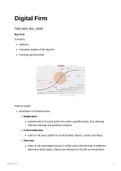
Big Tech
Concerns:
addictive
monopoly position of the big tech
misusing personal data
Platformization:
penetration of infrastructures
Datafication
transformation of social action into online quantified data, thus allowing
real-time tracking and predictive analysis
Commodification
refers to the ways platforms commercialize objects, actions and ideas
Selection
refers to the automated process in which users with the help of platforms
determine which topics, objects are relevant in info and communication
Digital Firm 1
, From the traditional firm towards the digital firm
How is technological change affecting the nature of the
corporation, Birkinshaw(2018)
Questions
“nature of the firm” fundamentally changing
scale and scope, how firms are managed
instead of vertically integrated corporations, specialised firms that link
buyers with sellers - digital platforms
institutions need to adapt to this fundamental change of nature of firms
intellectual property rules
measurement and audit of firm activities
competition policy/law
labour laws
There is a digital shift
Not all digital technologies are adopted cuz,
technological advancement
low prices
usefulness
easy of use
Technology’s impact on the nature of firms
digital technologies lower transaction costs and turns firms into
markets/platforms
user generated content/ app development
outside-in innovation - inverted firm
AI-based data analytics - improve prediction, personalisation, matching etc.
Digital Firm 2
, Lowering transaction costs
Coase’s transaction costs theory:
organization come into existence in order to minimize the transaction costs and
informational deficiencies that resulted from coordinating economic activity
through decentralized markets. A company would internalize activities when it
can be organize more efficient than the market and externalize those it could not
Intensive use of information technology being used and within and between firms
is that transaction costs are falling
From Hierarchies to markets/platforms
vertical scope
horizontal scope\
The inverted firm
is achieved by shifting the production from inside the company to its ecosystem
partners and users.
Network effects cannot occur internally and within standalone companies, but it
becomes easier if companies look within their business frame in the ecosystem.
The role of developers/users has become so central indigital platform that firms
have developed strategies for “platform evangelism” to manage user- and third
party contributions that have become central to platform success
Two-faced platforms
Platforms combine characteristics of traditional organization (hierarchy, planning,
coordinating etc.) and markets (regulating match supply and demand). Platforms do
not invest in production but rather in building the infrastructure and tools to support
and grow networked markets places or communities.
The rise of the platform business model and the transformation
of twenty-first-century capitalism, Rahman and Thelen(2019)
Questions
Digital Firm 3
Paper notes, plan - Spotify
Big Tech
Concerns:
addictive
monopoly position of the big tech
misusing personal data
Platformization:
penetration of infrastructures
Datafication
transformation of social action into online quantified data, thus allowing
real-time tracking and predictive analysis
Commodification
refers to the ways platforms commercialize objects, actions and ideas
Selection
refers to the automated process in which users with the help of platforms
determine which topics, objects are relevant in info and communication
Digital Firm 1
, From the traditional firm towards the digital firm
How is technological change affecting the nature of the
corporation, Birkinshaw(2018)
Questions
“nature of the firm” fundamentally changing
scale and scope, how firms are managed
instead of vertically integrated corporations, specialised firms that link
buyers with sellers - digital platforms
institutions need to adapt to this fundamental change of nature of firms
intellectual property rules
measurement and audit of firm activities
competition policy/law
labour laws
There is a digital shift
Not all digital technologies are adopted cuz,
technological advancement
low prices
usefulness
easy of use
Technology’s impact on the nature of firms
digital technologies lower transaction costs and turns firms into
markets/platforms
user generated content/ app development
outside-in innovation - inverted firm
AI-based data analytics - improve prediction, personalisation, matching etc.
Digital Firm 2
, Lowering transaction costs
Coase’s transaction costs theory:
organization come into existence in order to minimize the transaction costs and
informational deficiencies that resulted from coordinating economic activity
through decentralized markets. A company would internalize activities when it
can be organize more efficient than the market and externalize those it could not
Intensive use of information technology being used and within and between firms
is that transaction costs are falling
From Hierarchies to markets/platforms
vertical scope
horizontal scope\
The inverted firm
is achieved by shifting the production from inside the company to its ecosystem
partners and users.
Network effects cannot occur internally and within standalone companies, but it
becomes easier if companies look within their business frame in the ecosystem.
The role of developers/users has become so central indigital platform that firms
have developed strategies for “platform evangelism” to manage user- and third
party contributions that have become central to platform success
Two-faced platforms
Platforms combine characteristics of traditional organization (hierarchy, planning,
coordinating etc.) and markets (regulating match supply and demand). Platforms do
not invest in production but rather in building the infrastructure and tools to support
and grow networked markets places or communities.
The rise of the platform business model and the transformation
of twenty-first-century capitalism, Rahman and Thelen(2019)
Questions
Digital Firm 3