The Keynesian Cross
Chapter 14
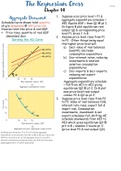
1. Suppose ecos price level = P1 &
Aggregate Demand aggregate expenditure schedule =
Schedule/curve shows total quantity AE1. Equilib GDP = then Q1 @ pt 1.
of g/s demanded @ diff price lvls. In figure B plot equilibrium real
Inverse relat btw price & real GDP: output Q1 & corresponding price
▪ Price rises, quantity of real GDP level P1. Gives 1’ in B.
demanded decr. 2. Assume price level rises from P1
Deriving the AD Curve to P2 . Other things being equal
this higher price level will:
a) Decr value of real balances
(wealth), decrease
consumption expenditure
b) Incr interest rates, reducing
investments & interest
sensitive consumption
expenditures
c) Incr imports & decr exports,
reducing net export
expenditures.
Aggregate expenditure schedule
= fall from AE1 to AE2 giving
equilibrium Q2 @ pt 2. In B plot
new price-level-real-output
combo: P2 & Q2 as pt 2’.
3. Suppose price level rises from P2
to P3. Value of real balances falls,
interest rate rises, export fall &
import rise. Consumption
investments, investment & net
export schedules fall, shifting AE
schedule downwards from AE2 to
AE3 which gives equilibrium Q3 @
pt3 in B = enables 2 locate pt 3’
(price level P3 & real output Q3).
, Aggregate Demand Shifts & Aggregate Demand Curve Inverse
Aggregate Expenditures Model Relationship
w/e eco moves down aggregate demand
curve = moves 2 lower general price
level.
But circular flow model shows w/e
consumer pay lower prices 4 g/s = less
nominal income flows 2 resource
suppliers in wages, rent, interest, &
profit.
Result = decline in price level does not
necessarily mean increase in nominal
income of eco.
Explanation 4 downward sloping
aggregate demand curve rests on 3
effects as follows:
Real balances effect: tendency 4
incrs in price level 2 lower real value
(/ purchasing power) of financial
assets w/ fixed money value &, result =
reduce total spending & real output, &
conversely 4 decreases in price level.
Interest rate effect: tendency 4
increases in price level 2 increase
demand 4 money, raise interest rates
&, result = reduce total spending & real
output in eco (reverse 4 price-level
decr).
Foreign purchase effect: inverse
relat btw net exports of eco & price
level relative 2 foreign price levels.
Chapter 14
1. Suppose ecos price level = P1 &
Aggregate Demand aggregate expenditure schedule =
Schedule/curve shows total quantity AE1. Equilib GDP = then Q1 @ pt 1.
of g/s demanded @ diff price lvls. In figure B plot equilibrium real
Inverse relat btw price & real GDP: output Q1 & corresponding price
▪ Price rises, quantity of real GDP level P1. Gives 1’ in B.
demanded decr. 2. Assume price level rises from P1
Deriving the AD Curve to P2 . Other things being equal
this higher price level will:
a) Decr value of real balances
(wealth), decrease
consumption expenditure
b) Incr interest rates, reducing
investments & interest
sensitive consumption
expenditures
c) Incr imports & decr exports,
reducing net export
expenditures.
Aggregate expenditure schedule
= fall from AE1 to AE2 giving
equilibrium Q2 @ pt 2. In B plot
new price-level-real-output
combo: P2 & Q2 as pt 2’.
3. Suppose price level rises from P2
to P3. Value of real balances falls,
interest rate rises, export fall &
import rise. Consumption
investments, investment & net
export schedules fall, shifting AE
schedule downwards from AE2 to
AE3 which gives equilibrium Q3 @
pt3 in B = enables 2 locate pt 3’
(price level P3 & real output Q3).
, Aggregate Demand Shifts & Aggregate Demand Curve Inverse
Aggregate Expenditures Model Relationship
w/e eco moves down aggregate demand
curve = moves 2 lower general price
level.
But circular flow model shows w/e
consumer pay lower prices 4 g/s = less
nominal income flows 2 resource
suppliers in wages, rent, interest, &
profit.
Result = decline in price level does not
necessarily mean increase in nominal
income of eco.
Explanation 4 downward sloping
aggregate demand curve rests on 3
effects as follows:
Real balances effect: tendency 4
incrs in price level 2 lower real value
(/ purchasing power) of financial
assets w/ fixed money value &, result =
reduce total spending & real output, &
conversely 4 decreases in price level.
Interest rate effect: tendency 4
increases in price level 2 increase
demand 4 money, raise interest rates
&, result = reduce total spending & real
output in eco (reverse 4 price-level
decr).
Foreign purchase effect: inverse
relat btw net exports of eco & price
level relative 2 foreign price levels.