ASSESS FUNCTIONALISM
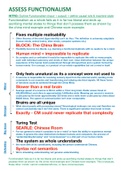
INTRO: Outline Functionalism (input + output) + de ne causal role & machine state
Functionalism as a whole fails as it is far too liberal and ends up
ascribing mental states to things that don’t possess them as shown by
the china mind example and Chinese room example.
Fixes multiple realisability
➢ Other theories of the mind (type-identify) can’t do thus. The de nition is extremely adaptable
(human minds, animal brains, alien minds, computer systems etc.)
BLOCK: The China Brain
➢ Flexibility become too liberal, e.g. deeming a functional duplicate with no qualia to be a mind.
Human mind = impossible to replicate
➢ So complex and co-ordinated it would be impossible to replicate this with so many people,
each with individual autonomy and minds of their own. Clear distinction between the unique
experience of the human brain (understood through introspection) and a system formed by
human minds. It in concept, is a product of our minds capabilities but not a mind in itself.
Only feels unnatural as its a concept were not used to
➢ A neurone is responsible for receiving sensory input from the external world, sending motor
commands to our muscles and transforming and relaying electrical signals. All these forms
of functions could be achieved through the China Mind.
Minor
Slower than a real brain
➢ Average speed of a neurone is 50m/s within a 15cm long brain. Radio waves travel at
300,000,000m/s and china is approximately 3,400miles wide. Meaning per second a neurone
could pass by the brain approximately 333 times and a radio wave could pass by china about
88235 times. The speed of communication isn’t even comparable.
Brains are all unique
➢ What about people with processing issues? Neurological makeups can vary and therefore we
Stronger
cannot conclusively say it isn’t the same. There is signi cant variation from brain to brain.
Exactly - CM could never replicate that complexity
Turing Test
Big issue
SEARLE: Chinese Room
➢ Far too general in what it considers to be a ‘mind’ or have the ability to experience mental
states. It ignores the clear distinctions between humans and computers; the process of
“understanding/knowing” and “consciousness” is a vital part of our human minds.
The system as whole understands
Defeating
➢ the room with all its constituents, including the person understands Chinese.
Syntax not semantics
➢ We’re simulating understanding not genuine understanding
Functionalism fails as it is far too liberal and ends up ascribing mental states to things that don’t
possess them as shown by the china mind example and Chinese room example. This is because,
these other ‘minds’ cannot understand/know, or have consciousness.
fi fifi
INTRO: Outline Functionalism (input + output) + de ne causal role & machine state
Functionalism as a whole fails as it is far too liberal and ends up
ascribing mental states to things that don’t possess them as shown by
the china mind example and Chinese room example.
Fixes multiple realisability
➢ Other theories of the mind (type-identify) can’t do thus. The de nition is extremely adaptable
(human minds, animal brains, alien minds, computer systems etc.)
BLOCK: The China Brain
➢ Flexibility become too liberal, e.g. deeming a functional duplicate with no qualia to be a mind.
Human mind = impossible to replicate
➢ So complex and co-ordinated it would be impossible to replicate this with so many people,
each with individual autonomy and minds of their own. Clear distinction between the unique
experience of the human brain (understood through introspection) and a system formed by
human minds. It in concept, is a product of our minds capabilities but not a mind in itself.
Only feels unnatural as its a concept were not used to
➢ A neurone is responsible for receiving sensory input from the external world, sending motor
commands to our muscles and transforming and relaying electrical signals. All these forms
of functions could be achieved through the China Mind.
Minor
Slower than a real brain
➢ Average speed of a neurone is 50m/s within a 15cm long brain. Radio waves travel at
300,000,000m/s and china is approximately 3,400miles wide. Meaning per second a neurone
could pass by the brain approximately 333 times and a radio wave could pass by china about
88235 times. The speed of communication isn’t even comparable.
Brains are all unique
➢ What about people with processing issues? Neurological makeups can vary and therefore we
Stronger
cannot conclusively say it isn’t the same. There is signi cant variation from brain to brain.
Exactly - CM could never replicate that complexity
Turing Test
Big issue
SEARLE: Chinese Room
➢ Far too general in what it considers to be a ‘mind’ or have the ability to experience mental
states. It ignores the clear distinctions between humans and computers; the process of
“understanding/knowing” and “consciousness” is a vital part of our human minds.
The system as whole understands
Defeating
➢ the room with all its constituents, including the person understands Chinese.
Syntax not semantics
➢ We’re simulating understanding not genuine understanding
Functionalism fails as it is far too liberal and ends up ascribing mental states to things that don’t
possess them as shown by the china mind example and Chinese room example. This is because,
these other ‘minds’ cannot understand/know, or have consciousness.
fi fifi