STM 2 quizzes and answers graded A+
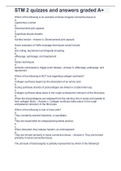
Which of the following is an example of dense irregular connective tissue is: a. Ligamentus nuchae b. Glenohumeral joint capsule c. Superficial fascial sheaths d. Achilles tendon b. Glenohumeral joint capsule Some examples of Hoffa massage techniques would include: a. skin rolling, tapotement and fingertip kneading b. effleurage, petrissage, and tapotement c. friction techniques d. ischemic compression, trigger point release b. effleurage, petrissage, and tapotement Which of the following is NOT true regarding collagen synthesis? a. Collagen synthesis begins by the absorption of an amino acid b. During synthesis strands of protocollagen are linked in a triple helix loop. c. Collagen synthesis takes place in the rough endoplasmic reticulum of the fibrocytes. d. When the tropocollagens are released from the cell they link in series and parallel to form collagen fibrils. c. Collagen synthesis takes place in the rough endoplasmic reticulum of the fibrocytes Which of the following is true of mast cells? a. They constantly secrete histamine, a vasodilator b. They are responsible for phagocytosing waste product. e. c. When disrupted, they release heparin, an anticoagulant d. They are formed primarily in loose connective tissue. d. They are formed primarily in loose connective tissue The principle of biotensegrity is partially represented by which of the following? a. Ligaments holding bones together b. Compressive forces resisted by muscle c. Tensile forces distributed through bone d. Fascia absorbing tensile forces d. Fascia absorbing tensile forces Which of the following is NOT true regarding fibroblasts: a. Synthesize collagen, ground substance, elastin and reticulin b. Respond to stress with proliferation c. Synthesize collagen, ground substance and eosinophils d. Are considered fixed cells within connective tissue C. synthesize collagen, ground substance, and eosinophils The goal of structural integration or Rolfing is to a. use of oscillations to restore mobility and function b. restore balance and harmony of movement c. reduce pain and swelling d. apply superficial techniques to the skin and subcutaneous tissue to restore circulation b. restore balance and harmony of movement Which of the following is true about ground substance? a. It can be replenished by mast cells after tissue is re-mobilized with movement b. It maintains a "critical interfiber distance" between collagen fibers to prevent restrictions/adhesions c. It can start to dry up in 4-6 weeks following immobilization d. It is used to for rejuvination, elimination and production It maintains a "critical interfiber distance" between collagen fibers to prevent restrictions/adhesions Which of the following could be described as a technique that incorporates gentle sequences of movement that would allow for slow deliberate changing of abnormal inefficient movement patterns into normal, efficient movements. a. Myofasical Release b. Connective Tissue Massage c. Feldenkrais Method d. PNF C. Feldenkrais method Which of the following statements is NOT true regarding junctional zones? a. Myotendinous junctional zones are rarely sites of injury b. The tendon-bone junction sustains greater forces due to forces generated by the muscle than ligament-bone. c. There are two types of insertions identified in literature: direct and indirect. d. The junctional zones of ligament, tendon and capsule are relatively avascular compared with tissue on either side of the zone. a. myotendinous junctional zones are rarely sites of injury Which of the following best describe the characteristics of Golgi tendon organs? are extremely sensitive to changes in tension of connective tissue are located in striated muscle are responsible for transducing both rapid and slow change in muscle length have specialized transducers called nuclear chain fibers are extremely sensitive to changes in tension of connective tissue According to your text, which of these best represent the four phases of scaring process following a wound to the tissues? Vascularity phase, inflammatory phase, fibroblastic phase, and maturation phase Inflammatory phase, fibroblastic phase, vascularity phase, and granulation phase Inflammatory phase, granulation phase, fibroblastic phase, and maturation phase Fibroblastic phase, inflammatory phase, maturation phase, and granulation phase Inflammatory phase, granulation phase, fibroblastic phase, and maturation phase Which of the following represent a physiological effect of myofascial manipulation? improved tissue mobility increased blood flow due to capillary dilation release of micro adhesions resetting of aberrant movement patterns Increased blood flow due to capillary dilation According to the study of Flowers and Pheasant: After 4 weeks of remobilization, the number of sarcomeres return to normal. Collagen content begins to decrease after 4-6 days of immobilization Connective tissue immobilized beyond 6 weeks will only recover by 50% Traumatic exudate is required as a catalyst to begin the contracture process Traumatic exudate is required as a catalyst to begin the contracture process According to your textbook, which of the following bests explain the general effects of nontraumatic immobilization of connective tissue? Loss of ground substance, decreased tissue extensibility, and formation of fibrofatty macroadhesion. Loss of net collagen, decreased ground substance, and decreased tissue extensibility Effects are normalized within six weeks, decreased amounts of collagen, and scar formation. Increased fatty infiltrates, increase ground substance, and loss of tissue extensibility. Loss of ground substance, decreased tissue extensibility, and formation of fibrofatty macroadhesion Which of the following is NOT true regarding the cycle of fibrosis for connective tissue? Myofibroblasts cause the tissue to tighten or shrink as they anchor to adjacent collagen fibers and contract. The fibrotic process can continue as long as an irritant is present The fibrotic process is self-limiting like the scaring process With increased vascularity and debridement, fibroblasts are activated to replace lost collagen. the fibrotic process is self-limiting like the scaring process Which of the following best explains the result of soft tissue immobilization of muscle? initial significant loss of collagen content loss of sarcomeres and fiber diameter loss of collagen and elastin increased binding of fascial elements and GAG Loss of sarcomeres and fiber diameter Meissner Corpuscles are: are the most peripheral of all sensory receptors found in the fibrous joint capsule higher in density in glabrous (hairless) skin like the palms of the hands located in hairy skin and the glabrous skin of mammals Higher in density in glabrous (hairless) skin like the palms of the hands The Meissner's corpuscle, Golgi tendon organ, Ruffini's corpuscle and Merkel's receptor are all examples of: Chemoreceptors Mechanoreceptors Nociceptors Thermoreceptors Mechanoreceptors
Written for
- Institution
- STM
- Course
- STM
Document information
- Uploaded on
- October 31, 2022
- Number of pages
- 7
- Written in
- 2022/2023
- Type
- Exam (elaborations)
- Contains
- Questions & answers
Subjects
-
stm 2 quizzes and answers graded a
-
which of the following is an example of dense irregular connective tissue is
-
some examples of hoffa massage techniques would include
-
which of the following is not

Also available in package deal