Practical 3 – Genetic epidemiology
1. Researchers have found that type-2 diabetes has a heritability (h2) of 36%. How was this
figure of 36% obtained (type of study), and how should this figure be interpreted?
Heritability can be obtained by family-based studies:
- Twin studies
o Inflated
o Share more than just genetics
- Larger pedigrees studies
Also estimated using genome-wide SNP association
- Population based
- Deflated
Heritability estimates the proportion of phenotypic variance due to genetics
Narrow sense = h2 = 36%
Interpretation: 36% of the variance type 2 diabetes is attributable to additive genetic factors.
Broad sense = H2
2. Your colleagues in the Department of Cardiology ascertain a family with a high incidence
of ventricular fibrillation (VF), a serious arrhythmia that frequently leads to sudden
cardiac death (SCD). They come to you, the genetic epidemiologist, to try to determine
the genetic cause that likely underlies this disease in the family. You find a mutation in
the SCN5A gene, an excellent potential susceptibility gene as it encodes a cardiac
sodium ion channel, which is rare in the general population.
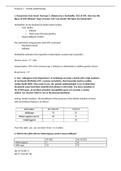
Among family members, the breakdown of the presence of the SCN5A mutation in those
with and without disease is as follows:
From this table, you can construct three 2 x 2 tables:
a. What is the odds ratio for heterozygous carriers versus wildtype?
VF/SCD No VF/SCD
Heterozygous 5 34
Wild type 10 70
OR: (A*D)/(B*C)
OR: (5*70)/(34*10)
, Practical 3 – Genetic epidemiology
OR: 1.03
b. What is the odds ratio for homozygous mutants versus wildtype?
VF/SCD No VF/SCD
Homozygous 30 1
Wildtype 10 70
OR: (A*D)/(B*C)
OR: (30*70)/(1*10)
OR: 210
c. What is the odds ratio for homozygous mutants versus heterozygous carriers?
VF/SCD No VF/SCD
Homozygous 30 1
Heterozygous 5 34
OR: (A*D)/(B*C)
OR: (30*34)/(1*5)
OR: 204
d. Comparing those odds ratios, you can infer the mode of inheritance. What mode of
inheritance would you conclude is behind this pattern?
Homozygous mutants autosomal recessive patterns of heritance
Inbreeding = recessive pattern (consanguinity)
e. Some of the 2 x 2 tables contain cells with very low numbers. What statistical test
would you employ to determine significance with such low counts?
Fisher’s exact test = low cell counts
Chi-square = normally
f. The mode of inheritance implies a special property of the family. What is that
property?
The mode of inheritance determined how certain alleles are inherited:
- Autosomal dominant inheritance
- Autosomal recessive inheritance
- X-linked inheritance
- Complex inheritance
Property = inbreeding
g. What analysis technique was likely used to find the region containing the
SCN5A mutation?
1. Researchers have found that type-2 diabetes has a heritability (h2) of 36%. How was this
figure of 36% obtained (type of study), and how should this figure be interpreted?
Heritability can be obtained by family-based studies:
- Twin studies
o Inflated
o Share more than just genetics
- Larger pedigrees studies
Also estimated using genome-wide SNP association
- Population based
- Deflated
Heritability estimates the proportion of phenotypic variance due to genetics
Narrow sense = h2 = 36%
Interpretation: 36% of the variance type 2 diabetes is attributable to additive genetic factors.
Broad sense = H2
2. Your colleagues in the Department of Cardiology ascertain a family with a high incidence
of ventricular fibrillation (VF), a serious arrhythmia that frequently leads to sudden
cardiac death (SCD). They come to you, the genetic epidemiologist, to try to determine
the genetic cause that likely underlies this disease in the family. You find a mutation in
the SCN5A gene, an excellent potential susceptibility gene as it encodes a cardiac
sodium ion channel, which is rare in the general population.
Among family members, the breakdown of the presence of the SCN5A mutation in those
with and without disease is as follows:
From this table, you can construct three 2 x 2 tables:
a. What is the odds ratio for heterozygous carriers versus wildtype?
VF/SCD No VF/SCD
Heterozygous 5 34
Wild type 10 70
OR: (A*D)/(B*C)
OR: (5*70)/(34*10)
, Practical 3 – Genetic epidemiology
OR: 1.03
b. What is the odds ratio for homozygous mutants versus wildtype?
VF/SCD No VF/SCD
Homozygous 30 1
Wildtype 10 70
OR: (A*D)/(B*C)
OR: (30*70)/(1*10)
OR: 210
c. What is the odds ratio for homozygous mutants versus heterozygous carriers?
VF/SCD No VF/SCD
Homozygous 30 1
Heterozygous 5 34
OR: (A*D)/(B*C)
OR: (30*34)/(1*5)
OR: 204
d. Comparing those odds ratios, you can infer the mode of inheritance. What mode of
inheritance would you conclude is behind this pattern?
Homozygous mutants autosomal recessive patterns of heritance
Inbreeding = recessive pattern (consanguinity)
e. Some of the 2 x 2 tables contain cells with very low numbers. What statistical test
would you employ to determine significance with such low counts?
Fisher’s exact test = low cell counts
Chi-square = normally
f. The mode of inheritance implies a special property of the family. What is that
property?
The mode of inheritance determined how certain alleles are inherited:
- Autosomal dominant inheritance
- Autosomal recessive inheritance
- X-linked inheritance
- Complex inheritance
Property = inbreeding
g. What analysis technique was likely used to find the region containing the
SCN5A mutation?