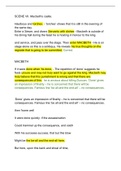
SCENE VII. Macbeth's castle.
Hautboys and torches. - ‘torches’ shows that it is still in the evening of
the same day.
Enter a Sewer, and divers Servants with dishes - Macbeth is outside of
his dining hall during the feast he is hosting in honour to the king.
and service, and pass over the stage. Then enter MACBETH - He is on
stage alone so this is a soliloquy. He reveals his true thoughts on the
regicide that is going to be committed. Correct
MACBETH
If it were done when 'tis done, - The repetition of ‘done’ suggests he
feels unsure and may not truly want to go against the king. Macbeth may
truly believe that this punishment is wrong and that there are
consequences of this. he is anxious about killing Duncan. ‘Done’ gives
an impression of finality – he is concerned that there will be
consequences. Famous line ‘be all and the end-all’ – no consequences.
‘Done’ gives an impression of finality – he is concerned that there will be
consequences. Famous line ‘be all and the end-all’ – no consequences.
then 'twere well
It were done quickly: if the assassination
Could trammel up the consequence, and catch
With his surcease success; that but this blow
Might be the be-all and the end-all here,
But here, upon this bank and shoal of time,
,We'ld jump the life to come. But in these cases
We still have judgment here; - ‘judgement’ has connotations of
punishment – this could mean the afterlife ‘here’ shows the punishment
he would receive if he would be caught committing treason.
that we but teach
Bloody instructions, which, being taught, return
To plague the inventor: - Metaphor of ‘plague’ is a Biblical allusion –
shows a punishment which is from the Plagues of Egypt. Here Macbeth
considers that when you act with violence, the ‘inventor’ (person who
started it) will eventually be punished with violence – he believes that his
actions and regicide that he is going to be committed will not be hid but
would be punished and will lead to the fall of Macbeth and many more
consequences. Metaphor of ‘plague’ is a Biblical allusion – suggests a
punishment from God. Here Macbeth considers that when you act with
violence, the ‘inventor’ (person who started it) will eventually be
punished with violence – he is clearly worried about committing regicide.
this even-handed justice
Commends the ingredients of our poison'd chalice
To our own lips.
He's here in double trust; - ‘double trust’ – two reasons why Duncan
should trust Macbeth. He is his kinsman and subject.
First, as I am his kinsman and his subject,
, Strong both against the deed; - Macbeth cannot name ‘the deed’
Of killing King Duncan, which is the act of regicide, he does not want to
name this because he believes that this act is wrong and as he is
Duncan’s subject he should have loyalty towards Duncan. By naming
this deed it will lead Macbeth to have a sense of knowledge about the
actions he is going to commit, leading him to not do this deed. However,
by covering his eye to this deed and covering the name of this deed he
would not feel guilt towards his actions, therefore, meaning that this guilt
would not drive him away from not committing regicide.
then, as his host,
Who should against his murderer shut the door,
Not bear the knife myself. Besides, this Duncan
Hath borne his faculties so meek, hath been
So clear in his great office, that his virtues
Will plead like angels, - Adjective ‘meek’ suggests Duncan is gentle,
showing the fact that he is honest and a loyal king.
Adjective ‘great’ means Duncan is important, worthy to be king.
Noun ‘virtues’ have connotations of goodness and righteousness, it is
the trait of being morally good.
and the simile
‘like angels’ suggests hope, trust, love, devotion Correct
trumpet-tongued, against
The deep damnation of his taking-off;
And pity, like a naked new-born babe,
Striding the blast, or heaven's cherubim, horsed
Upon the sightless couriers of the air,
Hautboys and torches. - ‘torches’ shows that it is still in the evening of
the same day.
Enter a Sewer, and divers Servants with dishes - Macbeth is outside of
his dining hall during the feast he is hosting in honour to the king.
and service, and pass over the stage. Then enter MACBETH - He is on
stage alone so this is a soliloquy. He reveals his true thoughts on the
regicide that is going to be committed. Correct
MACBETH
If it were done when 'tis done, - The repetition of ‘done’ suggests he
feels unsure and may not truly want to go against the king. Macbeth may
truly believe that this punishment is wrong and that there are
consequences of this. he is anxious about killing Duncan. ‘Done’ gives
an impression of finality – he is concerned that there will be
consequences. Famous line ‘be all and the end-all’ – no consequences.
‘Done’ gives an impression of finality – he is concerned that there will be
consequences. Famous line ‘be all and the end-all’ – no consequences.
then 'twere well
It were done quickly: if the assassination
Could trammel up the consequence, and catch
With his surcease success; that but this blow
Might be the be-all and the end-all here,
But here, upon this bank and shoal of time,
,We'ld jump the life to come. But in these cases
We still have judgment here; - ‘judgement’ has connotations of
punishment – this could mean the afterlife ‘here’ shows the punishment
he would receive if he would be caught committing treason.
that we but teach
Bloody instructions, which, being taught, return
To plague the inventor: - Metaphor of ‘plague’ is a Biblical allusion –
shows a punishment which is from the Plagues of Egypt. Here Macbeth
considers that when you act with violence, the ‘inventor’ (person who
started it) will eventually be punished with violence – he believes that his
actions and regicide that he is going to be committed will not be hid but
would be punished and will lead to the fall of Macbeth and many more
consequences. Metaphor of ‘plague’ is a Biblical allusion – suggests a
punishment from God. Here Macbeth considers that when you act with
violence, the ‘inventor’ (person who started it) will eventually be
punished with violence – he is clearly worried about committing regicide.
this even-handed justice
Commends the ingredients of our poison'd chalice
To our own lips.
He's here in double trust; - ‘double trust’ – two reasons why Duncan
should trust Macbeth. He is his kinsman and subject.
First, as I am his kinsman and his subject,
, Strong both against the deed; - Macbeth cannot name ‘the deed’
Of killing King Duncan, which is the act of regicide, he does not want to
name this because he believes that this act is wrong and as he is
Duncan’s subject he should have loyalty towards Duncan. By naming
this deed it will lead Macbeth to have a sense of knowledge about the
actions he is going to commit, leading him to not do this deed. However,
by covering his eye to this deed and covering the name of this deed he
would not feel guilt towards his actions, therefore, meaning that this guilt
would not drive him away from not committing regicide.
then, as his host,
Who should against his murderer shut the door,
Not bear the knife myself. Besides, this Duncan
Hath borne his faculties so meek, hath been
So clear in his great office, that his virtues
Will plead like angels, - Adjective ‘meek’ suggests Duncan is gentle,
showing the fact that he is honest and a loyal king.
Adjective ‘great’ means Duncan is important, worthy to be king.
Noun ‘virtues’ have connotations of goodness and righteousness, it is
the trait of being morally good.
and the simile
‘like angels’ suggests hope, trust, love, devotion Correct
trumpet-tongued, against
The deep damnation of his taking-off;
And pity, like a naked new-born babe,
Striding the blast, or heaven's cherubim, horsed
Upon the sightless couriers of the air,