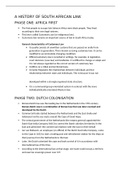
A HISTORY OF SOUTH AFRICAN LAW
PHASE ONE: AFRICA FIRST
The first people to occupy Sub Saharan Africa were black people. They lived
according to their own legal systems.
This law is called Customary Law (or indigenous law).
Customary law remains an important source of law in South Africa today.
General characteristics of Customary Law
It usually consists of unwritten customs that are passed on orally from
generation to generation. This is known as Living customary law. It can be
modified to accommodate changing conditions
Official customary law is recorded in writings, for example, in legislation,
court decisions (case law) and textbooks. It is difficult to change or adapt and
it is not always regarded as the correct version of customary law.
It differs on a tribal and territorial basis.
It mainly Regulates the relationships between individuals and Not
relationships between state and individuals. This is because it was not
developed within a strongly organised state structure.
It is a communal/group-orientated system in contrast with the more
individualistically orientated Western law.
PHASE TWO: DUTCH COLONISATION
Roman-Dutch law was the leading law in the Netherlands in the 17th century.
Roman-Dutch Law is a combination of Roman law that was later received and
developed by the Dutch.
Commercial trade started between the Netherlands and the East (India and
Indonesia) via the sea route around the Cape of Good Hope.
The central government of the Netherlands (the estates general) appointed the
Dutch East India Company (VOC) to control the Dutch colonies (territories) in the
East and administer the commercial relations with the east on their behalf.
Jan van Riebeeck, an employee (an official) of the Dutch East India Company, came
to the Cape in 1652 to start a trading post and refreshment station for the ships on
their journey from the Netherlands to the East.
Later, the Dutch colonized the cape and took control of it in accordance with
international law of the time.
According to the international law at that stage, one state could occupy a territory
and exercise sovereign power over it if:
, 1. the territory was res nullius (this means it had no previous owner; and
2. if the state had the intention of colonising it.
The Dutch colonists lived according to Roman-Dutch law because that was their legal
system with which they were acquainted.
Roman-Dutch Law was slowly introduced into the Cape.
Affairs of the Cape was regulated by the Artyckelbrief
The Artyckelbrief = the rules and regulations governing the service of those
employees of the Company who were on official duty
The official sources of law in the cape under Dutch rule were:
The Roman-Dutch law of Holland
Batavian Placaaten (legislation from the Dutch colony of Batavia that is today
known as Jakarta). Placaaten Governed the early cape settlement. Placaaten
were posters stuck to the walls of public places.
The statutes of India
Over the next 150 years the settlement Expanded, and Roman-Dutch Law was further
developed and applied by the settlers’ established courts as the legal system. The courts of
the settlers were known as Landdrosten and Heemraden.
Roman-Dutch law was imposed on African People. The Dutch Authorities ignored the
Existing customary law of these African people.
If the African People voluntarily received European law this process would have been
called a reception.
If the first people of Africa had no laws, the introduction of European law would
have been called a transplantation.
Roman law (COMPONENT OF ROMAN-DUTCH LAW)
ROMAN MONARCHY: PERIOD OF KINGS
753 BCE TO 510 BCE
Romans founded the city of Rome in Italy in 753 BCE
Formalistic law. Religious rules formed part of the law.
7 kings reigned over the romans, who were primitive farmers living according
to unwritten customs which were passed down from generation to generation.
Had special legal formulae for required remedies.
PHASE ONE: AFRICA FIRST
The first people to occupy Sub Saharan Africa were black people. They lived
according to their own legal systems.
This law is called Customary Law (or indigenous law).
Customary law remains an important source of law in South Africa today.
General characteristics of Customary Law
It usually consists of unwritten customs that are passed on orally from
generation to generation. This is known as Living customary law. It can be
modified to accommodate changing conditions
Official customary law is recorded in writings, for example, in legislation,
court decisions (case law) and textbooks. It is difficult to change or adapt and
it is not always regarded as the correct version of customary law.
It differs on a tribal and territorial basis.
It mainly Regulates the relationships between individuals and Not
relationships between state and individuals. This is because it was not
developed within a strongly organised state structure.
It is a communal/group-orientated system in contrast with the more
individualistically orientated Western law.
PHASE TWO: DUTCH COLONISATION
Roman-Dutch law was the leading law in the Netherlands in the 17th century.
Roman-Dutch Law is a combination of Roman law that was later received and
developed by the Dutch.
Commercial trade started between the Netherlands and the East (India and
Indonesia) via the sea route around the Cape of Good Hope.
The central government of the Netherlands (the estates general) appointed the
Dutch East India Company (VOC) to control the Dutch colonies (territories) in the
East and administer the commercial relations with the east on their behalf.
Jan van Riebeeck, an employee (an official) of the Dutch East India Company, came
to the Cape in 1652 to start a trading post and refreshment station for the ships on
their journey from the Netherlands to the East.
Later, the Dutch colonized the cape and took control of it in accordance with
international law of the time.
According to the international law at that stage, one state could occupy a territory
and exercise sovereign power over it if:
, 1. the territory was res nullius (this means it had no previous owner; and
2. if the state had the intention of colonising it.
The Dutch colonists lived according to Roman-Dutch law because that was their legal
system with which they were acquainted.
Roman-Dutch Law was slowly introduced into the Cape.
Affairs of the Cape was regulated by the Artyckelbrief
The Artyckelbrief = the rules and regulations governing the service of those
employees of the Company who were on official duty
The official sources of law in the cape under Dutch rule were:
The Roman-Dutch law of Holland
Batavian Placaaten (legislation from the Dutch colony of Batavia that is today
known as Jakarta). Placaaten Governed the early cape settlement. Placaaten
were posters stuck to the walls of public places.
The statutes of India
Over the next 150 years the settlement Expanded, and Roman-Dutch Law was further
developed and applied by the settlers’ established courts as the legal system. The courts of
the settlers were known as Landdrosten and Heemraden.
Roman-Dutch law was imposed on African People. The Dutch Authorities ignored the
Existing customary law of these African people.
If the African People voluntarily received European law this process would have been
called a reception.
If the first people of Africa had no laws, the introduction of European law would
have been called a transplantation.
Roman law (COMPONENT OF ROMAN-DUTCH LAW)
ROMAN MONARCHY: PERIOD OF KINGS
753 BCE TO 510 BCE
Romans founded the city of Rome in Italy in 753 BCE
Formalistic law. Religious rules formed part of the law.
7 kings reigned over the romans, who were primitive farmers living according
to unwritten customs which were passed down from generation to generation.
Had special legal formulae for required remedies.