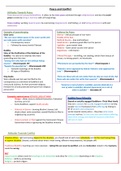
Peace and Conflict
Attitudes Towards Peace
Peace is a central concept in Buddhism. It refers to the inner peace achieved through enlightenment and also the social
peace created by living in harmony with all living beings.
Peace-making: working towards peace by overcoming disagreements and finding just and lasting settlements with past
adversaries
Examples of peacekeeping Evidence for Peace
Dalai Lama Ahimsa – ethical principle of non-harm
“We can never obtain peace in the outer world until Parable of the Saw -
we make peace with ourselves” Metta & Kaurna – love and kindness
o Contemporary source Good Karma – produces good effect on the person
o Followed by many (mainly Tibetan) Upekkha – pure mental state
Nibbana - Outer peace causes inner peace
Buddha Angulimala – reformation
Story of the Pacification of the Relatives of the
Buddha – he said to his relatives who were 5 Moral Precepts – not killing, not stealing, refrain from misuse of
quarrelling over the river: senses, no wrong speech, no intoxicants
“among men who hate we live without hating
anyone” – Dhammapada 197 “Phenomena are proceeded by the heart”– Dhammapada 1
“happily the peaceful live” – Dhammapada 208
o Verbatim teachings of the Buddha “Hatred is never appeased by hatred. Hatred is only appeased by
o All types of Buddhists Love” – Dhammapada 5
King Asoka “there are those who do not realise that one day we must all die. But
Won a bloody war but was horrified by the those who do realize this settle their quarrels” – Dhammapada 6
consequences so converted to Buddhism and
renounced violence, he then promoted religious "Greed as a root of what is unskilful, aversion (hatred) as a
freedom for all and protected everyone from religious root of what is unskilful, delusion (ignorance) as a root of
persecution what is unskilful." – Itivuttaka 50
Examples against peace (OTHERS LOOK AT WAR)
- Vinaya - allows mons to defend themselves if attacked Buddhist Peace Fellowship
but they can’t kill (based on socially engaged Buddhism –Thich Nhat Hanh)
- Some Buddhists support death penalty they are a catalyst for socially engaged Buddhism to help
people liberate themselves from suffering, by linking to
- Violence in Burma – burning Muslim’s homes, left BT of wisdom and compassion
dozens dead, some assaulted, caused Muslims to flee to works towards social justice – they take extra moral
neighbouring countries precepts such as: Do not close your eyes before suffering;
share time, energy and material resources with those
- Violent protests in Tibet against the Communist Chinese who are in need.
Government who is oppressing the Buddhist minority
Attitudes Towards Conflict
Situation Ethics: right and wrong depend in the situation, you should look at each case individually and do the most loving thing
in a given situation. (biased, confused about what is most loving, different interpretations, lets people off)
Traditional Buddhist teachings are more absolute – taking life can never be justified, and any motivation rooted in the 3 poisons
would be wrong.
BUT
Upaya kausala allows room for teachings to be interpreted and allow for skilful action depending on the situation.
Defence – skilful as protecting
Religion – protect religion
Attitudes Towards Peace
Peace is a central concept in Buddhism. It refers to the inner peace achieved through enlightenment and also the social
peace created by living in harmony with all living beings.
Peace-making: working towards peace by overcoming disagreements and finding just and lasting settlements with past
adversaries
Examples of peacekeeping Evidence for Peace
Dalai Lama Ahimsa – ethical principle of non-harm
“We can never obtain peace in the outer world until Parable of the Saw -
we make peace with ourselves” Metta & Kaurna – love and kindness
o Contemporary source Good Karma – produces good effect on the person
o Followed by many (mainly Tibetan) Upekkha – pure mental state
Nibbana - Outer peace causes inner peace
Buddha Angulimala – reformation
Story of the Pacification of the Relatives of the
Buddha – he said to his relatives who were 5 Moral Precepts – not killing, not stealing, refrain from misuse of
quarrelling over the river: senses, no wrong speech, no intoxicants
“among men who hate we live without hating
anyone” – Dhammapada 197 “Phenomena are proceeded by the heart”– Dhammapada 1
“happily the peaceful live” – Dhammapada 208
o Verbatim teachings of the Buddha “Hatred is never appeased by hatred. Hatred is only appeased by
o All types of Buddhists Love” – Dhammapada 5
King Asoka “there are those who do not realise that one day we must all die. But
Won a bloody war but was horrified by the those who do realize this settle their quarrels” – Dhammapada 6
consequences so converted to Buddhism and
renounced violence, he then promoted religious "Greed as a root of what is unskilful, aversion (hatred) as a
freedom for all and protected everyone from religious root of what is unskilful, delusion (ignorance) as a root of
persecution what is unskilful." – Itivuttaka 50
Examples against peace (OTHERS LOOK AT WAR)
- Vinaya - allows mons to defend themselves if attacked Buddhist Peace Fellowship
but they can’t kill (based on socially engaged Buddhism –Thich Nhat Hanh)
- Some Buddhists support death penalty they are a catalyst for socially engaged Buddhism to help
people liberate themselves from suffering, by linking to
- Violence in Burma – burning Muslim’s homes, left BT of wisdom and compassion
dozens dead, some assaulted, caused Muslims to flee to works towards social justice – they take extra moral
neighbouring countries precepts such as: Do not close your eyes before suffering;
share time, energy and material resources with those
- Violent protests in Tibet against the Communist Chinese who are in need.
Government who is oppressing the Buddhist minority
Attitudes Towards Conflict
Situation Ethics: right and wrong depend in the situation, you should look at each case individually and do the most loving thing
in a given situation. (biased, confused about what is most loving, different interpretations, lets people off)
Traditional Buddhist teachings are more absolute – taking life can never be justified, and any motivation rooted in the 3 poisons
would be wrong.
BUT
Upaya kausala allows room for teachings to be interpreted and allow for skilful action depending on the situation.
Defence – skilful as protecting
Religion – protect religion