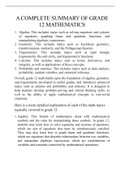
A COMPLETE SUMMARY OF GRADE
12 MATHEMATICS
1. Algebra: This includes topics such as solving equations and systems
of equations, graphing linear and quadratic functions, and
manipulating algebraic expressions.
2. Geometry: This includes topics such as Euclidean geometry,
transformations, similarity, and the Pythagorean theorem.
3. Trigonometry: This includes topics such as right triangle
trigonometry, the unit circle, and trigonometric functions.
4. Calculus: This includes topics such as limits, derivatives, and
integrals, as well as applications of these concepts.
5. Probability and statistics: This includes topics such as data analysis,
probability, random variables, and statistical inference.
Overall, grade 12 math builds upon the foundation of algebra, geometry,
and trigonometry developed in earlier grades, and introduces advanced
topics such as calculus and probability and statistics. It is designed to
help students develop problem-solving and critical thinking skills, as
well as the ability to apply mathematical concepts in real-world
situations.
Here is a more detailed explanation of each of the math topics
typically covered in grade 12:
1. Algebra: This branch of mathematics deals with mathematical
symbols and the rules for manipulating these symbols. In grade 12,
students may learn how to solve equations and systems of equations,
which are sets of equations that must be simultaneously satisfied.
They may also learn how to graph linear and quadratic functions,
which are equations that describe relationships between two variables,
and manipulate algebraic expressions, which are combinations of
variables and constants connected by mathematical operations.
12 MATHEMATICS
1. Algebra: This includes topics such as solving equations and systems
of equations, graphing linear and quadratic functions, and
manipulating algebraic expressions.
2. Geometry: This includes topics such as Euclidean geometry,
transformations, similarity, and the Pythagorean theorem.
3. Trigonometry: This includes topics such as right triangle
trigonometry, the unit circle, and trigonometric functions.
4. Calculus: This includes topics such as limits, derivatives, and
integrals, as well as applications of these concepts.
5. Probability and statistics: This includes topics such as data analysis,
probability, random variables, and statistical inference.
Overall, grade 12 math builds upon the foundation of algebra, geometry,
and trigonometry developed in earlier grades, and introduces advanced
topics such as calculus and probability and statistics. It is designed to
help students develop problem-solving and critical thinking skills, as
well as the ability to apply mathematical concepts in real-world
situations.
Here is a more detailed explanation of each of the math topics
typically covered in grade 12:
1. Algebra: This branch of mathematics deals with mathematical
symbols and the rules for manipulating these symbols. In grade 12,
students may learn how to solve equations and systems of equations,
which are sets of equations that must be simultaneously satisfied.
They may also learn how to graph linear and quadratic functions,
which are equations that describe relationships between two variables,
and manipulate algebraic expressions, which are combinations of
variables and constants connected by mathematical operations.