Chapter 11: Optimal Portfolio Choice and the Capital Asset Pricing Model
11.1 The Expected Return of a Portfolio
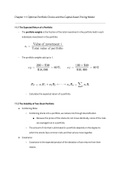
- The portfolio weights is the fraction of the total investment in the portfolio held in each
individuals investment in the portfolio:
- The portfolio weights add up to 1.
- Calculates the expected return of a portfolio.
11.2 The Volatility of Two-Stock Portfolio
● Combining Risks
○ Combining stocks into a portfolio, we reduce risk through diversification
■ Because the prices of the stocks do not move identically, some of the risks
are averaged out in a portfolio.
○ The amount of risk that is eliminated in a portfolio depends on the degree to
which the stocks face common risks and their prices move together.
● Covariance
○ Covariance is the expected product of the deviation of two returns from their
means.
, ○ Intuitively, if two stocks move together, their returns will tend to be above or
below average at the same time and the covariance will be positive.
○ If the stocks move in opposite directions, one will tend to be above average when
the other is below average, and the covariance will be negative.
● Correlation
○ Correlation is the covariance of the returns divided by the standard deviation of
each return.
○ Correlation is a barometer of the degree to which the returns share common risks
and tend to move together.
■ The closer the correlation is to +1, the more the returns tend to move
together as a result of common risk.
■ When it equals 0 they have no tendency to move together or in opposition.
■ Stock returns will tend to move together if they are affected similarly by
economic events
11.1 The Expected Return of a Portfolio
- The portfolio weights is the fraction of the total investment in the portfolio held in each
individuals investment in the portfolio:
- The portfolio weights add up to 1.
- Calculates the expected return of a portfolio.
11.2 The Volatility of Two-Stock Portfolio
● Combining Risks
○ Combining stocks into a portfolio, we reduce risk through diversification
■ Because the prices of the stocks do not move identically, some of the risks
are averaged out in a portfolio.
○ The amount of risk that is eliminated in a portfolio depends on the degree to
which the stocks face common risks and their prices move together.
● Covariance
○ Covariance is the expected product of the deviation of two returns from their
means.
, ○ Intuitively, if two stocks move together, their returns will tend to be above or
below average at the same time and the covariance will be positive.
○ If the stocks move in opposite directions, one will tend to be above average when
the other is below average, and the covariance will be negative.
● Correlation
○ Correlation is the covariance of the returns divided by the standard deviation of
each return.
○ Correlation is a barometer of the degree to which the returns share common risks
and tend to move together.
■ The closer the correlation is to +1, the more the returns tend to move
together as a result of common risk.
■ When it equals 0 they have no tendency to move together or in opposition.
■ Stock returns will tend to move together if they are affected similarly by
economic events