APEA 3 P Exam Prep- Psychiatric question and correct 100%
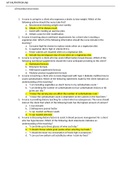
APEA 3 P Exam Prep- Psychiatric question and correct 100%The clinical difference between minor depression and major depression is: the length of time symptoms have lasted. the number of symptoms present. the severity of the symptoms. presence of suicidal ideations. B. Major depression is diagnosed when at least five out of nine symptoms characterizing depression are identified by the examiner. Minor depression is characterized by the presence of two to four of the nine symptoms. Symptoms must be present for at least 2 weeks and must be present most of the day nearly every day. One symptom that must be present is depressed mood. The nine criteria are identified by the DSM V manual. A patient reports that she takes kava kava regularly for anxiety with good results. What should the NP evaluate? Liver function studies Risk of bleeding Thyroid function Colon polyps A. Kava kava is an herb from the South Pacific that is used to treat anxiety, fibromyalgia, hyperactivity, and attention deficit disorder. Hepatotoxicity has been reported with kava kava use, especially when consumed as tea. Liver toxicity should be reviewed in this patient. If she is not willing to use another agent for treatment of her anxiety, liver function studies should be monitored periodically. A 29-year-old postpartum female reports that she is having difficulty with concentration, sleep, and has feelings of guilt. She states that she feels sad most of the time. These symptoms have been present since the birth of her baby about 1 month ago. She can be diagnosed with: dysthymia. minor depressive disorder. postpartum depression. hypothyroidism. C. This patient is correctly diagnosed with postpartum depression. Postpartum depression is diagnosed when depression begins within the first month after delivery. There are 9 symptoms that characterize depression (in nonpregnant patients) and these are used in postpartum patients as well. When a patient exhibits fewer than 5 symptoms, but at least 2 of these symptoms every day for most of the day for at least 2 weeks, s/he may be diagnosed with minor depressive disorder. Depressed mood must be one of these symptoms. If s/he exhibits 5 or more, s/he may be diagnosed with major depressive disorder. In dysthymia, similar symptoms are evaluated, and they must be present at least 2 years. Hypothyroidism can account for feelings of low energy, but hypothyroidism does not produce feelings of guilt or other symptoms associated with depression. Serotonin syndrome may result from taking an SSRI and: dextromethorphan. loratadine. pravastatin. niacin. A. Serotonin syndrome is a potentially life-threatening condition. The syndrome occurs when there is too much serotonergic activity in the central nervous system. It can occur with an interaction between two medications, like an SSRI and dextromethorphan, an SSRI and a triptan, an intentional overdose, or with high doses of an SSRI in a particularly sensitive patient. Symptoms of serotonin syndrome include hyperreflexia, clonus, rigidity in the lower extremities, tachycardia, hyperthermia, hypertension, vomiting, disorientation, agitated delirium, or tremor. None of the other medications listed can precipitate serotonin syndrome. The most common mental disorder in older adults is: alcohol abuse. depression. anxiety. bipolar disorder C. Anxiety is very common in older adults. Depression is very common too and may accompany anxiety in older adults. The prevalence of anxiety may be due in part to other physical illnesses or serious diseases or disorders, like cancer, and Parkinson’s disease. New-onset anxiety should prompt the examiner to consider withdrawal of medication or side effects of medication being taken at therapeutic levels. A common side effect of trazodone may be alleviated by: taking this medication with food. taking this medication at bedtime. drinking a big glass of water with each dose. eating increased fiber while taking this medication. B. Trazodone is a tricyclic antidepressant that can produce profound drowsiness. It is often taken at bedtime to induce sleep. This medication should always be taken at bedtime. Trazodone is often given to treat insomnia related to depression or to alleviate the jitteriness and restlessness sometimes associated with SSRI and SNRI use. A patient has suspected serotonin syndrome. How can this be diagnosed? CT scan of the brain Elevated white count and C-reactive protein Elevated CK Clinical exam and index of suspicion D. Serotonin syndrome is a clinical diagnosis characterized by too much serotonergic activity in the central nervous system. There is no way to measure serotonin levels at this time. Therefore, no clinical laboratory or imaging study can identify this syndrome. However, these studies may rule out other conditions. A newly diagnosed pregnant teenager has suspected depression. Before a diagnosis is made, she should have a CBC, TSH, renal and liver function tests and: sedimentation rate. quantitative beta hCG level. hemoglobin A1C. urine toxicology screen. D. There is a high correlation between psychiatric disorders and drug/alcohol use. This should be ascertained as soon as possible since these can have serious implications on the fetus/mother’s health. None of the other tests listed have an impact on diagnosis of depression in a pregnant patient. CBC, TSH, and renal/hepatic function tests are used to screen depression “look a likes” (anemia, hypothyroidism, renal or hepatic dysfunction). Hemoglobin A1C is a good idea but it is not as urgent as the urine toxicology screen unless diabetes risk factors are present. A 38-year-old patient diagnosed with bipolar disease has taken lithium for many months. His mood has stabilized. He was told to report frequent urination while taking lithium. What might be the underlying cause of his frequent urination? Blood sugar elevations Diabetes insipidus Urinary tract infection Elevated lithium level B. The most common side effect of lithium therapy is nephrogenic diabetes insipidus (NDI). Polyuria and polydipsia secondary to NDI occur in about 20% of patients who take lithium. Lithium accumulates in the collecting tubule cells and causes damage. This leads to changes in antidiuretic hormone (ADH) production, sodium levels, and hypercalcemia. Other changes can occur in the renal system such as mild renal insufficiency. Patients on lithium therapy should be monitored closely for side effects and to ensure that lithium levels are maintained within therapeutic range because lithium has a narrow therapeutic index. A common strategy used to minimize the incidence of side effects when giving an older adult a selective serotonin reuptake inhibitor (SSRI) is: take the medications at bedtime. stand slowly to minimize dizziness. prescribe a low dose initially. take the medication with food. C. A principle that is employed when prescribing medications for older adults is to “start low and go slow”. This should be employed when prescribing SSRIs too. The lowest dose should be a starting point; or a prescriber may order an even lower dose initially. The dose may be slowly increased until therapeutic effects are observed. A good first choice of antidepressants in an older adult is: a tricyclic antidepressant (TCA). an SSRI. an MAO inhibitor. any agent is a good first choice. B. An SSRI is a good choice of antidepressant for an older adult because of the decreased side effects seen when compared with the other agents listed, but especially a TCA. These can produce conduction defects in older adults, sedation, and potent anticholinergic side effects. The preferred medication class to treat patients with an initial episode of minor depressive disorder is: tricyclic antidepressants. monoamine oxidase inhibitors. selective serotonin reuptake inhibitors. any class, there is no preferred class. C. The major classes of antidepressants used to treat depression are listed in this question. Multiple studies have concluded that there is no clear choice of one class over another for efficacy in patients who have minor depressive disorder. However, SSRIs are usually the first choice because they are associated with fewer side effects and there is less danger of suicide with an overdose. Monoamine oxidase inhibitors are involved with a number of drug-drug and drug-food interactions, so these are seldom an initial choice. Which older adult is at highest risk of suicide? 86-year-old male with chronic pain and depression 75-year-old female with history of depression 65-year-old female with a terminal illness 81-year-old male with active alcohol abuse A. Older adults are more successful than younger patients when they attempt suicide. Those at highest risk are white males 85 years or older with depression. Symptoms in older adults that should be of particular concern to healthcare providers are hopelessness, insomnia, unremitting pain, alcohol abuse, restlessness, and impaired concentration. A patient is taking a generic version of a selective serotonin reuptake inhibitor (SSRI). She reports intermittent nausea and mild headache daily since she started this medication 5 days ago. How should the nurse practitioner respond? Brand name medication may help the side effects resolve. These are typical complaints of patients who take SSRIs. This sounds like a viral syndrome. Continue the SSRI. These symptoms are common in patients with depression. B. Typical symptoms of SSRIs include mild headache, nausea, insomnia, restlessness, and agitation. The emergence of these symptoms is typically dose-related and will resolve within 2 weeks. The patient should be encouraged to eat small bites when she feels like she is becoming nauseated and may take acetaminophen or a similar product if the headaches are bothersome. Changing drug classes is also a possibility if the symptoms become too distracting or bothersome. A depressed patient is started on an SSRI. When should another antidepressant be tried if there is no response? 3-7 days 2-3 weeks 4-6 weeks 8-12 weeks D. Most learned authorities agree that if there is no response by 8-12 weeks at a maximal therapeutic dose, a different antidepressant should be tried. The 8-12 week period is an appropriate time frame because it will take this long to reach maximal dose for therapeutic response. 4-6 weeks is nearing the appropriate time frame, but this may be too short a period of time to reach and evaluate therapeutic effect. A patient may derive benefit from a tricyclic antidepressant (TCA) if he experiences depression and: chronic pain. constipation. bipolar disease. hyperlipidemia. A. Amitriptyline and nortriptyline are commonly used in patients who exhibit depression and chronic pain syndromes. TCAs are known to produce mild peripheral vasodilator effects and subsequent relief of pain by an unknown mechanism. Within 6 months of treatment, patients who are treated for depression with selective serotonin reuptake inhibitors often exhibit: insomnia. weight gain. increased libido. hyperglycemia. B. Weight gain is common among men and women who take SSRIs and tricyclic antidepressants (TCAs) because they stimulate appetite. Decreased libido may occur several weeks after starting SSRIs, but this can also be a symptom of depression. The tricyclic and heterocyclic compounds are often associated with blood sugar elevations. Elevations almost never occur within 6 months of starting use. Jitteriness and restlessness are commonly associated with SSRI use. These side effects generally subside after a month or less of therapy. What are the recommendations for screening older patients for depression? Screen at each visit. Screen only if symptoms exist. Screen only patients who are at high risk. Screen every patient annually. A. Depression is common in all adults, especially older adults. Screening can be accomplished easily and quickly in a primary care setting. Untreated depression leads to higher rates of mortality when other comorbid conditions exist, especially heart disease. Depression is diagnosed on clinical presentation. What time frame is important for distinguishing between depressed mood and clinical depression? 1 week 2 weeks 3weeks 4 weeks B. Screening tests for depression include questions about depressed mood or other symptoms that have lasted at least two weeks. This is an important time frame. Typical screening questions ask: “in the past 2 weeks, have you felt little interest or pleasure in doing things” or “in the past 2 weeks, have you felt down, depressed, or hopeless”? Which of the following characterizes bulimia nervosa? Binge eating Purging Food restriction Concern over body weight A. Recurrent episodes of binge eating characterize bulimia. Loss of control is always present, especially when eating. This results in eating quantities of food far beyond what would normally be consumed. Binge eating is always followed by a compensatory activity. This may take the feature of purging or nonpurging. Nonpurging involves excessive exercise or post-binge fasting. Binges and the compensatory activity occur a minimum of twice weekly for at least 3 months for diagnosis of bulimia nervosa. Which symptom listed below is typical of depression? Difficulty falling asleep Snoring Early morning wakening Keeping late night hours reading C.
Written for
- Institution
- Apea
- Course
- Apea
Document information
- Uploaded on
- January 25, 2023
- Number of pages
- 15
- Written in
- 2022/2023
- Type
- Exam (elaborations)
- Contains
- Questions & answers
Subjects
-
apea 3 p exam prep psychiatric question and correct 100
-
the clinical difference between minor depression and major depression is the length of time symptoms have lasted the number of symptoms pr

Also available in package deal