Peds Final Exam with 100% correct answers
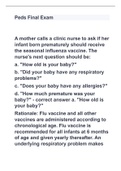
A mother calls a clinic nurse to ask if her infant born prematurely should receive the seasonal influenza vaccine. The nurse's next question should be: a. "How old is your baby?" b. "Did your baby have any respiratory problems?" c. "Does your baby have any allergies?" d. "How much premature was your baby?" a. "How old is your baby?" Rationale: Flu vaccine and all other vaccines are administered according to chronological age. Flu vaccine is recommended for all infants at 6 months of age and given yearly thereafter. An underlying respiratory problem makes flu vaccine important. Awareness of allergies is also necessary, but the first question is chronological age to determine if the infant is old enough to receive the vaccine. The nurse can refer the special needs infant or toddler to an early intervention federal:state program offered at the local level often through: a. The child's home or daycare center. b. food and nutrition programs c. community religious organizations d. the public school system The child's home or a day care center Rationale: Observing the mother:child interaction during feeding and hygiene activities would disclose lack of knowledge of child care, poor feeding techniques, or inappropriate maternal bonding and interaction as inorganic causes or failure to thrive. The child's lack of interest in or inability to feed would indicate organic causes, as would determining that the child consumed adequate calories for age and finding a history of prematurity or congenital anomaly. 00:00 01:24 Which statement by the mother of a special needs toddler requires nursing intervention? Select all that apply. a. "we give her lots of finger foods so she can feed herself" b. "she teethed late, and her teeth are still coming in so we haven't looked for a dentist." c. "we take her to the park when the weather is good" d. "she scoots around on the floor so we keep her in a playpen for safety." b. "she teethed late, and her teeth are still coming in so we haven't looked for a dentist." d. "she scoots around on the floor so we keep her in a playpen for safety." Rationale: Safety is important, but restricting the toddler to a playpen interferes with motor development and learning. Toddlers explore their environment to develop motor skills and learn through trial and error. Being enclosed in one environment (playpen) does not provide for this. Late teething may occur in special needs children. However, dental care is essential to the health of all children, and early evaluation and care is often even more important to the special needs child. Special needs children benefit from problem prevention or correction in all arenas to support development and promote functioning at the highest possible level. Finger foods support self-feeding and the autonomy desired by toddlers. Excursions to the park provide motor and sensory stimulation and fun. A 3-month-old boy was diagnosed with failure to thrive. What action will be most helpful in assisting the nurse to determine if there is an inorganic cause? a. reviewing the medical records for a history of prematurity or a congenital anomaly b. assessing for adequate calorie intake through recording ounces of formula consumed c. observing the mother-child interaction during feeding and hygiene activities d. observing the child's interest in and ability to feed c. observing the mother-child interaction during feeding and hygiene activities Rationale: Observing the mother:child interaction during feeding and hygiene activities would disclose lack of knowledge of child care, poor feeding techniques, or inappropriate maternal bonding and interaction as inorganic causes or failure to thrive. The child's lack of interest in or inability to feed would indicate organic causes, as would determining that the child consumed adequate calories for age and finding a history of prematurity or congenital anomaly. The nurse is preparing a 7-year-old girl recovering from head trauma and receiving gastrostomy feedings for discharge from the hospital. Which activity is most important before the child is discharged home? a. determining the parents' ability to administer the enteral feedings b. preparing a list of home equipment and supplies needed c. assessing the parents' emotional status d. helping the family to access financial resources a. determining the parents' ability to administer the enteral feedings Rationale: The parents' ability to maintain their child's nutrition is essential to the child's well-being. The transition can go forward while still resolving financial resource adequacy and the emotional status of the parents. Equipment and supplies will be ordered as part of discharge planning and are not needed until the parents can safely administer feedings. The parents of a 10-year-old boy with cystic fibrosis restrict him from camping, sleepovers with friends, and school field trips. They time his respiratory treatments and log his diet, choosing most foods for him. They have him seen medically between scheduled appointments and call their physician frequently with concerns. The nurse considers these behaviors indicative of: a. parental depression b. need for respite care c. vulnerable child syndrome d. parental denial of the child's condition c. vulnerable child syndrome Rationale: Descriptors fit vulnerable child syndrome. Parents "see" the child as more fragile and dependent than he actually is. Resultant protective behaviors on the part of the parents interfere with the boy's ability to grow and develop as normally as possible within the restraints of his illness. Media is beginning to promote immunizations for the upcoming influenza season. The mother of a premature infant 7 months chronological age and 5 months corrected age asks about immunizing her child. The nurse responds: a. "no child receives seasonal flu vaccine until age 4 years" b. "your child as a 7-month-old should be immunized." c. "the child's corrected age makes him too young." d. "premature infants should not be immunized against the seasonal flu until 1 year old chronologically." b. "your child as a 7-month-old should be immunized." Rationale: Infants receive influenza vaccine at 6 months of age. Chronological age is used for premature infants. All the other responses are incorrect. Nurses explain that before the parents of a premature infant leave the hospital with their baby, the child must: a. be immunized against pertussis b. have no apnea episodes c. be able to nipple feed d. maintain oxygenation in a car seat d. maintain oxygenation in a car seat Rationale: Maintaining satisfactory oxygenation saturation while sitting in a car seat is necessary prior to hospital discharge for premature infants. Special padding of the seat may be necessary. All immunizations will be given based on chronological age with pertussis first given at 2 months. Premature infants may be discharged from hospital units with feeding tubes and apnea monitors.
Written for
- Institution
- Nursing peds
- Course
- Nursing peds
Document information
- Uploaded on
- February 1, 2023
- Number of pages
- 228
- Written in
- 2022/2023
- Type
- Exam (elaborations)
- Contains
- Questions & answers
Subjects
-
peds final exam with 100 correct answers

Also available in package deal