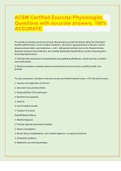
ACSM Certified Exercise Physiologist, Questions with accurate answers, 100% ACCURATE.
Risk factors that may be favorably modified by physical activity habits - -- Improvement in cardiovascular and respiratory function - Reduction in cardiovascular disease risk factors - Decreased morbidity and mortality - Decreased anxiety/depression - Improved cognitive function - Enhanced physical function and independent living in older individuals - Enhanced feeling of well being - Enhanced performance of work, recreational, and sport activities. - Reduced risk of falls and injuries from falls in older individuals - Prevention or mitigation of functional limitations in older adults - Effective therapy for many chronic diseases in older adults Total Cholesterol - -Sum of all forms of cholesterol in the blood. Healthy TC typically below 200 mg/dL. Borderline high 200-239. High >_ 240 mg/dL High Density Lipoprotein Cholesterol (HDL-C) - -"Good" cholesterol. Low <40. High >_60. Low HDL is strongly and inversely associated with CVD risk. Raising HDL cholesterol reduces CVD risk. Low Density Lipoprotein Cholesterol (LDL-C) - -"Bad" cholesterol. Optimal <100, near optimal/above optimal 100-129, borderline high 130-159, high 160-189, very high >_ 190. Elevated LDL cholesterol is a powerful risk factor for CVD. Triglycerides - -Normal <150, borderline high 150-199, high 200-499, very high >_ 500. Elevated triglycerides increase CVD risk. Impaired fasting glucose - -Prediabetes, elevated blood glucose in response to dietary carbohydrates in a fasted state. 100-125 mg/dL fasting at least 8 hours. Impaired glucose tolerance - -2 hour values in oral glucose tolerance test. 140-199 mg/dL during an oral glucose tolerance test. Hypertension - -Resting systolic blood pressure (SBP) >_ 140 mmHg and diastolic blood pressure (DBP) >_ 90 mmHg, taking anti-hypertension medication, or being told by a physician or other health care professional on at least 2 occasions that an individual has high Bp. Increased risk of CVD, stroke, heart failure, peripheral artery disease, and chronic kidney disease. Risk of CVD doubles for each incremental increase in SBP or 20 mmHg of DBP of 10 mmHg. Atherosclerosis - -Process where fatty streaks develop causing the artery wall to thicken while reducing luminal diameter. Progressive and dangerous arterial build up of fat and fibrous plaques. Myocardial Infarction - -Complete obstruction of blood flow to the cardiac myocardial tissue. Heart attack and results in tissue death or narcosis. Dyspnea - -Shortness of breath Tachycardia - -Rapid beating or fluttering of the heart Claudication - -Pain and/or cramping in the lower leg due to inadequate blood flow to the muscles Syncope - -Fainting and dizziness during exercise may indicate poor blood flow to the brain because of inadequate cardiac output from a number of cardiac disorders Ischemia - -Shortage of oxygenated blood flow to the heart myocardium Recommended plasma cholesterol levels for adults based on National Cholesterol Education Program/ATP guidelines - -LDL Cholesterol: Optimal <100 Near optimal/above optimal 100-129 Borderline High 130-159 High 160-189 Very high >_ 190 HDL Cholesterol: Low <40 High >_ 60 Total Cholesterol: Desirable <200 Borderline high 200-239 High >_ 240 Triglycerides: Normal <150 Borderline high 150-199 High 200-499 Very high >_ 500 Recommended blood pressure levels for adults based on National Blood Pressure Education Program Guidelines - -Normal: SBP <120 DBP <80 Prehypertension: SBP 120-139 DBP 80-89 Stage 1 Hypertension: SBP 140-159 DBP 90-99 Stage 2 Hypertension: SBP >_ 160 DBP >_100 The components of a health history questionnaire - -- Past and current medical history - Family history of cardiac disease - Orthopedic limitations - Prescribed medications - Activity patterns - Nutritional habits - Stress and anxiety levels - Smoking and alcohol use The physiological basis of the major components of physical fitness: cardiorespiratory fitness, body composition, flexibility, muscular strength, and muscular endurance. - -Cardiorespiratory Endurance: The ability of the circulatory and respiratory system to supply oxygen during sustained physical activity Body Composition: Relative amounts of muscle, fat, bone, and other vital parts of the body. Muscular strength: The ability of muscle to exert force. Muscular endurance: The ability of muscle to continue to perform without fatigue. Flexibility: The range of motion available at a joint. Selecting the most appropriate testing protocols for each participant based on preliminary screening data. - -Consider specific fitness goals Consider injury history Based on past medical history, preparticipation screening, and physical exam Calibration techniques and proper use of fitness testing equipment - -- Calibrated on a monthly basis - Ensure the accuracy of the collected data, devices and related equipment must be calibrated prior to testing - Review equipment manuals for specifics The purpose and procedures of fitness testing protocols for the components of health related fitness - -Purpose: - Educating participants about their present health/fitness status relative to health related standards and age and sex matched norms - Providing data that are helpful in development of individualized exercise prescriptions to address all health/fitness components - Collecting baseline and follow-up data that allow evaluation of progress by exercise program participants - Motivating participants by establishing reasonable and attainable health/fitness goals Procedures: - Organize forms - Calibrate equipement - Organize equipment - Informed consent form - Room temp between 68-72 degrees fahrenhight and humidity less than 60% with adequate air flow Test Order: - HR, BP, height, weight, and body comp done first. These are resting measurements - Cardiorespiratory fitness: VO2 max, submax, field test, treadmill, cycle ergometers, and step tests Test termination criteria and proper procedures to be followed after discontinuing health fitness tests - -- Onset of angina or angina-like symptoms - Drop in SBP or >_10 mmHg with an increase in work rate or if SBP decreases below the value obtained in the same position prior to testing - Excessive rise in BP: Systolic pressure >250 mmHg and/or diastolic pressure >115 mmHg - Shortness of breath, wheezing, leg cramps, or claudication - Signs of poor perfusion: light-headedness, confusion, ataxia, pallor, cyanosis, nausea, or cold and clammy skin. - Failure of HR to increase with increased exercise intensity - Noticeable change in heart rhythm by palpatation or auscultation. - Subject requests to stop - Physical or verbal manifestations of sever fatigue - Failure of the testing equipment Fitness assessment sequencing - -- Assure all forms, score sheets, tables, graphs, and other testing documents are organized in the client's or patient's file and available for the test's administration - Calibrate all equipment at least monthly, or more frequently based on use - Organize equipment so that tests can follow in sequence without stressing the same muscle group repeatedly - Provide informed consent form and allow time for the individual undergoing assessment to have all questions adequately addressed - Maintain room temp between 68-72 degrees and humidity less than 60% with adequate air flow - HR, BP, height, weight, and body comp done first - HR and BP should be allowed to return to baseline between tests conducted serially The effects of common medications and substances on exercise testing - -Beta blockers: Cardiovascular medications Decrease or the same cardiac output Decrease or the same HR Decrease BP Decrease ECG changes Decrease or the same exercise capacity Alpha blockers/Vasodilating Agents: Same cardiac output Increase or the same HR Decrease BP Increase resting HR, Exercise HR Decrease Exercise Ischemia Increase exercise capacity for patients with angina and CHF, the same for patient's without angina Antiarrhythmic Agents: All antiarrhythmic agents may cause new or worsened arrhythmias Bronchodilators: HR: the same at rest and exercise BP: the same at rest and exericse ECG: the same at rest and exercise Ex Capacity: The same VO2 max for patients limited by bronchospasm Psychotropics: No effect Alcohol: HR: The same rest and exercise BP: chronic use may have role in Increased BP, increased BP after acute ingestion ECG: Rest and exercise may provoke arrhythmias Ex Capacity: Decreased performance and VO2 max Diet pills: HR: increased BP: increased Ex Capacity: Increased or the same endurance and performance Cold Tablets: HR: the same rest and exercise, may increase during exercise BP: the exercise, may increase SBP during exercsie ECG: May produce premature ventricular contractions Ex capacity: the same performance Caffeine: HR: increased resting and possibly exercise BP: increased Ex capacity: increased endurance
Written for
- Institution
- ACSM
- Course
- ACSM
Document information
- Uploaded on
- February 17, 2023
- Number of pages
- 27
- Written in
- 2022/2023
- Type
- Exam (elaborations)
- Contains
- Questions & answers
Subjects
-
acsm certified exercise physiologist
-
questions with accurate answers
-
100 accurate pre activity screening procedures and tools that provide accurate information about the individuals healthm

Also available in package deal