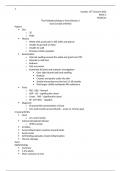
NR 283 Pathophysiology Exam 1 Study Guide - Concepts Review 2023/2024
NR 283 Pathophysiology Exam 1 Concepts Review 2023. Cellular Biology/Cellular Adaptation/Cellular Injury Chapter 1 and 3 8 functions of cells o Movement – muscle cells generate force to produce motion o Conductivity – As a response to a stimulus. This is the chief function of nerve cells o Metabolic Absorption – take in and use nutrients o Secretion – with mucous gland cells – absorb substances to be secreted elsewhere o Excretion – Rid themselves of waste products o Respiration – Absorb oxygen to transform nutrients to energy o Reproduction – New cells produced to replace those lost o Communication – vital for cells to survive as a society (think Osmosis Jones movie) ATP • ATP or adenosine triphosphate plays a major role in that • ATP is a molecule that stores and transfers energy for the functioning of our cells • Specifically it is used in the synthesis (creation) of molecules, muscle contractions, and active transport Mitochondria the main job of the mitochondria is that it produces most of the cell’s ATP or energy. Cellular metabolism There are 2 parts to metabolism: • Anabolism • The energy using process • Catabolism • The energy releasing process Ribosomes Ways of cellular communication Cellular respiration Anaerobic and aerobic Sodium/Potassium pump-function, what happens when it fails?, need ATP for this… Cellular adaptation-hypertrophy, atrophy, hyperplasia, metaplasia, dysplasia (know examples, pathologic, physiologic, hormonal, compensatory) Reversible/irreversible injury Apoptosis vs. Necrosis Apoptosis(“dropping of”) is an important distinct type of cell death that differs from necrosis in several ways. Apoptosis is an active process of cellular self-destruction called programmed cell death and is implicated in both normal and pathologic tissue changes Necrosis--Cellular death eventually leads to cellular dissolution, or necrosis. Necrosis is the sum of cellular changes after local cell death and the process of cellular self-digestion, known as autodigestion or autolysis Types of Necrosis (liquefactive, coagulative, fat, gas gangrene, dry gangrene, wet gangrene caseous) Dry gangrene: Slow spreading, tissue becomes dry, brown or black, it shrinks and wrinkles. Wet gangrene:Area is cold, swollen, pulseless, moist, black and a foul odor production Coagulative necrosis. Occurs primarily in the kidneys, heart, and adrenal glands; commonly results from hypoxia caused by severe 103ischemia or hypoxia caused by chemical injury, especially ingestion of mercuric chloride. Coagulation is a result of protein denaturation, which causes the protein albumin to change from a gelatinous, transparent state to a firm, opaque state .The area of coagulative necrosis is called an infarct. Types of cells Cellular Injury (Chemical, Ischemia, Free Radicals, Reperfusion, Infectious, etc.) Ischemia: lack of blood flow Types of Injury (Blunt force, sharp, asphyxiation, gunshot wound, etc.) Bruising-hemosiderin Steps in cellular injury Aging Somatic Death-stages after death of body (livor mortis, algor mortis, rigor mortis) 2 Death-stages 1) Somatic death, which is the cessation of the vital process, and (2) molecular death, which is the progressive disintegration of the body Changes that occur within the first 12 hours of death i. Algor mortis (Cooling of the body) ii. Livor mortis/Post-mortem hypostasis (Lividity) the blood will tend to flow downward. Consequently they will accumulate in capillaries and small veins in dependent parts of the body, and this is manifest as a purple or reddish-purple colour on the skin. This is known as lividity, and it is usually apparent within half an hour to two hours after death, fully developing within 12 hours iii. Rigor mortis (Stiffening of the body) Genetics Chapter 2 DNA- in the nucleus GENES ARE COMPOSED OF DNA WHICH HAS 3 BASIC COMPONENTS: A 5 CARBON MONOSACCHARIDE (DEOXYRIBOSE) A PHOSPHATE MOLECULE 4 NITROGENOUS BASES 2 ARE PYRIMADINES: CYTOSINE AND THYMINE 2 ARE PURINES: ADENINE AND GUANINE THE IMPORTANCE OF DNA IS THAT IT DIRECTS THE SYNTHESIS OF ALL THE BODY’S PROTEINS DNA REPLICATION CONSISTS OF BREAKING THE WEAK HYDROGEN BONDS BETWEEN THE BASES, LEAVING A SINGLE STRAND WITH EACH BASE UNPAIRED THE CONSISTENT PAIRING OF A TO T AND C TO G IS CALLED COMPLEMENTARY BASE PAIRING. IT IS THE KEY TO ACCURATE REPLICATION OF THE DNA RNA (RIBONUCLEIC ACID) • now remember, DNA is formed in the nucleus and the synthesis of the protein takes place in the cytoplasm • the code or information from the DNA has to make it out of the nucleus so that the protein can be made • this is done by RNA through the processes of transcription and translation • RNA is very similar to DNA with a few exceptions: • the sugar molecule is ribose instead of deoxyribose • one of the nitrogenous bases is different, instead of thymine, RNA has uracil • RNA is typically only a single strand, not a double Mitosis/Meiosis for cellular replication Meiosis is the formation of new gamete cells Mitosis is the formation of new somatic cells Chromosomes (normal number, abnormal numbers-aneuploidy, tetraploidy, etc, Monosomies, Trisomies, etc.)
Geschreven voor
Documentinformatie
- Geüpload op
- 21 februari 2023
- Aantal pagina's
- 17
- Geschreven in
- 2022/2023
- Type
- Tentamen (uitwerkingen)
- Bevat
- Vragen en antwoorden
Onderwerpen
- nr 283
- nr 283 pathophysiology
- pathophysiology
-
nr
-
nr 283 pathophysiology exam 1 concepts review 2023
-
nr 283 pathophysiology exam 1 concepts review
-
nr 283 pathophysiology exam 1

Ook beschikbaar in voordeelbundel