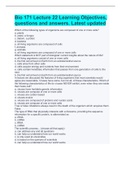
Bio 171 Lecture 22 Learning Objectives, questions and answers. Latest updated
Bio 171 Lecture 22 Learning Objectives, questions and answers. Latest updated Explain in general how a biogeochemical cycle works, including how nutrients enter ecosystems and how they are altered within ecosystems A biogeochemical cycle is the path that an element takes as it moves from one compartment or pool to another within an ecosystem. Nutrients enter the cycle by decomposers break down organic material into inorganic material that goes back into the soil nutrient pool. Rhizobium bacteria break down nitrogen into ammonium and then into nitrate which can then be fixed by another rhizobium bacteria in plant roots (when the nitrogen is in air pockets in the roots). Nutrients are altered within ecosystems by nitrogen changing forms into gas, ammonium, and then into nitrate, and once it is in the body it is used to build molecules within the body. 2. Identify the major groups of decomposers; place decomposers on the tree of life Bacteria, Archaea, and Fungi (which are Eukarya). All throughout tree of life 00:41 01:30 3. Recognize fungi as one major group of decomposers, identify their Domain, and describe basic aspects of their biology: how they acquire nutrients, their cell wall structure Domain: Eukarya. Chemoheterotrophs (carbon and energy source from organic molecules), release digestive enzymes and then absorb nutrients from the environment or other organisms.Have cell walls made of chitin 4. Explain the abiotic factors that limit rates of decomposition in terrestrial ecosystems Abiotic factors like temperature and soil water content limit decomposition of detritus which limits the rate at which nutrients move through an ecosystem. An increase in temperature increases decomposition rates and a decrease in temperature decreases it. For example, a decomposition occurs quickly in a rainforest that is damp and warm but slowly in the arctic where it is dry and cold. 5. Explain how decomposers influence nutrient cycling and why ecosystem services, such as primary production, would cease without them Decomposers cycle nutrients from detrital pool back to abiotic environment. Their ecosystem service is that they break down complex organic molecules into inorganic forms which are used by producers. Primary production would cease without them because plants cannot grow without nutrients in the soil and decomposers return nutrients from dead organisms back to the soil. 6. Explain the global N cycle: describe the major atmospheric pool of nitrogen, the forms of nitrogen that can be used by primary producers, why heterotrophs need N atoms, how nitrogen moves up a food chain, and how decomposition moves nitrogen between pools Start with atmosphere, nitrogen fixation in plant roots, ammonium and nitrate (inorganic to organic) that makes take up in their roots, plants use the nitrogen, plants are consumed, nitrogen is organic again, consumer dies, decomposers carry out denitrification and nitrogen is inorganic again and goes back to atmosphere. Major pool of Nitrogen: the atmosphere; Forms of N that can be used by primary producers: NH4+ (ammonium) and NO3- (nitrate); Heterotrophs need N atoms: amino acids and proteins, and nucleic acids (DNA/RNA); Herbivores eat plants and then predators eat prey. Herbivory and then predation; Nitrogen ends up in detrital pool and then decomposers turn organic molecules back into inorganic molecules which are then returned back into the soil nutrient pool and atmosphere. 7. Describe how humans have altered the nitrogen cycle, and be able to link this with eutrophication Humans take nitrogen and turn it into fertilizer; increased the rate of nitrogen that is in a bioavailable form. Agricultural runoff (excess nitrogen) goes into rivers and then into oceans which causes massive algal blooms (eutrophication). 8. Explain how humans have altered habitats, the major drivers of land use change, and the consequences of those changes for biodiversity Because of algal blooms caused by massive agriculture and the altered nitrogen cycle, humans have caused dead zones in oceans which do not have enough oxygen to support marine life on the bottom which destroys ecosystems. Humans are the major drivers of land use change by altering habitats. Logging (deforestation), housing, and livestock farming. Biggest drivers of extinction rate: habitat loss, pollution, invasive species, and climate change have significant reduction to biodiversity. 9. Describe the major trends in biodiversity that have characterized the Anthropocene Biodiversity has decreased in the Anthropocene. Humans are causing declines in abundance of local populations, population extirpations, species extinctions (6th mass extinction). Anthropocene has a rate of high extinction. 10. Describe the major factors threatening vertebrate and invertebrate populations, the general trends in vertebrate and invertebrate animal populations, and the potential impacts of those losses Major threatening factors: over exploitation (logging), and agricultural activity; Vertebrate general trend: decline of species, on average vertebrate populations are less than half the size they were 40 years ago, 322 vertebrate species extinctions since 1500; Invertebrate: ¼ of invertebrates are at risk of extinction; freshwater species especially at risk (construction of dams), Drivers: habitat loss, pollution, invasive species, and climate change 11. Explain how humans have altered species distributions and some ways in which invasive species can impact native communities Humans can intentionally or accidentally introduce an invasive species into an ecosystem. Invasive species can become widely established and economic harm, compete with natives for food and habitat, can have direct and indirect effects on food webs, large decline in native species. Example. Python in the everglades. Humans increased invasive species distribution. 12. Explain how two invasive species, goats in the Galapagos and pythons in the Everglades, have caused major ecological problems Pythons: caused large decline in native mammals; Goats: eat all vegetation-- destroyed forests, drip pools, and shade that tortoises relied on, removed plants which lead to massive erosion. Without the plants the ecosystem services of the plants were gone as well.
Geschreven voor
- Instelling
- Bio 171
- Vak
- Bio 171
Documentinformatie
- Geüpload op
- 25 februari 2023
- Aantal pagina's
- 9
- Geschreven in
- 2022/2023
- Type
- Tentamen (uitwerkingen)
- Bevat
- Vragen en antwoorden
Onderwerpen
-
bio 171 lecture 22 learning objectives
-
questions and answers latest updated
-
explain in general how a biogeochemical cycle works
-
including how nutrients enter ecosystems and how they are altered wit

Ook beschikbaar in voordeelbundel