2011 Zone B Question#6
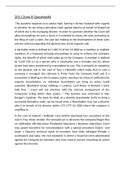
The question required us to advise Niall, Sabrina’s former husband with regards
to whether he can bring a derivative claim against Sabrina on behalf of Citadel Ltd
of which she is the managing director. In order to ascertain whether the Court will
allow proceedings for such a claim, it is essential to assess the rules pertaining to
the filing of such a claim, the case law relating to the development of these rules
and the criticism regarding this doctrine due to the majority rule.
A derivative claim is defined by S.260 (1) of the CA 2006 as; a member or multiple
members of a Company bringing proceedings to suing to enforce the Company
rights, the benefit of which shall solely go to the Company. A member is defined
by S.260 (50) (c) as a person who is necessarily not a member but for whom
shares have been transferred or transmitted by Law. This is primarily an exception
to the general rule in the case of Foss v Harbottle which holds that in case a
company is wronged, the claimant is Prima Facie the Company itself and if a
transaction is binding on the Company and its members by virtue of ratification by
majority shareholders, no individual shareholder can bring an action (cadit
quaestio) (Breckland Group Holdings v London). Lord Davey in Burland v Earle
held that “…Court will not interfere with the internal management of the
Companies acting within their power…” This decision was reiterated in Mac
Dougall v Gardiner. The basis for Niall, as a minority shareholder (10%) to bring a
successful derivative claim can be found since a Shareholder may sue a director
who is in breach of his director duties (171-177) CA 2006 where the company is
unwilling to.
In the case of Edward v Halliwell, Lord Jenkins stipulated four exceptions to the
rule in Foss, these include; the wrongful act is ultravires the Company/illegal thus
no ratification will take place (Prudential Assurance v Newman Industries), Court
may award injunction for noncompliance with a special procedure (Quinn and
Axten v Salmon), personal rights of members have been infringed (Pender v
Lushington) and lastly, the real exception is where a fraud has been perpetrated
against the Company by members who have control and are restricting an action
against the minority.
The question required us to advise Niall, Sabrina’s former husband with regards
to whether he can bring a derivative claim against Sabrina on behalf of Citadel Ltd
of which she is the managing director. In order to ascertain whether the Court will
allow proceedings for such a claim, it is essential to assess the rules pertaining to
the filing of such a claim, the case law relating to the development of these rules
and the criticism regarding this doctrine due to the majority rule.
A derivative claim is defined by S.260 (1) of the CA 2006 as; a member or multiple
members of a Company bringing proceedings to suing to enforce the Company
rights, the benefit of which shall solely go to the Company. A member is defined
by S.260 (50) (c) as a person who is necessarily not a member but for whom
shares have been transferred or transmitted by Law. This is primarily an exception
to the general rule in the case of Foss v Harbottle which holds that in case a
company is wronged, the claimant is Prima Facie the Company itself and if a
transaction is binding on the Company and its members by virtue of ratification by
majority shareholders, no individual shareholder can bring an action (cadit
quaestio) (Breckland Group Holdings v London). Lord Davey in Burland v Earle
held that “…Court will not interfere with the internal management of the
Companies acting within their power…” This decision was reiterated in Mac
Dougall v Gardiner. The basis for Niall, as a minority shareholder (10%) to bring a
successful derivative claim can be found since a Shareholder may sue a director
who is in breach of his director duties (171-177) CA 2006 where the company is
unwilling to.
In the case of Edward v Halliwell, Lord Jenkins stipulated four exceptions to the
rule in Foss, these include; the wrongful act is ultravires the Company/illegal thus
no ratification will take place (Prudential Assurance v Newman Industries), Court
may award injunction for noncompliance with a special procedure (Quinn and
Axten v Salmon), personal rights of members have been infringed (Pender v
Lushington) and lastly, the real exception is where a fraud has been perpetrated
against the Company by members who have control and are restricting an action
against the minority.