ISDS 705 - Module 1 questions and answers 2023
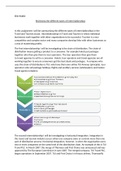
ISDS 705 - Module 1 questions and answers 2023Sustainable Competitive Advantage Financial performance that consistently outperforms industry peers. Operational Effectiveness Refers to performing the same tasks better than rivals perform them, but the danger is "sameness." Fast Follower Problem Exists when savvy rivals watch a pioneer's efforts, learn from their successes and missteps, then enter the market quickly with a comparable or superior product at a lower cost. Strategic Positioning Refers to performing different activities from those of rivals, or the same activities in a different way. Having technology itself is easy to replicate, but using technology as a tool to differentiate your business makes it harder to copy. Inventory Turns How fast the firm sells its product; higher inventory turns mean the firm is selling product faster, so it collects money quicker than its rivals do. And those goods are fresher since they've been in stock for less time, too. Straddling Trying to do business in two different markets or niches. Resource-Based View of Competitive Advantage If a firm is to maintain sustainable competitive advantage, it must control a set of exploitable resources that have four critical characteristics. The resources must be: (1) Valuable (2) Rare (3) Imperfectly imitable (tough to imitate) (4) Non-substitutable Dense wave division multiplexing (DWDM) Enabled existing internet fiber to carry more transmissions than ever before. Imitation-Resistant Value Chains A way of doing business that others will struggle to replicate, and in nearly every successful effort of this kind, technology plays a key enabling role. Value Chain A set of activities through which a product or service is created and delivered to customers. Primary components of a value chain Inbound Logistics Operations Outbound Logistics Marketing and Sales Support Secondary components of a value chain Firm Infrastructure Human Resource Management Technology / Research and Development Procurement Value Chain: Inbound Logistics Getting needed materials and other inputs into the firm from suppliers Value Chain: Operations Turning inputs into products or services Value Chain: Outbound Logistics Delivering products or services to consumers, distribution centers, retailers, or other partners Value Chain: Marketing and Sales Customer engagement, pricing, promotion, and transaction Value Chain: Support Service, maintenance, and customer support Value Chain: Firm Infrastructure Functions that support the whole firm, including general management, planning, IS, and finance Value Chain: Human Resource Management Recruiting, hiring, training, and development Value Chain: Technology / Research and Development New product and process design Value Chain: Procurement Sourcing and purchasing functions Strategic Frameworks Help managers describe the competitive environment a firm is facing, and can be brainstorming tools to generate new ideas for responding to industry competition. Porter's Five Forces (Industry and Competitive Analysis) One of the most popular frameworks for examining a firm's competitive environment (1) intensity of rivalry among existing competitors (2) threat of new entrants (3) threat of substitute goods or services (4) bargaining power of buyers (5) bargaining power of suppliers Intensity of Rivalry Businesses invest in a new channel or technology out of what is perceived to be a necessity.
Written for
- Institution
- Mha 705
- Course
- Mha 705
Document information
- Uploaded on
- March 17, 2023
- Number of pages
- 4
- Written in
- 2022/2023
- Type
- Exam (elaborations)
- Contains
- Questions & answers
Subjects
-
isds 705 module 1 questions and answers 2023
-
sustainable competitive advantage financial performance that consistently outperforms industry peers
-
operational effectiveness refers to performing the