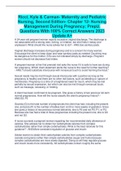
Ricci, Kyle & Carman- Maternity and Pediatric Nursing, Second Edition- Chapter 12- Nursing Management During Pregnancy; PrepU. Questions With 100% Correct Answers 2023 Update A+
Ricci, Kyle & Carman- Maternity and Pediatric Nursing, Second Edition- Chapter 12- Nursing Management During Pregnancy; PrepU. Questions With 100% Correct Answers 2023 Update A+ A 24-year-old pregnant woman reports excessive vaginal discharge. The discharge is not associated with a strong odor, itching, or irritation, but she finds it messy and unpleasant. What should the nurse advise her to do? - ANS:Use sanitary pads. Vaginal discharge increases during pregnancy and is a concern for many women. Encourage the client to keep clean and wear sanitary pads as needed. Douching may be dangerous for the mother. STIs are not indicated simply by discharge. Pregnant women should not decrease fluid intake. A pregnant woman at her first prenatal visit asks the nurse if it is safe to have sex during her pregnancy. Which client statement alerts the nurse to the need for further teaching? - ANS:"I should substitute intercourse with nonsexual touch to avoid harming the fetus." Sexual needs may be met through sexual intercourse with a partner as long as the pregnancy is healthy and there are no other risk factors, such as bleeding or rupture of membranes. Pregnancy is a time of a heightened need for touch, which may be met partially by sexual expression, but which can also be met through nonsexual touch, such as massage, caressing, or holding. A client has been confirmed to be pregnant. She gives a history of two previous full-term normal pregnancies. How will the nurse classify the client's pregnancy history? - ANS:G3, P2 Gravida (G) is the total number of pregnancies the client has had, including the present one, and para (P) is the number of babies born at 20 or more weeks of gestation. Since she gives a history of two previous normal deliveries, she is P2 and not P0, P1, or P3. Because she has had a total of three pregnancies including the present one, she is G3 and not G2. A nurse counsels a pregnant woman regarding her recommended daily allowance of calories. She advises her to obtain her carbohydrate calories from complex carbohydrates rather than simple carbohydrates. What is the best rationale for this guidance? - ANS:More consistent regulation of glucose and insulin Advise women to obtain their carbohydrate calories from complex carbohydrates (cereals and grains) rather than simple carbohydrates (sugar and fruits) because complex carbohydrates are more slowly digested. Doing so will help regulate glucose and insulin levels more consistently. All carbohydrates contain roughly the same amount of calories per gram (4 kcal/g). Carbohydrates of any kind are not a significant source of fatty acids. During a routine prenatal visit, a client, 36 weeks pregnant, states she has difficulty breathing and feels like her pulse rate is really fast. The nurse finds her pulse to be 100 beats per minute (increased from baseline readings of 70 to 74 beats per minute) and irregular, with bilateral crackles in the lower lung bases. The nurse would develop a plan of care identifying interventions to promote which area as the priority? - ANS:gas exchange Typically, heart rate increases by approximately 10 to 15 beats per minute during pregnancy and the lungs should be clear. Dyspnea may occur during the third trimester as the enlarging uterus presses on the diaphragm. However, the findings described indicate that the woman is experiencing impaired gas exchange. There is no evidence to support problems with tissue perfusion, activity, or anxiety. A client in her second trimester of pregnancy has developed varicose veins and experiences leg cramps. Which suggestion would be most appropriate? - ANS:Elevate legs while sitting. The nurse should encourage the client to elevate her legs while sitting; this will prevent pooling and engorgement of veins in the lower extremities. Aerobic exercises do not help in preventing varicose veins. Folic acid intake is recommended in the first trimester to prevent congenital abnormalities. Increasing the intake of calcium helps in strengthening bones. A nurse is instructing a pregnant woman about monitoring fetal movements and informs her that normally the fetus will move the same amount every day. The nurse adds that if the client notices an unusual increase or decrease in movement, this is a sign of what? - ANS:response to a need for oxygen A fetus normally moves more or less the same amount every day. If there is an unusual increase or decrease in movement, the client should be examined because such a change suggests that the fetus is responding to a need for oxygen. A nurse explains to a pregnant woman the importance of consuming adequate iodine in her diet. Which of the following conditions can a deficiency in iodine lead to? - ANS:Goiter Iodine is essential for the thyroid gland to be able to produce thyroxine (which is necessary for overall body metabolism). As thyroid function increases during pregnancy, a woman needs to be certain to ingest more iodine than usual to supply this increased need. If iodine intake is inadequate, hypothyroidism (poorly functioning thyroid gland) and thyroid enlargement (goiter) can occur. The other conditions listed are not associated with iodine deficiency. Continues...
Gekoppeld boek
Geschreven voor
- Instelling
- Ricci, Kyle & Carman- Maternity and Pediatric Nur
- Vak
- Ricci, Kyle & Carman- Maternity and Pediatric Nur
Documentinformatie
- Geüpload op
- 23 maart 2023
- Aantal pagina's
- 15
- Geschreven in
- 2022/2023
- Type
- Tentamen (uitwerkingen)
- Bevat
- Vragen en antwoorden

Ook beschikbaar in voordeelbundel