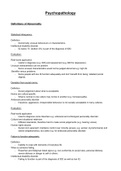
Psychopathology
Definitions of Abnormality
Statistical infrequency:
Definition
- Numerically unusual behaviours or characteristics.
Intellectual disability disorder
- IQ below 70 (bottom 2%) is part of the diagnosis of IDD.
Evaluation:
Real-world application
- Useful in diagnosis (e.g. IDD) and assessment (e.g. BDI for depression).
Unusual characteristics can be positive
- Some unusual characteristics would not be judged abnormal e.g. high IQ.
Benefits versus problems
- Some people with low IQ function adequately and don’t benefit from being labelled (social
stigma).
Deviation from social norms:
Definition
- Social judgement about what is acceptable.
Norms are culture-specific
- What is normal in one culture may not be in another (e.g. homosexuality).
Antisocial personality disorder
- Impulsive, aggressive, irresponsible behaviour is not socially acceptable in many cultures.
Evaluation:
Real-world application
- Used to diagnose some disorders e.g. antisocial and schizotypal personality disorder.
Cultural and situational relativism
- Different standards, therefore hard to make social judgements (e.g. hearing voices).
Human rights abuses
- Social norm approach maintains control over minority groups, e.g. women (nymphomania) and
slaves (drapetomania), but useful e.g. for antisocial personality disorder.
Failure to function adequately:
Definition
- Inability to cope with demands of everyday life.
When is someone failing
- Rosenhan and Seligman listed signs e.g. non-conformity to social rules, personal distress,
severe distress or danger to self or others.
Intellectual disability disorder
- Failing to function is part of the diagnosis of IDD as well as low IQ
Definitions of Abnormality
Statistical infrequency:
Definition
- Numerically unusual behaviours or characteristics.
Intellectual disability disorder
- IQ below 70 (bottom 2%) is part of the diagnosis of IDD.
Evaluation:
Real-world application
- Useful in diagnosis (e.g. IDD) and assessment (e.g. BDI for depression).
Unusual characteristics can be positive
- Some unusual characteristics would not be judged abnormal e.g. high IQ.
Benefits versus problems
- Some people with low IQ function adequately and don’t benefit from being labelled (social
stigma).
Deviation from social norms:
Definition
- Social judgement about what is acceptable.
Norms are culture-specific
- What is normal in one culture may not be in another (e.g. homosexuality).
Antisocial personality disorder
- Impulsive, aggressive, irresponsible behaviour is not socially acceptable in many cultures.
Evaluation:
Real-world application
- Used to diagnose some disorders e.g. antisocial and schizotypal personality disorder.
Cultural and situational relativism
- Different standards, therefore hard to make social judgements (e.g. hearing voices).
Human rights abuses
- Social norm approach maintains control over minority groups, e.g. women (nymphomania) and
slaves (drapetomania), but useful e.g. for antisocial personality disorder.
Failure to function adequately:
Definition
- Inability to cope with demands of everyday life.
When is someone failing
- Rosenhan and Seligman listed signs e.g. non-conformity to social rules, personal distress,
severe distress or danger to self or others.
Intellectual disability disorder
- Failing to function is part of the diagnosis of IDD as well as low IQ