RBT Credential Questions and Answers 2023
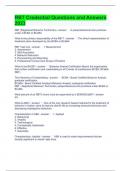
RBT Credential Questions and Answers 2023 RBT (Registered Behavior Technician) A paraprofessional who practices under a BCBA or BCaBA What is the primary responsibility of the RBT? The direct implementation of treatment plans developed by the BCBA or BCaBA RBT Task List 1.Measurement 2. Assessment 3. Skill Acquisition 4. Behavior Reduction 5. Documenting and Reporting 6. Professional Conduct and Scope of Practice What is the BACB? Behavior Analyst Certification Board; the organization that confers certification and credentialing to all 3 levels of practitioners (BCBA, BCaBA, RBT) The Hierarchy of Credentialing BCBA - Board Certified Behavior Analyst; graduate certification BCaBA - Board Certified Assistant Behavior Analyst; undergrad certification RBT - Registered Behavior Technician; paraprofessional who practices under BCBA or BCaBA What percent of an RBT's hours must be supervised by a BCBA/BCaBA? 5% What is ABA? One of the only research based methods for the treatment of behavior in Autism; aims to improve clients' life by increasing prosocial behaviors and decreasing maladaptive behaviors Characteristics of ABA 1. Applied 2. Behavioral 3. Analytic 4. Technological 5. Conceptually Systematic 6. Effective 7. Generality Characteristics: Applied ABA is used to make improvements that are socially significant in clients' daily lives. Characteristics: Behavioral The subject of ABA therapy must be the exact observable behavior targeted for change. Characteristic: Analytic Treatment must based off of observable and repeatable methods and demonstrate functional relationships. Characteristics: Technological Procedures must be identified and described with detail and clarity so that any reader has the ability to replicate the application with the same results. Characteristics: Conceptually Systematic Procedures must be based around evidence-based methods. Characteristics: Effective Treatments must be shown to produce significant positive change in subject's life. Characteristics: Generality The behavior changed by the procedure must be able to last over time and be applied to multiple socially appropriate situations. Reinforcement The addition or removal of a stimulus following a behavior that INCREASES the probability that the behavior will be repeated. Punishment The addition or removal of a stimulus following a behavior that DECREASES the probability that the behavior will be repeated. Motivating Operation An environmental variable that alters the reinforcing or punishing aspect of a stimulus/object/event OR alters the frequency of all behavior reinforced or punished by that stimulus/object/behavior. Stimulus Control A situation where the frequency/duration/severity of behavior is altered by the presence or absence of an antecedent stimulus. Operant Conditioning The basic principle of learning of which behavior is controlled by consequences. Key concepts in operant conditioning are positive reinforcement, negative reinforcement, positive punishment and negative punishment. Schedules of Reinforcement Rules specifying environmental arrangements and response conditions for reinforcement. 2 Categories of Schedules of Reinforcement 1. Continuous - reinforcement is given after every correct response 2. Intermittent - not continuous 4 Types of Intermittent Schedules of Reinforcement 1. Fixed-Ratio (FR) - reinforcement given after a constant or "fixed" number of correct responses 2. Fixed-Interval (FI) - reinforcement becomes available after a specific period of time; reinforcement is given if the correct response is emitted after the given time period has ended 3. Variable-Ratio (VR) - the delivery of reinforcement will "vary" but must average out at a specific number 4. Variable-Interval (VI) - the time periods that must pass before reinforcement becomes available will vary but must average out at a specific time interval Measurement The process of applying quantitative labels to observed properties of events using a standard set of rules. Data The common term used for measurement in the practice of ABA. Why do practitioners use data/measurement? To evaluate the effectiveness of interventions - if they are effective, we continue them; if they are ineffective, we use research to guide alterations to the interventions until an efficient and appropriate solution is found. Baseline Measurements The initial data on targets in which we test future successes of an intervention against. Examples of Measurement/Data Collection 5 trial data sheets; 1 trial probe data sheets; Behavior frequency tracking forms; Behavior duration tracking forms; ABC behavior charts Definitional Measures: Topography The physical form or shape of behavior Ex. - A hit is defined as the movement of the client's hand towards others that causes injury Definitional Measures: Magnitude The force or intensity with which a response is emitted. Ex. - A scream vs. a whisper Properties of The Measurable Dimensions of Behavior 1. Repeatability/ Countable 2. Temporal Locus 3. Temporal Extent Repeatability/Countable Behavior can be counted Temporal Locus When the behavior occurs Temporal Extent Duration of the behavior Measures Based on Repeatability 1. Count 2. Rate/Frequency 3. Celeration Count Number or responses emitted during an observed period Count Examples Joe smiled 3 times to peers. Bob slapped a peer 4 times. We saw 0 instances of verbal refusal. Rate/Frequency - Ratio of count per observation period - Reported as a number per standard unit of time ____ is a combination of count and the observable time, making it a stronger and more comprehensive form of measurement than count alone. Rate Rate/Frequency Example Bob hit 5 times in 30 minutes. Celeration Measure of the change in rate of responding per unit of time (Acceleration, Deceleration) Measure Based on Temporal Extent Duration Duration The amount of time a behavior occurs reported in standard time units Measures Based on Temporal Locus 1. Response Latency 2. Inter Response Time (IRT) Response Latency Delay between the stimulus and response Ex. - It took Bob 3 seconds to clap after being asked Inter Response Time (IRT) The measure of elapsed time between two successive responses Ex. - Bob clapped once, then clapped again 2 seconds later Continuous Measurement Measures all of the responses over a given period Discontinuous Measurement Captures responses within a specified time limit 1. Event Recording 2. Time Sampling Event Recording Documenting the number of times a target behavior occurs and the time period in which the behavior is observed; commonly use data sheets or counters Event Recording is appropriate for behaviors that are... Frequent enough too be recorded within a specific time period, but not too frequent that it is difficult to record accurately. Time Sampling Used in a variety of methods for observing and recording behavior during intervals or at specific moments in time; observation is divided into intervals, and presence or absence of behavior is recorded for each intervals (yes or no, as opposed to frequency)
Written for
- Institution
- Rbt
- Module
- Rbt
Document information
- Uploaded on
- May 15, 2023
- Number of pages
- 12
- Written in
- 2022/2023
- Type
- Exam (elaborations)
- Contains
- Questions & answers
Subjects
-
rbt credential questions and answers 2023
-
rbt registered behavior technician a paraprofessional who practices under a bcba or bcaba
-
rbt task list 1measurement 2 assessment 3 skill acquisition 4

Also available in package deal