Advanced research methods
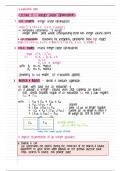
Session 1
Basic steps:
1. Formulate a knowledge question
2. Collect relevant knowledge that’s already out there
3. Collect new, additional data
4. Analyze and interpret
5. Formulate the answer to the question
Theory: Formalized explanations of phenomena
Expectations: Hypotheses of what we expect to observe
Studies: Experiments, surveys, case studies, secondary data analysis, simulations
Observations: Data stemming from studies
Scientific reasoning; three main logics
Inductive reasoning
- Given a series of observations, we derive an explanation / generalization that is probably true
Deductive reasoning
- Based on premises that are true, we logically come to a conclusion that is true
Abductive reasoning
- Based on interactions between observations and theories, we come to a likely explanation for what
we see
Logics are often combined in scientific argumentation
- Abduction to conceive ideas and hunches
- Deduction to logically construct propositions and hypotheses
- Induction to observe reality and generalize
, Managerial problem
- Typically a performance problem – Find out what performance dimensions are unsatisfactory
- Often, the managerial problem is a problem ‘mess’ – multiple interrelated problems and a complex
cause-and-effect network
- Different problems are perceived by different stakeholders
- Define the knowledge question behind the managerial problem
- Use abductive reasoning, collect prior studies around the problem, and do some quick exploratory
research
- Research objective: What do you aim to achieve with you research project?
Knowledge question
- Start collecting literature around the concepts mentioned in the research objective and the initial set
of questions
- Refine the questions until you have one main research question and a set of sub-questions
- If your research objective is a theory-testing objective, you would typically also formulate hypotheses
Four/five types of research questions as related to the type of knowledge they generate:
- Descriptive knowledge (How things are)
- Explanatory knowledge (Why things are that way)
- Predictive knowledge (How things will be)
- Prescriptive knowledge (How things should be done)
- Evaluative knowledge (How successful something is) – medicine research
Review of evidence
- Now that you have your research questions, you start a more systematic search for relevant literature:
o Academic literature (Scientific journal articles, scientific books, working/conference papers)
Exploration of theory (State the art of the theoretical knowledge)
o Professional literature (Magazine articles, professional books, blogs, websites, newspaper
articles)
Exploration of practice (Managerial problems and their solutions)
- Your results are captured in a critical synthesis of the literature
Session 1
Basic steps:
1. Formulate a knowledge question
2. Collect relevant knowledge that’s already out there
3. Collect new, additional data
4. Analyze and interpret
5. Formulate the answer to the question
Theory: Formalized explanations of phenomena
Expectations: Hypotheses of what we expect to observe
Studies: Experiments, surveys, case studies, secondary data analysis, simulations
Observations: Data stemming from studies
Scientific reasoning; three main logics
Inductive reasoning
- Given a series of observations, we derive an explanation / generalization that is probably true
Deductive reasoning
- Based on premises that are true, we logically come to a conclusion that is true
Abductive reasoning
- Based on interactions between observations and theories, we come to a likely explanation for what
we see
Logics are often combined in scientific argumentation
- Abduction to conceive ideas and hunches
- Deduction to logically construct propositions and hypotheses
- Induction to observe reality and generalize
, Managerial problem
- Typically a performance problem – Find out what performance dimensions are unsatisfactory
- Often, the managerial problem is a problem ‘mess’ – multiple interrelated problems and a complex
cause-and-effect network
- Different problems are perceived by different stakeholders
- Define the knowledge question behind the managerial problem
- Use abductive reasoning, collect prior studies around the problem, and do some quick exploratory
research
- Research objective: What do you aim to achieve with you research project?
Knowledge question
- Start collecting literature around the concepts mentioned in the research objective and the initial set
of questions
- Refine the questions until you have one main research question and a set of sub-questions
- If your research objective is a theory-testing objective, you would typically also formulate hypotheses
Four/five types of research questions as related to the type of knowledge they generate:
- Descriptive knowledge (How things are)
- Explanatory knowledge (Why things are that way)
- Predictive knowledge (How things will be)
- Prescriptive knowledge (How things should be done)
- Evaluative knowledge (How successful something is) – medicine research
Review of evidence
- Now that you have your research questions, you start a more systematic search for relevant literature:
o Academic literature (Scientific journal articles, scientific books, working/conference papers)
Exploration of theory (State the art of the theoretical knowledge)
o Professional literature (Magazine articles, professional books, blogs, websites, newspaper
articles)
Exploration of practice (Managerial problems and their solutions)
- Your results are captured in a critical synthesis of the literature