Inspector Goole
You are advised to spend about 45 minutes on this question.
You should use the extract below and your knowledge of the whole play to answer this question.
Write about the character of Inspector Goole and the way he is presented in An Inspector Calls.
In your response you should:
refer to the extract and the way she speaks and behaves;
the play as a whole;
show your understanding of characters and events in the play.[40]
5 of this question’s marks are allocated for accuracy in spelling, punctuation and the use of
vocabulary and sentence structures
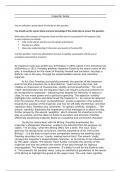
An Inspector Calls was written by J.B Priestley in 1945, based in the Industrial city
of Brumley in 1912. Priestley presents Inspector Goole as the moral centre of the
play, a mouthpiece for the views of Priestley himself and socialism. He plays a
didactic role in the play, through his imperturbable manner and relentless
inquiries.
In Act One, Priestley successfully presents the gravitas of the Inspector
and his forceful presence. He is described as: ‘need not be a big man, but
creates an impression of massiveness, solidity and purposefulness.’ The verb
‘need’ demonstrates how the Inspector does not require a physical presence to
be recognised or respected – indicating that despite his inferiority in status or
class, he has moral power and a spiritual superiority. The adjective ‘solidity’
highlights how resolute and determined the Inspector is – he cannot be deterred
from his purpose. This noun ‘purposefulness’ evokes suspense in the audience
towards the purpose of the Inspector and how he will edify the Birlings’ and their
capitalist views. Priestley also comments: ‘he speaks carefully, weightily…’ The
adverb ‘carefully’ illustrates the importance of the message he is about to relay,
further proven by the adverb ‘weightily’, which stresses his importance to the
play as a whole, and the ideas he holds on socialism and altruism; Priestley
effectively presenting Inspector Goole as a powerful and omniscient character.
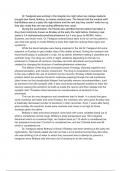
During his interactions with Mr Birling, Priestley emphasises the
Inspector’s phlegmatic character, unable to be deterred from his purpose. He
states: ‘I’m on duty,’ when Mrs Birling offers him a drink. The noun ‘duty’
portrays his strong moral conscience, and the importance of his visit to the
Birling’s – it is his duty to teach them compassion towards the working class.
Priestley describes his as: ‘(coolly, looking hard at him)’ The adverb ‘coolly’
conveys the Inspector’s imperturbable character, as he refuses to be influenced
by the upper classes. The adverb ‘hard’ further connotes the severity of the
Inspector and how he controls the events of the play through his rigorous
interrogations. The Inspector comments: ‘It’s better to ask for the Earth to take
it.’ This presents his socialist views, using an antithetical parallelism to the words
of Mr Birling to highlight the greed of the upper class. The verb ‘take’ signifies
You are advised to spend about 45 minutes on this question.
You should use the extract below and your knowledge of the whole play to answer this question.
Write about the character of Inspector Goole and the way he is presented in An Inspector Calls.
In your response you should:
refer to the extract and the way she speaks and behaves;
the play as a whole;
show your understanding of characters and events in the play.[40]
5 of this question’s marks are allocated for accuracy in spelling, punctuation and the use of
vocabulary and sentence structures
An Inspector Calls was written by J.B Priestley in 1945, based in the Industrial city
of Brumley in 1912. Priestley presents Inspector Goole as the moral centre of the
play, a mouthpiece for the views of Priestley himself and socialism. He plays a
didactic role in the play, through his imperturbable manner and relentless
inquiries.
In Act One, Priestley successfully presents the gravitas of the Inspector
and his forceful presence. He is described as: ‘need not be a big man, but
creates an impression of massiveness, solidity and purposefulness.’ The verb
‘need’ demonstrates how the Inspector does not require a physical presence to
be recognised or respected – indicating that despite his inferiority in status or
class, he has moral power and a spiritual superiority. The adjective ‘solidity’
highlights how resolute and determined the Inspector is – he cannot be deterred
from his purpose. This noun ‘purposefulness’ evokes suspense in the audience
towards the purpose of the Inspector and how he will edify the Birlings’ and their
capitalist views. Priestley also comments: ‘he speaks carefully, weightily…’ The
adverb ‘carefully’ illustrates the importance of the message he is about to relay,
further proven by the adverb ‘weightily’, which stresses his importance to the
play as a whole, and the ideas he holds on socialism and altruism; Priestley
effectively presenting Inspector Goole as a powerful and omniscient character.
During his interactions with Mr Birling, Priestley emphasises the
Inspector’s phlegmatic character, unable to be deterred from his purpose. He
states: ‘I’m on duty,’ when Mrs Birling offers him a drink. The noun ‘duty’
portrays his strong moral conscience, and the importance of his visit to the
Birling’s – it is his duty to teach them compassion towards the working class.
Priestley describes his as: ‘(coolly, looking hard at him)’ The adverb ‘coolly’
conveys the Inspector’s imperturbable character, as he refuses to be influenced
by the upper classes. The adverb ‘hard’ further connotes the severity of the
Inspector and how he controls the events of the play through his rigorous
interrogations. The Inspector comments: ‘It’s better to ask for the Earth to take
it.’ This presents his socialist views, using an antithetical parallelism to the words
of Mr Birling to highlight the greed of the upper class. The verb ‘take’ signifies