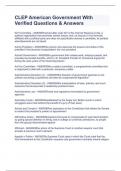
CLEP American Government With Verified Questions & Answers
527 Committee - ANSWERnamed after code 527 of the Internal Revenue Code, a political organization that promotes certain issues, and, as long as it if not formally affiliated with a political party and does not specifically endorse a candidate, its political advertisements are not taxed. Acting President - ANSWERthe person who assumes the powers and duties of the president if he becomes incapacitated- the vice president Activist Government - ANSWERa government that creates work, employs people, and provides tax-funded benefits, which U.S. President Franklin D. Roosevelt argued for during the early years of the Great Depression Ad Hoc Committee - ANSWERlike a select committee, a congressional committee that is organized to deal with a particular, temporary matter Administrative Discretion (1) - ANSWERthe freedom of government agencies to set policies according to guidelines provided by congressional legislation Administrative Discretion (2) - ANSWERthe interpretation of laws, policies, and court decisions that bureaucrats in leadership positions have Administrative Law - ANSWERrules and regulations formulated by government agencies Admiralty Courts - ANSWERestablished by the Sugar Act, British courts in which smugglers were tried without the benefit of a jury of their peers Advice and Consent - ANSWERan expression in the Constitution that allows the Senate to restrict the president's powers of appointment Affirmative Action - ANSWERprograms that seek to compensate for past discrimination by giving special attention in hiring, and in college or university admissions, to people from the groups discriminated against Affirmed - ANSWERthe action of the Supreme Court or another superior court that accepts a previous court's decision Agostini v.Felton - ANSWERa Supreme Court case in which the Court ruled that the First Amendment to the Constitution requires only government neutrality toward religion, which allowed public school teachers to teach remedial, nonreligious classes at religious schools at taxpayers' expense American Bill of Rights - ANSWERthe first ten amendments to the U.S. Constitution Amicus Curiae Brief - ANSWERa "friend of the court" brief, often submitted in a case by an interest group to persuade the court that it should decide a case a certain way Anti-incumbency - ANSWERa sentiment against elected officials currently in power Appropriations Committee - ANSWERthe committee in each chamber of Congress that is concerned with the spending of federal money Appropriations Committees - ANSWERcommittees that had to approve the funds authorized by congressional authorization committees before they were spent in the decades following World War II Approval Ratings - ANSWERregular polls that show the extent to which the public approves of the performance of the president or other politicians April 15 - ANSWERthe date on which annual tax returns are due to the government Articles of Confederation - ANSWERthe national constitution written before independence had formally been declared, adopted by the Second national Congress in 1777, and ratified by all the states by 1781 Athens - ANSWERthe Greek city-state that had the first known direct democracy, in which free male citizens debated and voted on every law Attack Ad - ANSWERan ad designed to create negative feelings about a candidate's opponent Attentive Policy Elites - ANSWERpeople who pay close attention to political matters Australian Secret Ballot - ANSWERthe model of the method by which people vote privately, first introduced in Australia in the late 1800s Authorization Committees - ANSWERvarious committees in congress that authorized spending on different projects (such as for upgraded dams in the Midwest) in the decades following World War II Baby Boomers - ANSWERAmericans who were born between 1946 and 1964 Balanced Budget Act - ANSWERa 1997 law, signed by President bill Clinton, that led not only to a balanced budget, but also to a budget surplus for the first time since the end of the 1960s Ballot - ANSWERthe method by which a person casts a vote in an election Barron v. Baltimore - ANSWERthe 1883 Supreme Court case in which the Court determined that the Bill of Rights applied to the federal governments and did not bind the state governments Bicameral - ANSWERrefers to a Congress with two houses; in the United States, the House of Representatives and the Senate Bill - ANSWERa proposed piece of legislation introduced by a member of the House or Senate in response to an issue that needs to be addressed Bimodal Distribution - ANSWERrespondents are divided almost evenly Bipartisan Campaign Reform Act (BCRA) - ANSWERa law passed in 2002 that attempted to control the influence of money on political campaigns for federal office; better known as the McCain-Feingold Act Bipartisanship - ANSWERcooperation among politicians in the major parties Black Codes - ANSWERpractices that entrenched segregationist practices in state laws; also called Jim Crow laws Block Grants - ANSWERfederal grants that have fewer strings attached to them than do categorical grants Blogs - ANSWERinternet logs through which anyone can act as a journalist Blue Dog Democrats - ANSWERdemocrats who advocate fiscal restraint Boston Tea Party - ANSWERa 1773 act of political an economic protest against the authority of the British government to impose taxes upon American colonies, in which a mob of colonists cast British tea into Boston Harbor Bowers v. Hardwick - ANSWERa 1986 Supreme Court case in which the Court ruled that a person did not have a private right to engage in homosexual acts, which were illegal in Texas Broad Construction - ANSWERan approach taken by (liberal) judges to tend to interpret the Constitution in light f its underpinning principles and in light of evolving moral and cultural standards Broadcast Media - ANSWERradio, television, and the internet Brown v. Board of Education of Topeka - ANSWERa 1954 case, and an enuring symbol of the Supreme Court's power to override state laws, that began the process of desegregation in the southern and some Midwestern states Bryan, William Jennings - ANSWERthe best-known presidential candidate of the People's Party who actually was the Democratic Party nominee in the U.S. presidential elections of 1896 and 1900 Budget and Accounting Act - ANSWERa 1921 law requiring the president to prepare a national budget and seek congressional approval of it Budget and Impoundment Control Act - ANSWERa 1974 law that governs the role of Congress in the federal budget process Budget Authority - ANSWERthe amounts of money that certain government agencies will be authorized to spend Budget Committees - ANSWERcongressional committees that oversaw the still political and complicated budgeting process that existed after the passage of the Budget and Impoundment Control Act of 1974 Budget Enforcement Act (BEA) - ANSWERa 1990 law that defended two types of federal spending Budget Outlays - ANSWERhow much money government agencies are actually expected to spend Budget - ANSWERa plan of the expected revenues and expenditures of a government bureau of Engraving and Printing - ANSWERthe federal agency that produces the nation's paper currency Bureau of Indian Affairs - ANSWERestablished in 1824, this agency is under the jurisdiction of the Department of the Interior and provides various services to Native Americans Bureau of Indian Education - ANSWERa federal agency that provides educational derives to Native Americans Bureau of the Budget - ANSWERestablished in 1921 by President Harding, a federal agency that placed formal restrictions on the spending of government funds Bureaucratic Imperialism - ANSWERthe politicization of bureaucrats when their responsibilities overlap and the compete for turf and protect the interests of their own agencies, and thus their own careers Burlington Industries v.Ellerth - ANSWERa 1998 Supreme Court case in which the Court ruled that employers are responsible for setting up safeguards against sexual harassment in the workplace Busing - ANSWERa solution to segregation, employed until the 1980s, requiring the transportation of white students to schools attended mainly by black students and vice versa Cabinet - ANSWERthe secretaries who preside over the various federal government agencies or who offer advice on vital issues Campaign Finance - ANSWERaccording to U.S. law, to receive federal funds for elections a political party must receive at least 5 percent of the popular vote nationally and must appear on at least ten state ballots Candidate Characteristics - ANSWERpersonal qualities of politicians, such as knowledgeable, serious, and trustworthy Cap - ANSWERan upper limit on spending Capitol Hill - ANSWERthe place in Washington, D.C, where the U.S. Congress meets Categorical Grants - ANSWERfederal grants to the states that fund specific projects Caucus - ANSWERan alternative to a primary used y some states in which local people select delegates to county meeting; the delegates support a certain candidate and then select delegates to represent them at a higher level, with the nominee with the most delegates winning Censure - ANSWERin politics, a formal congressional reprimand Census - ANSWERan official and periodic governmental count and demographic analysis of the population, taken every ten years in the United States Chad - ANSWERin a punch card, a circle of the card that hangs onto it because the hole was not punched completely through the card Chain of Command - ANSWERa clear system of knowing who is in charge of whom (one of the five characteristics that German sociologist max Weber suggested that bureaucracies share). Chief Justice - ANSWERthe judge of the Supreme Court who manages the Court itself and presides over the federal court system, as well as the Judicial Conference Chief of Staff - ANSWERa member of the president's personnel, who, depending on the president, may or may not be empowered to closely manage White House operations Civil Liberties - ANSWERfreedoms guaranteed by the Constitution Civil Rights Act of 1964 - ANSWERa law that outlawed discrimination in most kinds of housing Civil Rights - ANSWERprivileges and powers granted to people as equals under the law Civil Service - ANSWERgovernment employment for which people qualify based on merit rather then on political patronage Clear and Present Danger Test - ANSWERa standard for judging when freedom of speech can be suppressed Clientele - ANSWERin government, patrons of a bureaucracy, such as lobbyists and interest groups Clinton, Hillary Rodham - ANSWERa very strong candidate for the Democratic presidential nomination in 2008, although she lost the nomination to Barrack Obama; subsequently appointed as Secretary of State by President Obama Clinton, William - ANSWERthe second of only two U.S. presidents to be impeached, in 1998, for lying to a grand jury about an affair he had with an intern and for obstruction of justice Closed Primary - ANSWERa primary in which party members can vote onl for candidates from their own party Cloture - ANSWERthe method of ending a debate, especially a filibuster, in the Senate by means of a petition signed by at least sixteen senators and voted for by at least sixty senators, two days after the petition is offered Coercive Acts - ANSWER1774 British laws, passed in response to the Boston Tea party, tat imposed greater British control of the government of Massachusetts, prevented British officials accused of crimes from being tried in Massachusetts, and provided for the housing of British soldiers in private homes; also called the Intolerable Acts Commander-In-Chief - ANSWERthe president, who presides over all U.S. military forces Commerce Clause - ANSWERa statement in the Constitution that Congress has the power to regulate commerce that takes place between the states Communism - ANSWERan ideology that emphasizes not only government-directed equalization of wealth and government control of industry, but also the elimnation of private property Communities - ANSWERgroups that can significantly influence people's political views Compromise of 1820 - ANSWERthe resolution of the crisis between Southern, pr-slavery states and non-Southern states that occured when Missouri entered the Union as a slav state, and equality was maintained in the Senate; also called the Missouri Compromise Concurring Opinion - ANSWERa statement in which a justice of the Supreme Court who agres with a decision for reason different from those stated in the maority opinion explains those reasons Conference Committee - ANSWERlike a select committee, a temporary congressional committee that is formed to work out differences between Senate and House versions of a bill Congress of the Confederation - ANSWERthe successor to the Second Continental Congress, which included delegates appointmented by th legislatures of the states Congressional Budget Office (CBO) - ANSWERthe federal agency that assisted the budget committees after the passage of the Budget and Impoundment Control Act of 1974 Congressional Delegate - ANSWERa member of the House of Representatives who can vote in committees but who may not vote for or against final passage of legislation Congressional Globe - ANSWERthe record of proceedings of Congress, as required by the Constitution, from 1833 to 1873 Congressional Record - ANSWERa publication, begun in 1873, that records proceedings of Congress, as required by the Constitution Constituency - ANSWERthe voters or residents of a district who are represented by an elected official Constituent Service - ANSWERhelp and information that paid staff members of incumbent members of Congress provide to thir constituents Constituents - ANSWERthe citizens represented by an elected official Contract with America - ANSWERthe promise by Speaker of the House Newt Gingrich (R-Georgia) in 1994 of "a detailed agenda for national renewal, a written commitment with no fine print" Consensus Opinion - ANSWERthe favor of a large majority of Americans on an issue Contrast Ad - ANSWERan ad that draws distinctions between opponents Cooperative Federalism - ANSWERthe view that emphasizes the point that the responsibilities of the state government overlap and takes into account that the state and federal governments often share responsibilities Council of Economic Advisors - ANSWERa panel of three economists who advise the president on economic matters Cracking - ANSWERa practice whereby U.S. district designers break opposition party voters into as many districs as possible Crisis Management - ANSWERa program that a president should have in place that immediately begins the machinery of arriing at a solution of a crisis Critical Election - ANSWERan election associated with a major political realignment in the United States that persists through subsequent elections C-SPAN (Cable Satellite Public Affairs Network) - ANSWERa television network that broacasts politcal events from all political parties (excpt for extreme fringe groups) without commentary Cynicism - ANSWERdistrust or skepticism about the motives of others; a belief that others are motivated by selfishness De Facto Segregation - ANSWERsegregation resulting from the fact that people of different colors live in different areas and therefore go to different schools De Jure Segregation - ANSWERsegregation as a matter of law Dealignment - ANSWERthe trend in the late twentieth and early twenty-first centuries inwhich more and more U.S. citizens have become disenchanted with the major parties Debates and Proceedings in the Congress of the United States - ANSWERthe record of proceedings of Congress, as required b the Constitution, from 1789 to 1824 Debs, Eugene - ANSWERthe Socialist U.S. presidential candidate with the greatest drawing power, who ran in the elections of 1904, 1908, 1912, and 1920 Declaration of Independence - ANSWERa statement primarily written by Thomas efferson and adopted by delegates from the American colonies in 1776 that declared that the thirteen American colonies then at war with Britian regarded themselves as independent tates and no longer of the British Empire Declare War - ANSWERa power of Congress Defendant - ANSWERa party who is sued or accused of a crime in a court of law Deficit - ANSWERin a given year, the spending of the federal government of more money than it taks in Delegation of Powers - ANSWERthe act of Congress granting the president broad authority to act in response to a crisis Democratic Republic - ANSWERa form of government that does not have a monarch, but instead operates on democratic principles Department of Commerce - ANSWERa federal agency that handles details about U.S. trade with other nations and is overseen by Congress Deregulation - ANSWERthe lessening of government oversight ad the allowance of greater freedom to private enterprise Descriptive Representation - ANSWERthe belief that Congress should resemble the nation in terms of gender and ethnicity Desegregation of the Military - ANSWERan order by President Harry S. Truman in 1948 Devolution - ANSWERthe turning over of functions formerly carried out by the federal government to the tates Direct Democracy - ANSWERa form of government in which citizens vote directly on politcal issues and the majority wins Direct Election of Senators - ANSWERestablished by the Seventeenth Amendment to the Constitution, which was ratified in 1913 Discretionary Spending - ANSWERgovernment sending that can change from year to year Dissenting Opinion - ANSWERa statement in which a justice of the Supreme Court who disagrees with the majority states why he of she disagrees Dissident - ANSWERa person who opposes the current government Divided Government - ANSWERone in which a president of one party faces one or two congressional houses in the hands of the other party Divided Opinion - ANSWERdisagreement among American issues Dixiecrat - ANSWERanother name for members of the States' Rights Democratic Party Dual Citizenship - ANSWERa person who is a citizen of two countries at the same time Dual Federalism - ANSWERthe view that the national and state governments have absolute authority in their own distinct spheres-a view that seeks clear distinctions between the governments Duties - ANSWERtaxes on goods imported into the United States; also called tariffs Earmarks - ANSWERfederalfunding for projects that serve the interests of the constituents of certain members of Congress and that circumvent a direct allocation process by being attached to bills-and often burried in the language of the bills-that frequently have nothng whtsoever to do with those projects Easy Issue - ANSWERa politcal issue that is easily stated and often linked to high emotios Economic Protest Party - ANSWERa politcal party that focuses on some aspect of the economy Economic Status - ANSWERa factor that can significantly influence a person's political views Education - ANSWERa factor that can significantly influence a person's politcal views Election Every Two Years - ANSWERa requirement for seats in the House of Representatives that is based on the intention of the framers of the Constitution that the House of Representatives was to be the federal government body that is closest to the people Electoral College - ANSWERthe body, in which each state's representation is the equivalent of the number of the state's Senate and House members, that casts the actual votes for the preident of the United States Electoral Realgnment - ANSWERresulting from a critical election, a sharp change in issues, demographic power bases of Republicans and Democrats, and party leaders, ad a long-lasting replacements of the dominant party by the other party Electoral Vote - ANSWERa vote cast in the Electoral College of the United States by each representative of every state in a presidential election Electronic Voting - ANSWERa paperless method of voting in which voters may press a button or touch a choice on a computer screen Elite Theory - ANSWERthe idea that no mater how a vote turns out, a small group of elites who profess to believ in popular sovereignty run for office, pay campaigns, scratch their friends' backs, and accumulate politcal power Eminent Domain - ANSWERthe government's right to acquire private property for the public interest Engel v. Vitale - ANSWERa 1962 Supreme Court cas that struck down a brief prayer said in New York public schools Engish Bill of Rights - ANSWERa 1688 British document requiring that "freedom of speech" be allowed in Parliamentary proceedings and that "excessive bail ought to be required nor excessive fines imposed nor cruel and unusual punichments inflicted"; this document influenced the American colonists in framing the Constitution Entitlement - ANSWERa government program that guarantees and must provide benefits to a particular group Enumerated Powers - ANSWERthe powers explicitly stated in the Constitution that Congress has to carry out its responsibilites Equal Employment Oppurtunity Commission (EEOC) - ANSWERa federal agency that sets policies to carry out civil rights laws and has the power to investigate whether the laws have been broken Equal Oppurtunity - ANSWERthe concept that all citizens should have an equal chance to succeed in life Equal Pay Act - ANSWERa 1963 law requiring equal pay for women whose work is substantially the same as that of men Equal Pay for Equal Work - ANSWERa goal of the National Organization for Women (NOW), which was founded in 1966, that women should receive the same wages as men for performing the same jobs Equal Protection Clause - ANSWERa
Written for
- Institution
- CLEP American Government
- Module
- CLEP American Government
Document information
- Uploaded on
- May 20, 2023
- Number of pages
- 40
- Written in
- 2022/2023
- Type
- Exam (elaborations)
- Contains
- Questions & answers
Subjects
- clep american government
- a polit
-
clep american government with verified questions amp answers
-
clep american government stuvia
-
527 committee answernamed after code 527 of the internal revenue code

Also available in package deal