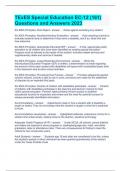
TExES Special Education EC-12 (161) Questions and Answers 2023
TExES Special Education EC-12 (161) Questions and Answers 2023 Six IDEA Principles: Zero Reject Rules against excluding any student Six IDEA Principles: Nondiscriminatory Evaluation Rule requiring schools to evaluate students fairly to determine if they have a disability, and if so, what kind and how extensive. Six IDEA Principles: Appropriate Education/IEP A free, appropriate public education to all children who have been identified as needing special education. Program must be tailored to the needs of the student. Includes related services and supplementary aides and services if needed. Six IDEA Principles: Lease Restrictive Environment When the Individualized Education Program (IEP) is written, a determination is made regarding the amount of time each student with disabilities will spend with nondisabled peers both in the classroom and al other school activities. Six IDEA Principles: Procedural Due Process Provides safeguards against schools' actions, include a right to sue in court, provisions are made for the settlement of disputes by an impartial third party. Six IDEA Principles: Parents of children with disabilities participate Parents of children with disabilities participate in the planning and decision making for their child's special education. Parents' rights primarily involve access to students' educational records for inspection and review and the need for parental consent to release personally identifiable information. Accommodations Adjustments made in how a student with a disability is taught or tested. They do not change what the student is taught or what he is expected to know. Accommodations (examples) highlighted textbooks, extensions of time for a student who writes slowly, seating close to the teacher, assistive technology Adequate Yearly Progress (AYP) Under NCLB, all schools, school districts and states are required to show progress in: reading/language arts, math, and either graduation rates or attendance rates. There are consequences for failing to meet the criteria for two consecutive years. Adult Students Students age 18 and older are considered to be this, unless the student's parent or other individual has been granted guardianship of the student under the Texas Probate Code Alternative Education Programs (AEPs) Disciplinary programs operated by school districts for students who have committed a range of offenses specified in state law and/or in the district's Student Code of Conduct. Students with disabilities who are in these programs are still entitled to special education services. Disciplinary Alternative Education Program (DAEP) Operated by the school district. Juvenile Justice Alternative Education Program (JJAEP) Operated by the juvenile justice system. Types of AEPs Alternative Education Program, Disciplinary Alternative Education Program, Juvenile Justice Alternative Education Program Admission, Review and Dismissal Committee (ARD) In Texas, this is the name for the group made up of a student's paretns and school staff that meets at least annually to decide whether or not the student has an eligible disability and what special education and related services will be provided. Its major responsibility is the development of the IEP for students receiving special education. Assessment Tests given to all students in the state to evaluate learning. Most common in Texas is the STAAR, previously known as TAKS. Students receiving special education take the same state and district-wide ________ given to all students, unless their ARD committee determines a particular test is not appropriate. In this situation, the ARD committee will determine whether the student will take STAAR modified or alternate. Assistive Technology Any item, piece of equipment or product used to increase, maintain or improve the functioning of a student with a disability. Types of Assistive Technology devices used for seating and positioning, mobility, augmentative communication, computer access and instruction, environmental control, adaptive toys and games, visual and listening aids, self-care. Assistive Technology services Including training, these services assist students with disabilities in the selection, acquisition or use of an AT device. Assistive Technology Evaluation Will determine if an assistive technology device and/or service is necessary to ensure the student will benefit from special education services. Behavior Intervention Plan (BIP) A part of the IEP that identifies supports and services that will be provided to prevent inappropriate behaviors from occurring and to support desired behaviors. Early Intervening Services IDEA allows schools to use up to 15 percent of IDEA funds for support services for students not identified as having a disability, but who need additional academic and behavioral supports to succeed in a general education classroom. Early Childhood Intervention (ECI) A statewide program for children from birth to age three who have developmental delays. Services must be made available for every eligible child. Required by Part C of IDEA. Education Service Centers (ESCs) Located in each of 20 geographic regions covering the state, their main function is to provide training and technical assistance to the school districts located in their region. Must also include parents in some of its training. Extended School Year (ESY) Refers to education services provided in the summer (or over a holiday break) to some students with disabilities who require them as a part of their free appropriate public education. These services are to be provided in accordance with the IEP and at no cost to the parents. Free Appropriate Public Education (FAPE) Special education and/or related services designed to meet the individual needs of each student at no cost to the parents, guaranteed to all students with disabilities by IDEA. Functional Behavioral Assessment (FBA) A problem-solving process for addressing student problem behavior. It relies on a variety of assessments, techniques and strategies to identify the purposes of specific behavior and to help ARD committees select interventions to directly address the problem behavior. _________ can be used, as appropriate, throughout the process of developing, reviewing and, if necessary,revising a student's IEP. Highly Qualified Teachers NCLB and IDEA require each state to require all teachers, including special education teachers, who teach in "core academic subjects" to be "__________". Individuals with Disabilities Education Act (IDEA) Federal law requiring school districts to provide students with disabilities with a free appropriate public education. Individual Education Program (IEP) The written plan that details the special education and related services that much be provided to each student who receives special education. Parents and school personnel should work together to write this at the ARD meeting. Must be reviewed and revised, if needed, at least every year. Least Restrictive Environment (LRE) The term used in IDEA to refer to a student's right to be educated to the maximum extent appropriate with students who do not have disabilities and as close to home as possible. Manifestation Determination Review (MDR) A review of the relationship between a student's disability and behavior that is the subject of disciplinary action.
Geschreven voor
- Instelling
- Nes special education
- Vak
- Nes special education
Documentinformatie
- Geüpload op
- 21 mei 2023
- Aantal pagina's
- 6
- Geschreven in
- 2022/2023
- Type
- Tentamen (uitwerkingen)
- Bevat
- Vragen en antwoorden
Onderwerpen
-
texes special education ec 12 161 questions and answers 2023
-
six idea principles zero reject rules against excluding any student
-
six idea principles lease restrictive environment when the individu

Ook beschikbaar in voordeelbundel