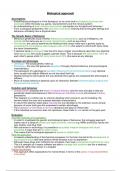
Biological approach
Assumptions
- Everything psychological is it rst biological, so we must look to biological structures and
processes within the body e.g. genes, neurochemistry and the nervous system
- An understanding of brain structure and function can explain our thoughts and behaviour
- From a biological perspective, the mind lives in the brain meaning that all thoughts feelings and
behaviour ultimately have a physical basis
The Genetic Basis of Behaviour
- Behaviour geneticists study whether behavioural characteristics, such as intelligence, are
inherited in the same way as physical characteristics, such as eye colour
- Twin studies are used to determine the likelihood that certain traits have a genetic basis by
comparing the concordance rates between pairs of twins (the extent to which both twins share
the same characteristic)
- If identical twins (monozygotic) are found to have a higher concordance rates than non-identical
twins (dizygotic), this would suggest a genetic basis. This is because MZ twins share 100% of
each other's genes whilst DZ twins share about 50% (the same as any siblings)
Genotype and phenotype
- Genotype – the actual genetic make up
- Phenotype – the way that genes are expressed through physical behaviour and psychological
characteristics
- The expression of a genotype is inevitably in uenced by environmental factors e.g. identical
twins usually look slightly di erent as one has dyed their hair
- Despite having the same genes the way identical twins genes are expressed (the phenotype) is
di erent
- Much of human behaviour depends upon an interaction between inherited factors (nature) and
the environment (nurture)
Evolution and behaviour
- Charles Darwin proposed the theory of natural selection and the main principle is that any
genetically determined behaviour that enhances an individual survival will continue in future
generations
- This happens in a similar way to a farmer deciding which animal to use for breeding, the
farmers select the ones who possess desirable characteristics
- In nature this selection takes place naturally (no one decides) so the selection occurs simply
because of some traits give the possessed a certain advantages.
- The possessor is more likely to survive, reproduce and pass on these traits
- If the individual survives but does not reproduce, these traits do not remain in the gene pool.
Evaluation
Scienti c methods of investigation
- In order to investigate the genetic and biological basis of behaviour, the biological approach
makes use of a range of precise and highly scienti c methods e.g. fMRIs and EEGs, family and
twin studies, and drug trials
- With advances in technology it is possible to accurately measure biological and neural
processes in ways that are not open to bias
- This means that the biological approach is based on reliable data
Real-life application
- Increased understanding of biochemical processes it in the brain has led to the development of
psychoactive drugs that treat serious mental illnesses such as depression
- Although these drugs aren’t e ective for all patient, they have revolutionised treatment for many
- This is a strength as it means su erers are able to manage their condition and live a relatively
normal life rather than remain in a hospital
Causal conclusions
- This approach o ers explanations for mental illness in terms of the action of neurotransmitters
in the brain
ff
fi ff ff fffi ff fl fi
Assumptions
- Everything psychological is it rst biological, so we must look to biological structures and
processes within the body e.g. genes, neurochemistry and the nervous system
- An understanding of brain structure and function can explain our thoughts and behaviour
- From a biological perspective, the mind lives in the brain meaning that all thoughts feelings and
behaviour ultimately have a physical basis
The Genetic Basis of Behaviour
- Behaviour geneticists study whether behavioural characteristics, such as intelligence, are
inherited in the same way as physical characteristics, such as eye colour
- Twin studies are used to determine the likelihood that certain traits have a genetic basis by
comparing the concordance rates between pairs of twins (the extent to which both twins share
the same characteristic)
- If identical twins (monozygotic) are found to have a higher concordance rates than non-identical
twins (dizygotic), this would suggest a genetic basis. This is because MZ twins share 100% of
each other's genes whilst DZ twins share about 50% (the same as any siblings)
Genotype and phenotype
- Genotype – the actual genetic make up
- Phenotype – the way that genes are expressed through physical behaviour and psychological
characteristics
- The expression of a genotype is inevitably in uenced by environmental factors e.g. identical
twins usually look slightly di erent as one has dyed their hair
- Despite having the same genes the way identical twins genes are expressed (the phenotype) is
di erent
- Much of human behaviour depends upon an interaction between inherited factors (nature) and
the environment (nurture)
Evolution and behaviour
- Charles Darwin proposed the theory of natural selection and the main principle is that any
genetically determined behaviour that enhances an individual survival will continue in future
generations
- This happens in a similar way to a farmer deciding which animal to use for breeding, the
farmers select the ones who possess desirable characteristics
- In nature this selection takes place naturally (no one decides) so the selection occurs simply
because of some traits give the possessed a certain advantages.
- The possessor is more likely to survive, reproduce and pass on these traits
- If the individual survives but does not reproduce, these traits do not remain in the gene pool.
Evaluation
Scienti c methods of investigation
- In order to investigate the genetic and biological basis of behaviour, the biological approach
makes use of a range of precise and highly scienti c methods e.g. fMRIs and EEGs, family and
twin studies, and drug trials
- With advances in technology it is possible to accurately measure biological and neural
processes in ways that are not open to bias
- This means that the biological approach is based on reliable data
Real-life application
- Increased understanding of biochemical processes it in the brain has led to the development of
psychoactive drugs that treat serious mental illnesses such as depression
- Although these drugs aren’t e ective for all patient, they have revolutionised treatment for many
- This is a strength as it means su erers are able to manage their condition and live a relatively
normal life rather than remain in a hospital
Causal conclusions
- This approach o ers explanations for mental illness in terms of the action of neurotransmitters
in the brain
ff
fi ff ff fffi ff fl fi