Doula Training Exam Questions with correct Answers
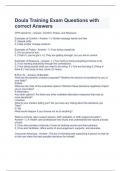
CPR stands for - Answer- Comfort, Praise, and Reassure Examples of Comfort - Answer- 1.) Gently massage hands and feet 2.) Speak softly 3.) Help mother change positions Examples of Praise - Answer- 1.) Your doing a great job 2.) I'm so proud of you 3.) That's it, you've got it. 4.) They are getting stronger, but you are in control. Examples of Reassure - Answer- 1.) Your body is doing everything it knows to do. 2.) Your working beautifully through the contractions. 3.) Your doing exactly what you need to be doing. 4.) Yoiu are focusing 5.) Hang in there 6.) Your body is limp, loose, it's heavy. B.R.A.I.N. - Answer- B-Benefits What are the benefits of option proposed? Whether the decision is beneficial for you or your baby? R-Risk What are the risks of the proposed options? Whether these decisions negatively impact you or your baby? A-Alternative Any other options? Are there any other available alternative measures that may be more beneficial? I-Intuition What is your intuition telling you? Do you have any inkling about the decisions you Take? N -No What would happen if you choose not to do anything? What is a Doula, labor support person, birth assistant, or birth support provider? - Answer- 1.) A Health care professional who trusts and understands the natural process of birth. 2.) One who provides continuity of care for birthing women and their partners. 3.) One who facilitates, offers words of encouragement, supports, and educates. Consumer Advocacy - Answer- The act of informing and supporting a person so that he or she can make the best possible decisions for himself. Informed Consent - Answer- To give permission for a procedure, after being given and understanding information about a procedure, benefits, risks, possible complications and alternatives. H.I.P.A.A. - Answer- Health Insurance Portability and Accountability Act Was enacted to insure the privacy and confidential handling of medical information for all patients in the U.S. Notice of Privacy Practices - Answer- All persons you collect information from either directly or indirectly is to be notified of their rights to privacy and what you do with their information. It must be signed by the patient or the patient must sign on a HIPAA consent form that they have r/c a copy of your privacy practices prior to signing a HIPAA consent. Signs of True labor - Answer- 1.) Contractions get closer, longer, and stronger. 2.) Contractions are felt in the lower back and abdomen. 3.) Changing activities makes the contractions stronger. 4.) Vaginal discharge and traces of blood. 5.) Diarrhea may be present. Signs of False labor - Answer- 1.) Contractions are irregular and do not get stronger. 2.) Contractions tend to only be felt in the abdomen. 3.) No Blood. 4.) No diarrhea is present. How the body works to birth a baby: - Answer- 1.) Uterus contracts-First stage 2.) Regular contractions dilate(Open) and efface (thin) the cervix. 3.) Baby Descends, moves down 4.) Baby is born- Second stage- 5.) Placenta is delivered-Third stage Planning your pregnancy may help you to: - Answer- 1.) conceive more easily 2.) have a healthier pregnancy 3.) avoid or minimize pregnancy complications 4.) give birth to a healthier baby 5.) recover more quickly and easily after giving birth 6.) have a more pleasant postpartum (post birthing) experience 7.) minimize your child's risk of future adult health problems. There are increased risks if you are in your mid-30s or older: - Answer- the greater your risk of having a miscarriage, pregnancy ends during the first five months, complications during pregnancy such as gestational diabetes, high blood pressure (pre-eclampsia, and placenta abruption, when the placenta detaches from the uterine wall, or a baby with chromosomal problems resulting in birth defects. Stations of presenting part (degree of engagement) - Answer- Station shows how far the baby has moved inside the mothers pelvis. There is a little bone point on each side of the pelvis that is used as a landmark. If an imaginary line is drawn between the 2 points, that line is called the zero station. If the baby's head is higher than the imaginary line, it is said to be a minus station. If the head is lower than the line, it is said to be at plus station. Pre-Labor - Answer- Characteristics/ emotions: *Cervix ripens, effaces and moves forward. *Non-progressing contractions; possible "restless" backache *Soft bowel movements *Menstrual-like cramps *May be tired, discouraged, anxious, if it is long and/or painful *May overestimate progress, start comfort techniques, go to hospital too early *May focus more than necessary on the contractions Pre-Labor - Answer- 1.) Encourage mom to do things that will distract her, if possible get out, finish project, have friends in 2.) Encourage restful activities, alternate with distraction; bath, music, laying down, massage, dark room, etc. 3.) "Give yourself permission to labor and birth your baby" First stage - Labor: LATENT PHASE - Answer- Characteristics/ emotions: *Dilation, 0-4 cm. *Cervix continues ripening, effacing, begins dilating. *Progressing contractions, possibly with bloody show. *Possible rupture of membranes. *Woman may need to begin using coping measures for contractions. *Excited, sociable, confident, optimistic or anxious, distressed. First stage - Labor: LATENT PHASE - Answer- 1.) Ask "What is going through your mind during these contractions?" 2.) Say "You're going to do exactly what you need to do to birth this baby". 3.) Suggest modifying thoughts, or reinforce coping thoughts, images. 4.) Feedback, not false praise. 5.) Assist with muscle relaxation. True progress of labor - Answer- 1.) Cervix softens. 2.) Cervix changes positions. 3.) Cervix effaces, thins. 4.) Cervix dilates, opens. 5.) Baby's head rotates. 6.) Baby moves down. What is the role of oxytocin during labor and birth? - Answer- Receptor cells that allow your body to respond to oxytocin increase gradually in pregnancy and then sharply during labor. Oxytocin stimulates powerful contractions, which help to thin and open (dilate) the cervix, move the baby down and out of the birth canal, expel the placenta, and limit bleeding at the site of the placenta. What is an example of the cascade of intervention? - Answer- Epidural analgesia can provide very effective pain relief during labor. It also increases the risk of experiencing a sudden drop in blood pressure, a longer labor, difficulty moving about, difficulty urinating, difficulty pushing the baby out, fever, and other undesirable effects. Epidural - Answer- anaesthetic, used especially in childbirth to produce loss of sensation below the waist . In particular introduced into the space around the dura mater of the spinal cord . Pitocin - Answer- Pitocin is a liquid medication that is a synthetic form of the naturally occurring hormone, oxytocin. Pitocin is diluted with a standard saline solution an introduced into your body by I V drip. The medication is regulated on a medication pump. This is an attempt to minimize complications and to help your doctor or midwife mimic normal labor as much as possible. There are increased risks with using Pitocin including: - Answer- fetal distress more likely to request pain medication like an epidural cesarean section uterine rupture Forceps - Answer- Forceps are an instrument used in helping in the delivery of newborns during difficult labors. They look somewhat like a large set of tongs. The forceps are applied to either side of the baby's head and the physician uses them to help pull the baby from the vagina. While a forceps delivery does increase the chances of injury to the woman's pelvic floor and potential trauma to the baby(including some bruising on the fact) What is a cesarean section/ c-section? - Answer- A cesarean section is the delivery of a baby through a cut (incision) in the mother's belly and uterus. Reasons you might need an unplanned C-section include: - Answer- Labor is slow and hard or stops completely. The baby shows signs of distress, such as a very fast or slow heart rate. A problem with the placenta or umbilical cord puts the baby at risk. The baby is too big to be delivered vaginally. Reasons you might have a planned C-section include: - Answer- The baby is not in a head-down position close to your due date. You have a problem such as heart disease that could be made worse by the stress of labor. You have an infection that you could pass to the baby during a vaginal birth. You are carrying more than one baby (multiple pregnancy). You had a C-section before, and you have the same problems this time or your doctor thinks labor might cause your scar to tear (uterine rupture). What are the risks of C-section? - Answer- Infection of the incision or the uterus. Heavy blood loss. Blood clots in the mother's legs or lungs. Injury to the mother or baby. Problems from the anesthesia, such as nausea, vomiting, and severe headache. Breathing problems in the baby if it was delivered before its due date. episiotomy - Answer- A procedure in which the skin between the vagina and anus is cut. (This area is called the perineum.) It is done occasionally to enlarge the vaginal opening so that a baby can be more easily delivered. Description of episiotomy - Answer- Just before the baby is born, the obstetrician numbs the vaginal area opening and makes one of two cuts: 1.) A mediolateral cut is angled down away from the vagina and into the muscle. 2.) A midline cut is made straight down between the vagina and anus. The cut is stitched closed after the baby and placenta have been delivered. Preeclampsia - Answer- is sometimes also referred to as "pregnancy induced hypertension." Developing around 20 weeks gestation, the major indicator of preeclampsia is a rise in blood pressure. When blood pressure rises, blood vessels constrict. This causes less blood flow to the placenta. With less blood flow, less oxygen and nutrients are reaching the fetus. Preeclampsia Risk Factors - Answer- 1.) Having chronic hypertension 2.) Obesity 3.) Multiple fetuses 4.) Kidney or liver disorders Preeclampsia symptoms - Answer- 1.) Swelling or edema in feet, ankles, hands and/or face 2.) Headaches 3.) Stomach pain 4.) Low back pain 5.) Nausea 6.) Elevated blood pressure 7.) Vision changes Dilation of 4-7 centimeters - Answer- occurs during active labor. 0-4 centimeters dilation is considered - Answer- early labor. Dilation of 7-10 centimeters - Answer- is the transition phase First stage - Labor: LATENT PHASE - Answer- 6.) Focus eyes on her during contractions- undivided attention 7.) Respond to her comments-don't ignore what she says. 8.) remind her of comfort measures and positions, drinking and peeing. 9.) Describe to her "how" to relax. Pre Labor - Answer- 4.) Encourage clear liquids 5.) Time contractions, 4 or 5 at a time, every few hours or when labor seems to have changed. 6.) Begin to prepare the client mentally" you get to make the decision to work with your body". Preeclemsia Risk Factors - Answer- 5.) Autoimmune diseases 6.) Age 7.) Genetics-Female family members who have had preeclampsia 8.) Diabetes What is the role of Oxytocin during labor and birth? - Answer- During labor and birth, the pressure of the baby against the cervix, and then against tissues in the pelvic floor, stimulates oxytocin and contractions. So does a suckling newborn. Breech position - Answer- the baby's buttocks and/or feet, will be in place to be delivered first. Mal-Presentation position - Answer- An abnormal position of a baby's body or head during childbirth. Cord Prolapse - Answer- the umbilical cord drops (prolapses) through the open cervix into the vagina ahead of the baby. The cord can then become trapped against the baby's body during delivery. Placenta previa - Answer- In this condition, the placenta is attached too low in the uterine wall and blocks the baby's exit through the cervix. Cephalopelvic Disproportion (CPD) - Answer- when a baby's head or body is too large to fit through the mother's pelvis. Fetal distress - Answer- Condition when the baby is not receiving enough oxygen or is experiencing some other complication. APGAR - Answer- The APGAR is a quick assessment of overall newborn well being. apgar - Answer- Activity- (muscle tone)- absent or arm/ legs flexed or
Geschreven voor
- Instelling
- Doula
- Vak
- Doula
Documentinformatie
- Geüpload op
- 30 mei 2023
- Aantal pagina's
- 7
- Geschreven in
- 2022/2023
- Type
- Tentamen (uitwerkingen)
- Bevat
- Vragen en antwoorden
Onderwerpen
- cpr stands for
- examples of comfort
- examples of praise
- examples of reassure
-
doula training exam questions with correct answers

Ook beschikbaar in voordeelbundel